

The first week of June 2026 was among the harshest in recent memory for cryptocurrency investors. Most of the market, led by Bitcoin, saw a sharp drop, with Bitcoin shedding more than 16% over five days. Ethereum, the second-largest cryptocurrency, lost more than 17% over the same period.
Some altcoins fared even worse. Solana fell more than 21% in the space of a few days.

The Sale That Shook Markets
What lay behind the sell-off? While it may look like a rout at first glance, many investors regard the slump as paradoxically good news.
The immediate trigger was news that Strategy had sold 32 Bitcoin between 26 and 31 May – only the second time in the firm's history that it has divested part of its digital assets.
In practical terms, the sale is a drop in the ocean. Strategy continues to hold 843,706 Bitcoin, and from a fund management perspective the move is a classic portfolio rebalancing exercise that would ordinarily go unnoticed.
The significance is symbolic. Strategy's chief executive Michael Saylor has long proclaimed that the firm's business model – built primarily on accumulating Bitcoin against issued corporate bonds – would never involve selling a single Bitcoin. That pledge has now been broken.
For cryptocurrency markets, this is a warning signal. When the company that holds more Bitcoin than any other in the world, and its most prominent advocate, decide to offload even a token amount of an asset they have treated as inviolable, it sends a message. The damage, however modest, has been done.
A Test of Halving Cycles
The Strategy sale alone could not have moved markets so sharply. It landed at a moment of heightened sensitivity in the crypto community, where confidence in the halving cycle theory was already under strain.
Put simply, Bitcoin has historically alternated between three-year bull markets and decline phases. The current bear market has been running for several months, but many believe the cycle is past its midpoint and could end sooner than previous patterns suggest.
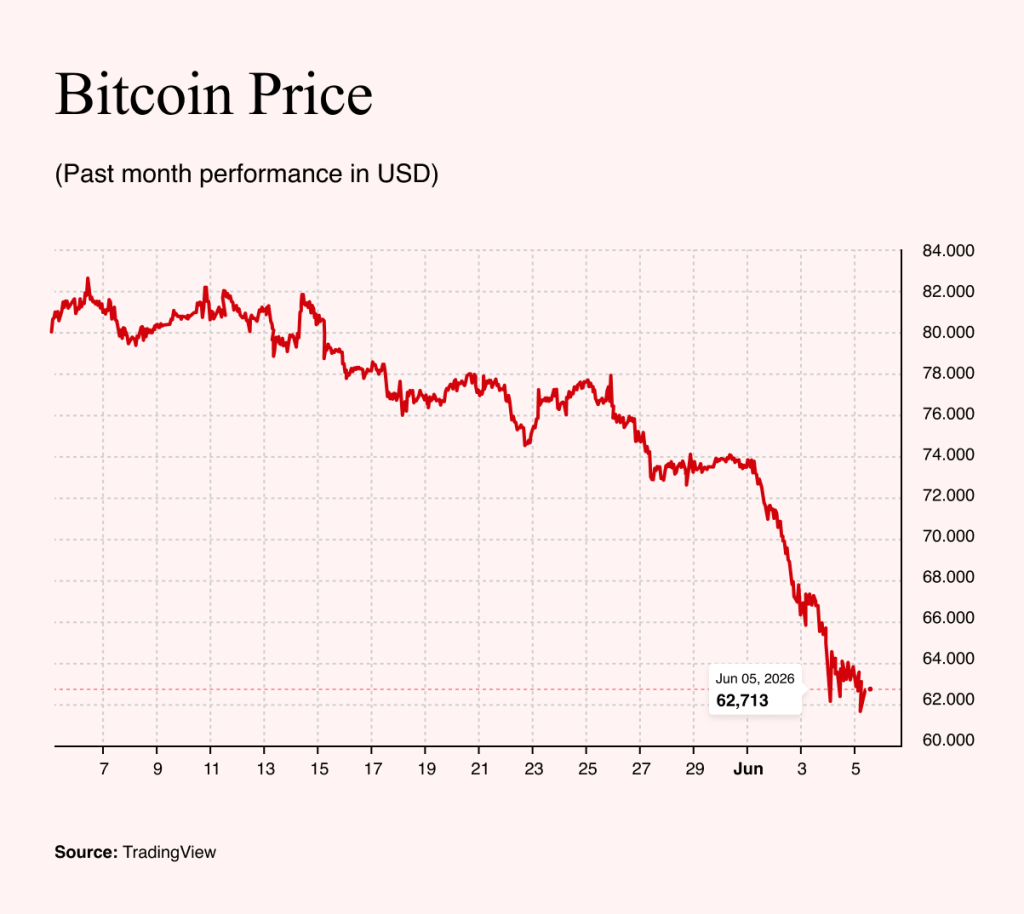
A strong recovery in mid-May led many to conclude that the bear market was over, or that the halving cycle theory had simply stopped working.
Two developments underpin that view. The arrival of exchange-traded funds (ETFs) has brought large financial institutions into the market, fundamentally altering how investors behave; and the dwindling supply of unmined Bitcoin has steadily eroded the influence that miners once held over prices.
If both arguments hold, there is no reliable formula for trading Bitcoin. That prospect unsettles markets, which – whether in equities or crypto – are allergic to uncertainty. This helps explain why the latest price drop has been greeted with a degree of relief.
Bitcoin has behaved precisely as the halving cycle theory predicts. The sell-off looks like the expected final flush before a reversal into a bull trend. It has been painful, however, wiping out investors who had positioned for continued growth. The market, as traders say, has been purged.
According to analytics platform CoinGlass, 277,000 people suffered immediate losses on crypto exchanges in a single day, having bet on rising Bitcoin and Ethereum prices. The market moved against them, and exchanges forced the closure of positions worth a combined $1.83bn.

Waiting for the Floor
If the halving cycle camp is right, the critical question is where the cycle bottoms. Whoever identifies that level accurately stands to profit considerably. For now, the $60,000 threshold looks vulnerable: options market data suggests large investors are holding back, most of them working from some version of the halving cycle playbook. Waiting for the bottom has the feel of a poker game.
It is also unclear whether prices will descend gradually to that level or whether sharper falls lie ahead. What does seem certain is that the picture will clarify by the end of June. Through July and August, cryptocurrency prices tend to be relatively stable, trading within a defined range.
The bull phase is expected to open in autumn – an entirely different story. That is why the halving cycle riddle is widely expected to be resolved, one way or another, before the end of June.
Bitcoin Marches to Its Own Beat
The sell-off has underscored one striking development: Bitcoin is increasingly moving to its own rhythm. It previously tracked technology stocks closely, but tech is now largely at all-time highs while Bitcoin is not. Nor does its correlation with gold hold: gold has retreated slightly from its peaks but is holding firm, again diverging from Bitcoin's trajectory.
This idiosyncratic behavior is itself an argument for the halving cycle theory. Looking at the recent gains of tech companies such as Micron and Dell, it is clear that speculative capital has not been flowing into Bitcoin. Investing in the cryptocurrency at this moment is therefore more of a long-term commitment than a bet on rapid appreciation in days or weeks.