

Investing in real estate has traditionally been viewed much like investing in other financial assets. By its nature, however, it has generally been regarded as a relatively conservative form of investment.
Conservative investors are drawn to property for several reasons. Unlike stocks, the risk that a house or apartment will become completely worthless is extremely low. Real estate is also less volatile than publicly traded assets, whose prices are revalued every day.
Buying property, particularly with mortgage financing, often takes weeks or months. Stocks and bonds, by contrast, can be purchased with a few clicks. This slower pace, combined with the tangible nature of property and the absence of visible day-to-day price swings, has long reinforced its reputation as a safe haven for investors.
When Conservative Investing Starts Looking Speculative
In recent decades, however, residential property has become increasingly popular as an investment. Rapid price growth has transformed what was once seen as a conservative asset into something that many investors increasingly view as a near-guaranteed source of profit.
The trend has been visible across much of Europe, although the scale varies from country to country. Years of low interest rates, limited housing supply and strong investor demand have pushed residential property prices higher in many markets.
The Czech Republic offers a particularly striking example. According to the Czech Statistical Office, apartment prices in Prague rose by 154% between 2015 and 2024. Across the country as a whole, prices increased by 158%. That translates into average annual growth of roughly 10.9% in Prague and 11.1% nationwide.
For an asset traditionally viewed as conservative, these are remarkable returns.
They are also broadly comparable to the long-term historical performance of the S&P 500, which is often cited as generating average annual nominal returns of around 10%. At first glance, the risks associated with owning individual stocks appear far greater than those involved in owning residential property in Central Europe.
Does that mean real estate has become the investing equivalent of a holy grail – a combination of relatively low risk and consistently high returns?
The Illusion of Permanent Growth
The answer is no. Some of the largest investment bubbles in history have emerged from the belief that past returns can simply be projected into the future. The assumption that prices will continue rising indefinitely is often one of the clearest warning signs.
A rational approach remains the best defense against speculative thinking. It is tempting to conclude that because housing construction in major cities remains constrained, prices must continue climbing for years to come. But that is only one piece of a much larger picture.
Property can be analyzed in much the same way as a dividend-paying stock. The value of the property corresponds to the share price, while rental income functions as the dividend. Against that income, investors must also account for maintenance costs, taxes, financing expenses and periods when a property may sit vacant.
This brings us to one of the most overlooked aspects of real estate investing. Returns do not depend solely on the rent a property generates. They also depend on how much investors are willing to pay for that income stream.
Understanding Valuation Multiples
In equity markets, investors often assess companies using valuation multiples. They ask how much they are paying for each euro of earnings. The same principle applies to real estate.
If an apartment generates €500 (about $570) per month in rent, that amounts to €6,000 (about $6,800) annually. If investors value that income at 20 times annual rent, the property is worth €120,000 (about $137,000). If investors later decide that the same rental income deserves a valuation of 30 times annual rent, the property’s value rises to €180,000 (about $205,000) – even though the rent itself has not increased by a single euro. In other words, property prices can rise in two ways.
The first is relatively straightforward: rents increase, generating more income for the owner. The second occurs when investors become willing to accept lower yields. They pay more for the same stream of rental income. Much of the price growth seen in Prague and many other European cities over the past decade reflects this second dynamic.
Around 2014, investors could often purchase Prague apartments with gross rental yields of roughly 5% or more. In effect, they were paying around twenty years' worth of rental income.
Today, attractive properties frequently offer gross yields closer to 3-4%, and sometimes less. That means investors are paying thirty years' worth of rent – or even more – for the same asset. A significant portion of the rise in property prices has therefore reflected not only higher rents and housing shortages, but also investors' growing willingness to accept lower returns.

The Limits of Rent Growth
Property prices and rental income cannot diverge indefinitely.
Rent is not an abstract number on a spreadsheet. It is paid by real households from their wages and salaries. Unless rents rise broadly in line with incomes over the long term, they eventually encounter affordability constraints.
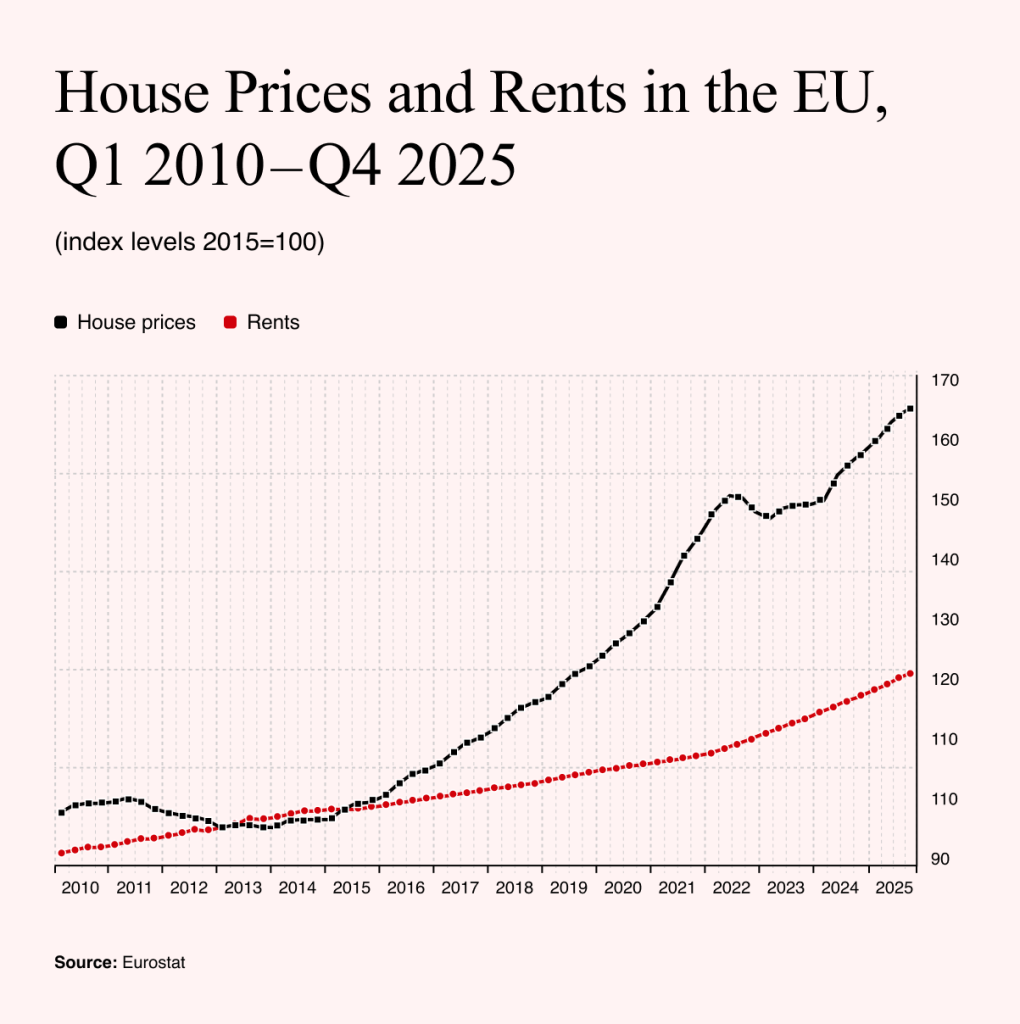
This is one of the key risks facing property investors today. When buyers accept ever-higher property valuations, they are effectively agreeing to lower future returns. In many markets, yields have already fallen to levels that provide only a modest premium over inflation.
That does not necessarily mean prices will fall. Markets can remain expensive for extended periods, but it does mean investors should think carefully about what assumptions are embedded in current valuations.
A Different Kind of Investment
Some investors may conclude that today's prices justify reducing their exposure to residential property or diversifying into other asset classes. Others may remain confident that limited housing supply will continue supporting valuations.
What is clear, however, is that the nature of the investment has changed. Many buyers are no longer purchasing relatively inexpensive assets that generate attractive rental yields. Instead, they are buying expensive assets in the expectation that future buyers will be willing to pay even more.
That does not automatically make them wrong, but it does mean that residential property is becoming increasingly dependent on optimistic assumptions about future price appreciation rather than on the underlying income generated by the asset itself.
And that is where the paradox of today's housing market emerges. A truly conservative investor should not ask only whether property is a safe asset. The more important question is whether it remains safe at its current price.
Even the sturdiest brick can become a speculative asset if investors begin valuing it as though risk no longer exists.