Endangered Species: The Vanishing British Millionaire
Amid the serious political climate change of the past decade or more, several species have found themselves threatened. None more so, new figures reveal, than the British millionaire.
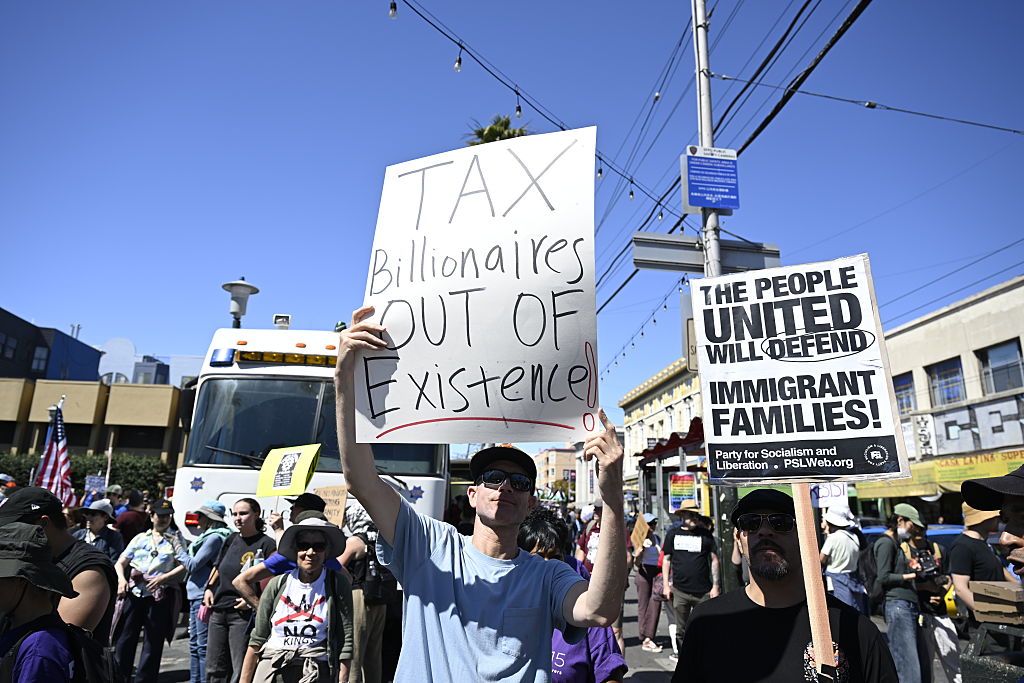
British millionaires are disappearing at a record pace as the country’s political and tax climate shifts. Photo: Evening Standard/Hulton Archive/Getty Images
|
What does it say about a country when the number of millionaires within its borders falls? Is the country more equal and equitable? Or is it simply poorer?
This, for whatever reason, is not a question that many Western countries have had to ask themselves over the past half-century or more. Indeed, the inexorable trend has been in the opposite direction, as the number of millionaires rises most years due in part to paper valuations of properties and landholdings, as well as the net effect of inflation, which makes somebody worth €1m today about as wealthy in real terms as somebody worth about €450,000 in 1990, using a blended multiplier to take account of inflation.
In other words, as the number of millionaires has increased, the social status of being a millionaire has fallen.
An Enormous Exodus of the Wealthy
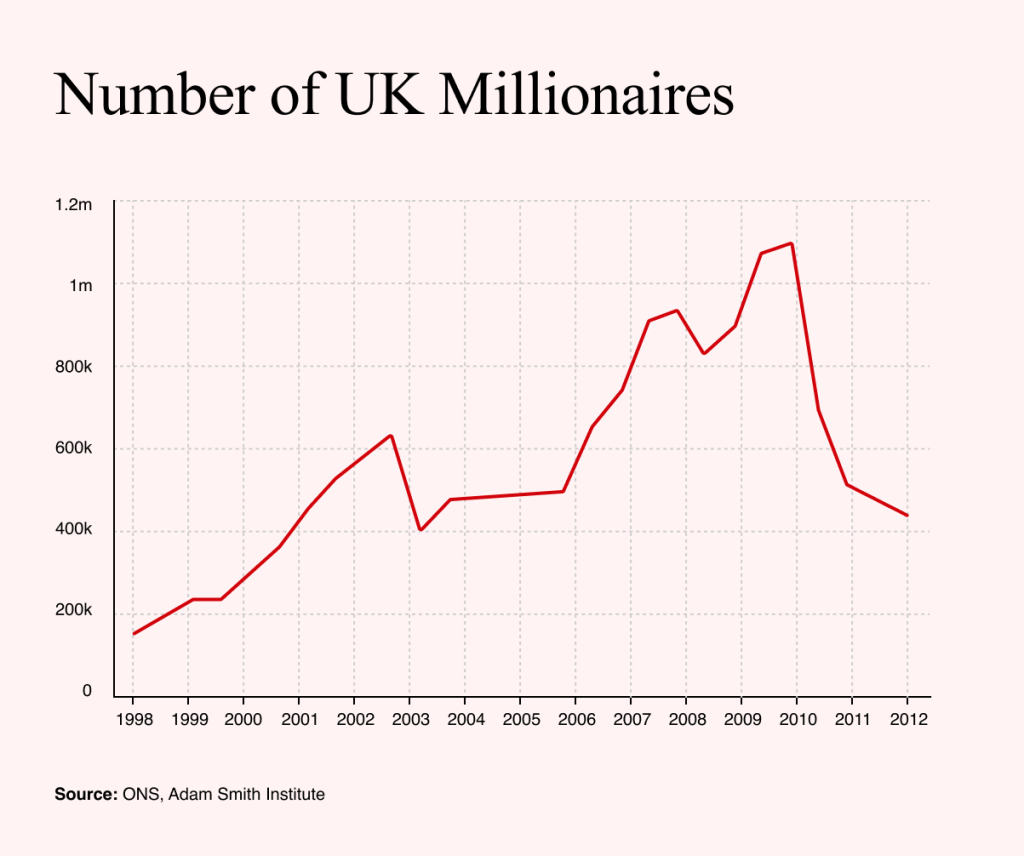
However, the latest figures from the UK show something unusual and dramatic: the number of millionaires in the country is in fact falling. And not just falling – falling steeply.
Source: ONS, Adam Smith Institute
The Adam Smith Institute, which put the figures together, says that the explanation relates to declining property values and, critically, the effect of the Labour government’s so-called “non-dom” tax reforms, which punish those who previously were not paying full UK taxes on their non-UK earnings. Many of these individuals, it seems, have simply relocated themselves fully overseas and are now paying no UK tax at all.
If the Adam Smith Institute is correct – and no compelling alternative explanation has been offered at the time of writing – then the figures are actually worse than they look. Those individuals who are relocating overseas to avoid tax are much more likely to be the actual high earners than asset-rich, cash-poor farmers in the Yorkshire Dales who are counted as millionaires because of the notional market value of their land. As such, the effect of the exodus on His Majesty’s Treasury is likely to be significantly magnified.
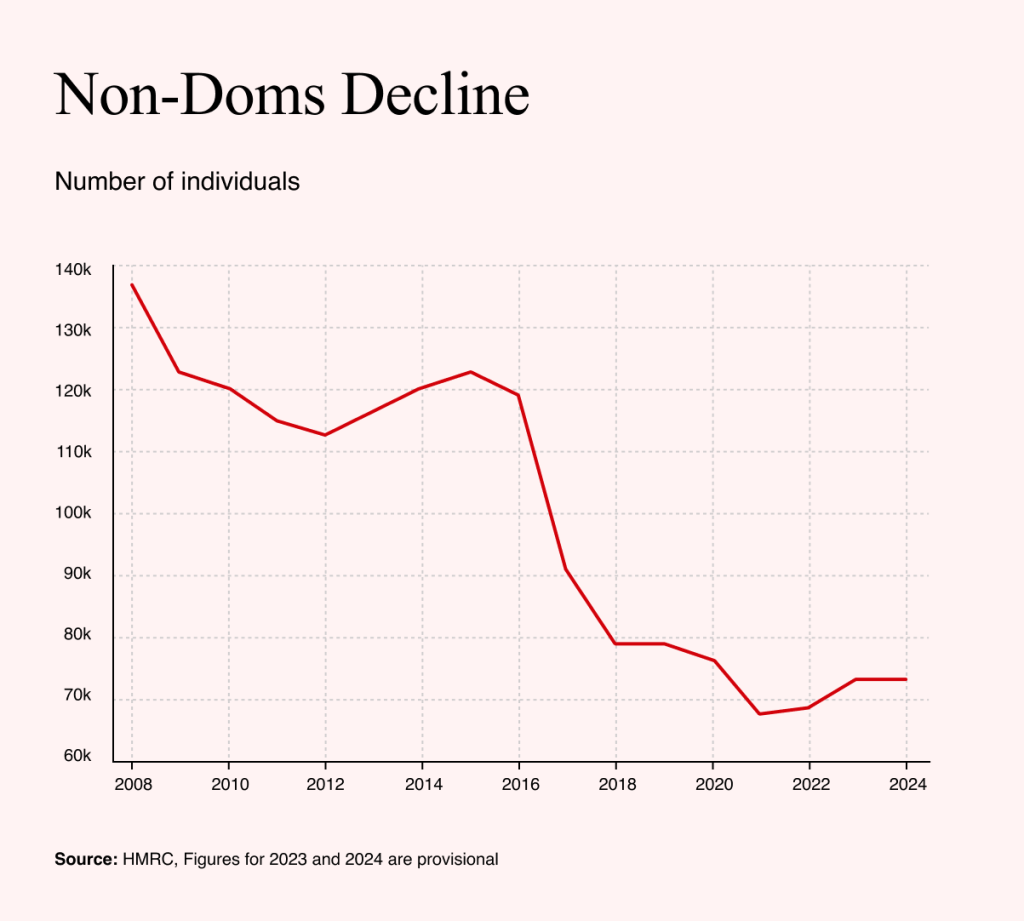
Indeed, official figures from the Treasury corroborate the Adam Smith Institute’s assumptions: as UK taxes on the wealthy have risen, so the number of so-called “non-doms” has halved.
Source: HMRC, Figures for 2023 and 2024 are provisional
A Popular Catastrophe
One of the problems, of course, is that this fiscal catastrophe for the UK Treasury is exceedingly popular with British voters, who understandably tend to look past the macro data and think instead in terms of the fact that non-doms avoid paying full taxes on their enormous incomes while Bob and Jane in Sheffield, earning the average salary, pay the full amount. That kind of deep unfairness strikes a chord with voters and inspires the kind of policy that Labour has been pursuing with respect to millionaires.
The problem, however, is that it does not really matter how much Bob and Jane in Sheffield complain: they, unlike the non-doms, are unlikely to move their tax residency to Hong Kong to protest the unfairness.
The net result, then, is that the UK Treasury – increasingly one of the most precariously positioned in Europe in terms of the debt burden carried on its books – is a significant net loser. All the while, the spending demands on the UK government are increasing, with the burden of defense spending being a significant factor in the premature end to the Starmer premiership.
Further, for incoming Prime Minister Andy Burnham, the figures are a stark warning. Politically, he is in no position to start unwinding previous mistakes and offering tax cuts to millionaires to entice them back to the UK. But he is also faced with a situation where the hard economic data suggests that the cheapest and easiest line for any mainstream-left politician – tax the rich – is not really available to him. If he tries it, he may find that the number of rich people is suddenly even lower than he expected.
Not an Easy Problem for Reform UK to Solve
The position also poses a real political challenge for the right-wing opposition. Reform UK, which has supplanted the Conservatives in polls if not seats as the leading party of the right, is significantly vulnerable to charges that it is too enamored of the wealthy. Indeed, Nigel Farage is currently fighting a by-election in his own seat sparked in part by a controversy over his acceptance of millions of pounds from a wealthy supporter to fund security.
Rarely has a party been more at the mercy of the notion that it is a rich boy’s party for rich boys – and it is therefore difficult to see how Reform UK could credibly argue for tax breaks for those who have fled the UK while maintaining its salt-of-the-earth appeal to working-class voters.
What Britain is caught in, therefore, is an economic trap driven by politics. Were one to manage the country without much need to consult the voters, it is relatively clear that reversing the flight of capital from the country should be priority number one: after all, 10 millionaires paying 10% of their income in tax are worth more to the Treasury than a thousand minimum-wage workers paying full whack.
But alas, the voters must be consulted. And without a politician capable of explaining to them in detail why more millionaires are necessary to fund health and education, it seems unlikely that any party, for the moment, has either the instinct or the ability to reverse the ongoing extinction of the British millionaire.
This is a country getting poorer, rapidly. And without much notion, it seems, of how to reverse it.