Tehran has reportedly considered strikes on US military targets in southeastern Europe. Parts of the continent already lie within range of Iran’s known arsenal – and the reported attack on Diego Garcia suggests its reach may extend farther than previously thought.
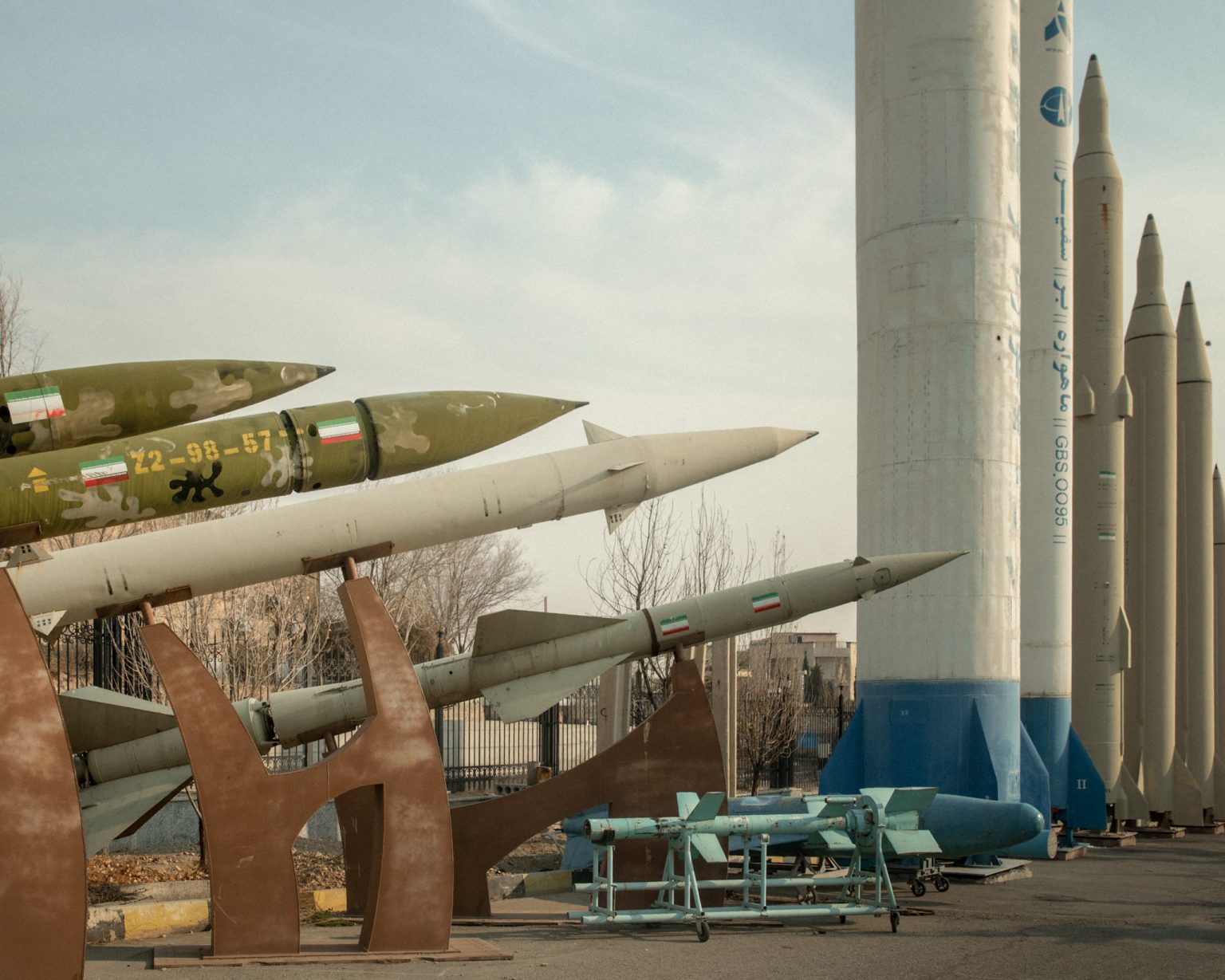
Iranian missiles displayed in Tehran as the regime expands the reach of its arsenal. Photo: Majid Saeedi/Getty Images
|
Iran has considered taking its war with the United States beyond the Middle East. Two people close to the regime told the Financial Times that Iranian forces had assessed possible strikes on US military assets in southeastern Europe if the conflict escalated.
Among the potential targets was Bezmer Air Base in Bulgaria, where parliament approved the temporary deployment of up to eight US KC-135 refueling aircraft and 250 military personnel in July. The deployment followed a request backed by Prime Minister Rumen Radev. Reuters reported that Iran had warned Bulgaria against allowing its territory to be used for US military operations.
Cyprus was also among the locations examined, according to the FT. Its two sovereign base areas are British rather than American, but RAF Akrotiri was struck on 2 March by an Iranian-made drone believed to have been launched from Lebanon, probably by Hezbollah.
Tehran has also considered attacking undersea fiber-optic cables in the Strait of Hormuz. Diplomacy remains stalled: US President Donald Trump said on Tuesday that no talks were taking place with Iran and none were scheduled, while Tehran insists that the strait will remain closed until Washington meets its conditions. In practice, shipping has been severely disrupted rather than completely halted. Before the war, the waterway carried nearly 20% of global crude oil and liquefied natural gas shipments.
For Europe, the threat is no longer entirely theoretical. Iran’s publicly known ballistic missiles cannot reach most of the continent, but parts of southeastern Europe already lie within range. Recent events also raise the possibility that Tehran’s operational capabilities extend beyond those it has publicly acknowledged.
Iran has not demonstrated an intercontinental ballistic missile. But senior figures have openly spoken of acquiring the ability to strike the United States.
Abdul-Nabi Mousavifard, the Friday prayer leader in Ahvaz and the Supreme Leader’s representative in Khuzestan, said on 7 August that Iran was preparing to extend the range of its missiles to as much as 15,000 km. Such a range would theoretically put the continental United States within reach.
“We are preparing so that the American people also experience missile strikes and understand what it means to be dragged through blood and dust”, he added.
Iran’s missile program does have a history of drawing on North Korean technology. Its Khorramshahr medium-range ballistic missile is likely derived from North Korea’s Musudan BM-25, according to the Center for Strategic and International Studies (CSIS).
North Korea has since developed genuine intercontinental systems. Its solid-fueled Hwasong-18, first tested in April 2023, has an estimated range of 15,000 km, while the larger Hwasong-19 was first tested in October 2024. CSIS lists the latter’s operational range as unknown. None of this proves that Iran can reproduce North Korea’s capabilities, but Iran’s missile program has long drawn on North Korean technology.
What Iran Can Reach Today
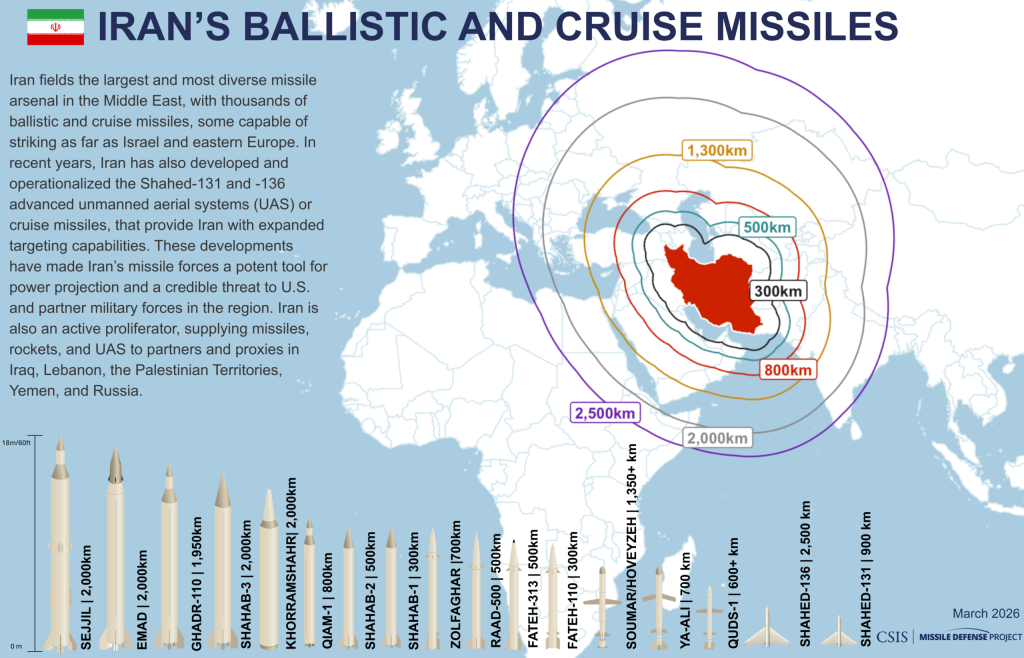
CSIS describes Iran as possessing the largest and most diverse missile arsenal in the Middle East, with thousands of ballistic and cruise missiles. Some can reach Israel and parts of Eastern Europe.
Among its longest-range publicly documented systems is the Sejjil, a two-stage solid-fueled ballistic missile with an estimated range of 2,000 km.
The Khorramshahr is also listed at 2,000 km, although a version displayed with a lighter reentry vehicle could reach around 3,000 km, according to CSIS. The Ghadr-1, a variant of the Shahab-3, has an estimated range of up to 1,950 km.
Those distances put Cyprus and parts of Turkey, Greece, Bulgaria, Romania and the Balkans within the potential reach of Iranian ballistic missiles, depending on the system and launch point. Germany is another matter: major US facilities such as Ramstein and Wiesbaden lie well beyond the 2,000–3,000 km ranges assigned to Iran’s best-documented systems.
Ranges of Iranian ballistic and cruise missiles and attack drones, according to CSIS data from March 2026. Graphic: CSIS Missile Defense Project
The Diego Garcia Question
The reported attack on Diego Garcia changes that calculation.
In March, Iran reportedly fired two ballistic missiles toward the joint US-UK military base in the Indian Ocean. The island lies roughly 4,000 km from Iran – well beyond the range Tehran had previously acknowledged for its ballistic arsenal.
The Wall Street Journal reported, citing US officials, that two ballistic missiles had been fired toward the base. Neither hit it: one reportedly failed during flight, while a US warship fired an SM-3 interceptor at the other.
Iran’s semi-official Mehr news agency also said two missiles had been launched toward Diego Garcia, although a senior Iranian official subsequently denied responsibility. Reuters reported the Iranian account separately.
The precise missile involved has not been publicly established. The incident therefore does not prove that Iran has a deployed 4,000 km ballistic missile of a known type. But if the US account is correct, it demonstrates an operational reach considerably beyond the 2,000–3,000 km associated with Iran’s published arsenal.
For Europe, that matters more than Tehran’s rhetoric about a future 15,000 km weapon. An ability to launch ballistic missiles over roughly 4,000 km would bring much more of the continent within theoretical range and suggest that assessments based solely on the published specifications of systems such as the Sejjil and Khorramshahr no longer tell the whole story.
Drones Extend the Threat
Iran’s drones add another layer to the threat.
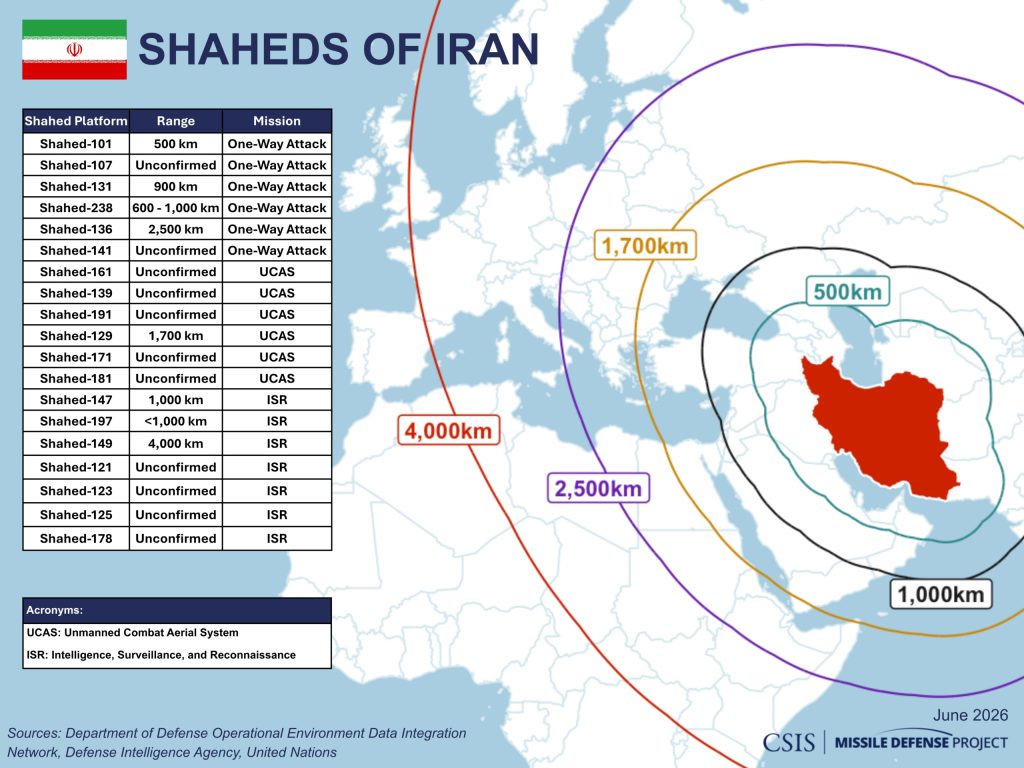
The Shahed-136 is a one-way attack drone rather than a ballistic missile, with a range of up to 2,500 km. At that distance, a drone launched from Iran’s far northwest could theoretically reach into central Europe, including Budapest, Belgrade, Sarajevo and Bratislava.
The Shahed-149 is a reusable long-endurance drone designed for both surveillance and strike missions. It has a reported range of up to 4,000 km, although that figure should not be treated as a demonstrated 4,000 km combat radius.
Ranges of Iranian Shahed drones based on data from the US Department of Defense Operational Environment Data Integration Network, Defense Intelligence Agency and United Nations. Graphic: CSIS Missile Defense Project
US Bases Within Range
Geography leaves some US forces in Europe exposed.
The United States maintains persistent military sites at Camp Bondsteel in Kosovo, Naval Support Activity Souda Bay in Crete and the Izmir and Incirlik facilities in Turkey. The Congressional Research Service also identifies a wider network of European military sites to which US forces have access.
Incirlik, Izmir and Souda Bay are within roughly 2,000 km of Iran’s northwestern frontier, while Camp Bondsteel lies around the outer edge of that distance. Bezmer in Bulgaria, although a Bulgarian rather than an American base, also falls within the potential envelope of a 2,000 km weapon launched from northwestern Iran.
Other host-nation facilities used by US forces lie across Romania, Greece and elsewhere on NATO’s eastern flank. Not all are American bases in the conventional sense: many remain under national control and host US forces temporarily or on a rotational basis.
The threat is therefore uneven. Iran’s known ballistic arsenal can reach the southeastern edge of Europe. On the available public evidence, it cannot strike anywhere on the continent at will.
Europe’s Exposure
Tehran has made clear that direct European involvement in the war could change its calculations.
On 3 March, Iranian Foreign Ministry spokesman Esmail Baghaei warned European governments against joining military operations against Iran. Referring to possible European action, Baghaei said: “It would be an act of war.”
European NATO members have so far avoided joining the US-Israeli campaign. France and Britain have instead proposed a multinational maritime mission aimed at restoring safe passage through the Strait of Hormuz. Reuters reported that the plan would depend heavily on Iranian cooperation and was intended to avoid drawing NATO members into the war itself.
That caution reflects the strategic dilemma. US bases and forces in Europe extend American military power toward the Middle East. In a direct war with Iran, some of those same installations could also become targets.
The arrival of the USS George Washington in the Middle East this week underlines that the immediate military focus remains closer to Iran. The carrier entered the region to relieve the long-deployed USS Abraham Lincoln, US Central Command confirmed on Thursday.
For Europe, the threat is no longer confined to its southeastern flank. Iran’s best-documented ballistic missiles have ranges of around 2,000–3,000 km, but the reported attack on Diego Garcia suggests that Tehran may possess a longer-range capability of roughly 4,000 km. If confirmed, that would put much of Europe within potential reach.
For Europe, the strategic question is no longer whether Iran can reach the continent, but how far its capabilities actually extend.