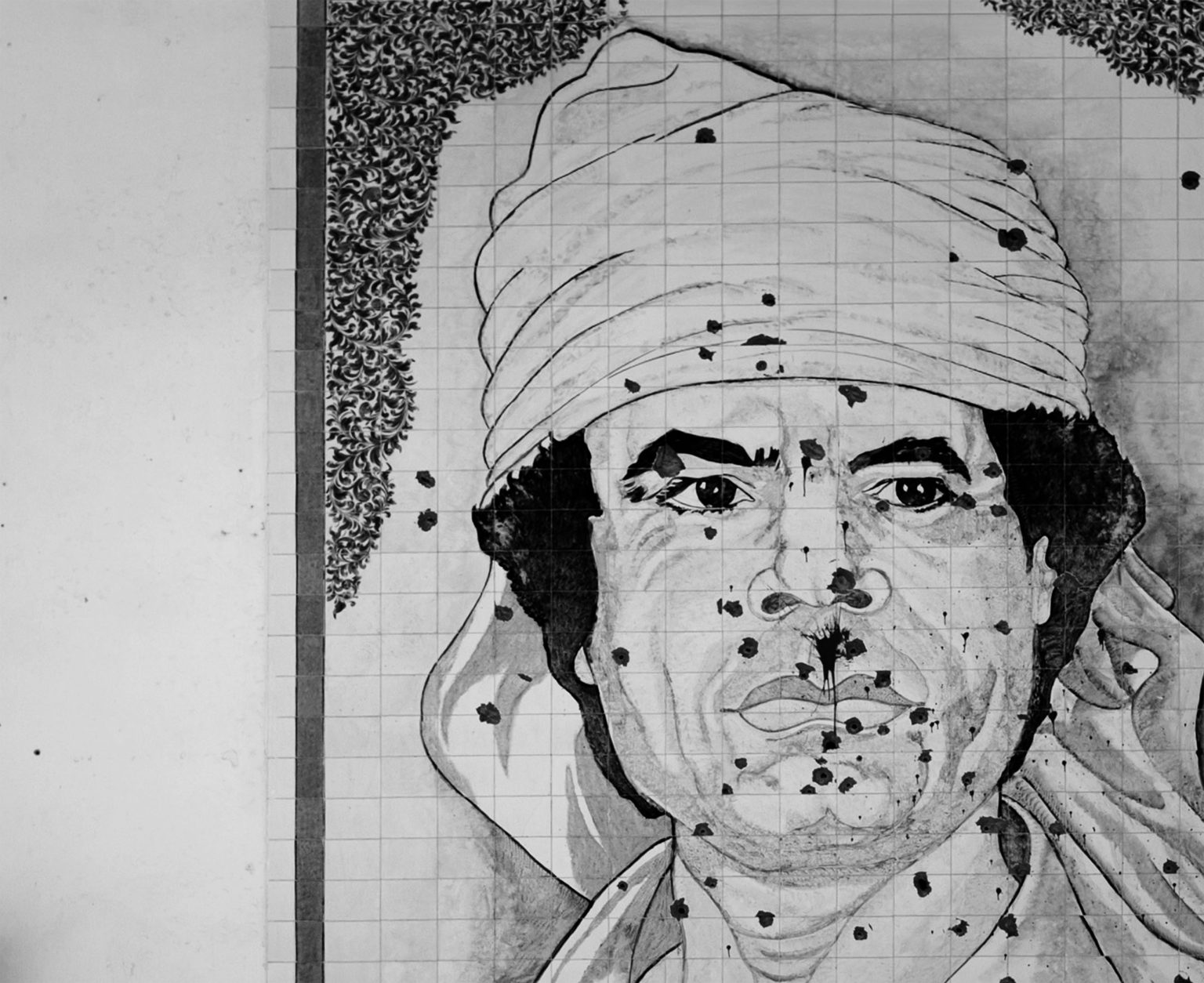
A mosaic depicting former Libyan leader Muammar Gaddafi on the wall of a building riddled with bullet holes. Photo: Daniel Berehulak/Getty Images
When the death of a dictator is not enough
Anatomy of failure: the West overthrew Gaddafi without a plan for Libya’s future. It thus left the oil-rich country to other players.
The war in Libya was a prime example of how Western powers can intervene with overwhelming force in another country without any credible plan for what follows. More striking still, they may present themselves during negotiations as partners seeking compromise, only to resort to full-scale military action almost immediately afterwards. Libya remains a monument to how not to resolve crises in complex states.
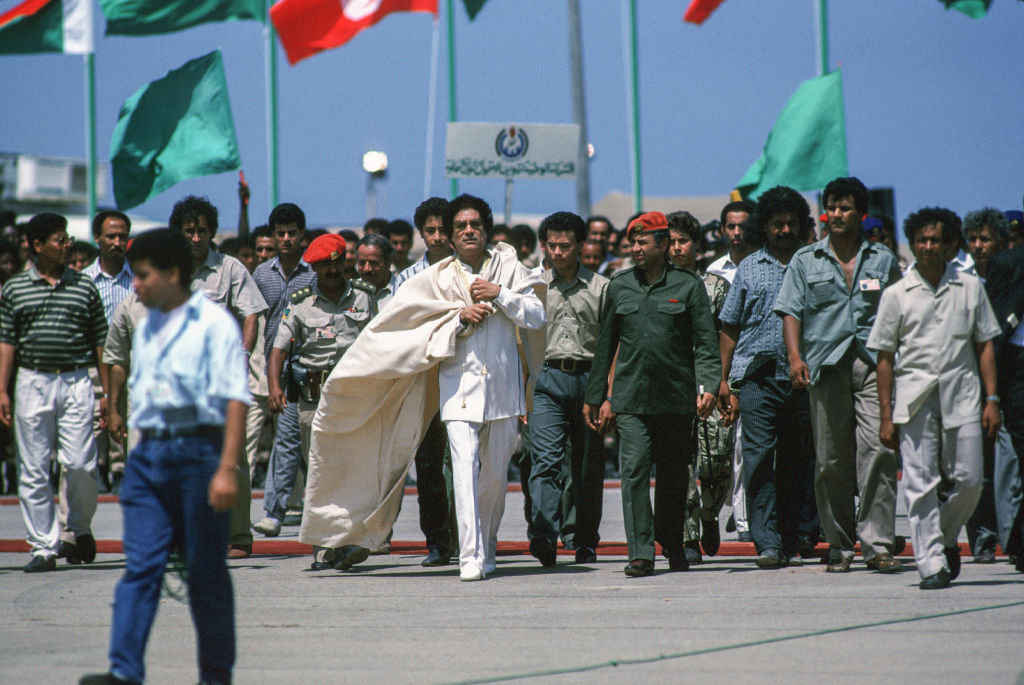
Libyan President Muammar Gaddafi (center, rear, in white robe) and his entourage arrives walk across the tarmac at Mitiga Airport outside Tripoli, Libya, 1989. Photo by Barry Iverson/Getty Images
An isolated dictatorship
Muammar Gaddafi bore certain similarities to the regime in Tehran. He ruled Libya for 42 years, from 1969 until 2011, with an iron grip and a strong ideological veneer of socialist pan-Arabism, while concealing a harsh repressive apparatus behind the language of populism.
As in the case of Iran, Libya is a country exceptionally rich in oil. Gaddafi did not hesitate to use the country’s wealth to support terrorism.
The best-known example is the Lockerbie bombing. Pan Am Flight 103 was destroyed by a bomb on 21 December 1988, causing the Boeing 747 to crash over Lockerbie in Scotland and killing 270 people, including 11 on the ground. The attack pushed Libya into deep international isolation.
Gaddafi therefore spent years consolidating his highly distinctive political order as a global pariah. The paradox is that Gaddafi’s fate was ultimately sealed by the very process of international normalisation.
The turning point came in 2003. Gaddafi, clearly alarmed by the US invasion of Iraq and the fall of Saddam Hussein, pragmatically announced that Libya would abandon its weapons-of-mass-destruction programme and agreed to compensate the families of the Lockerbie victims.
This unexpected diplomatic ‘thaw’ culminated in the summer of 2007 when, after lengthy negotiations, Libya released the Bulgarian nurses whom the regime had previously sentenced to death for allegedly spreading HIV. Paris played a key role in securing the breakthrough.
For the then French president Nicolas Sarkozy, Gaddafi’s return to the international community represented a major opportunity. The motivation of the Élysée Palace was twofold – geopolitical and economic.
Sarkozy wanted to involve Libya in his new regional initiative, the Union for the Mediterranean, and to secure Tripoli’s cooperation in limiting migration from Africa. Above all, however, Paris saw the prospect of lucrative contracts. After years of isolation, the oil-rich country required extensive modernisation.
For French industry this promised contracts worth billions, from infrastructure projects to the potential sale of Rafale fighter jets and even plans for civilian nuclear cooperation.
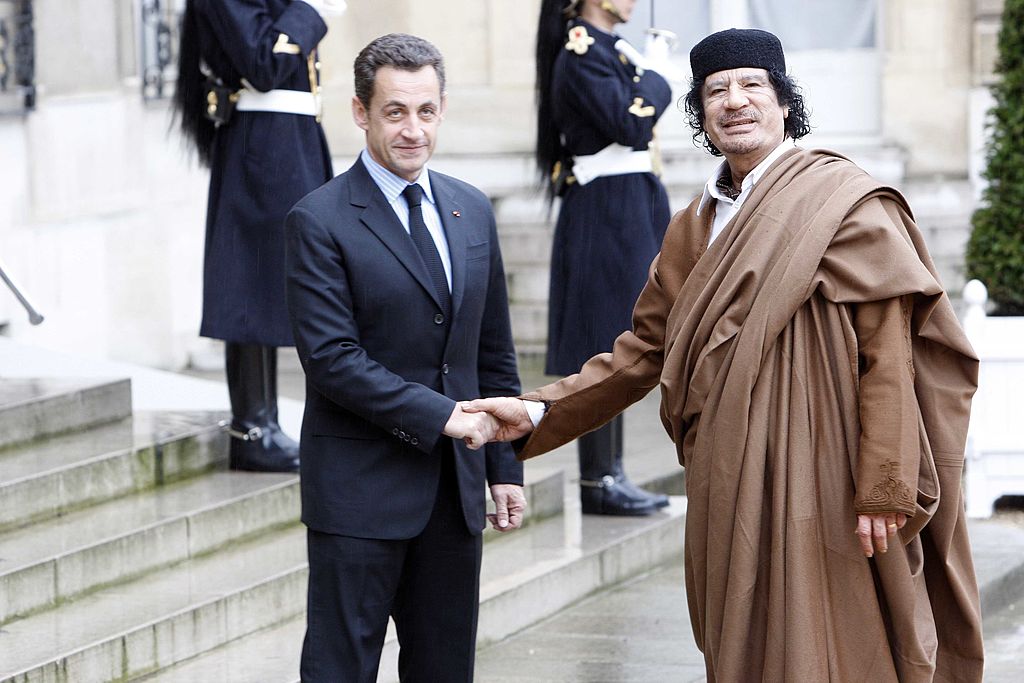
The Libyan leader Muammar Gaddafi and former French President Nicolas Sarkozy discussed trade and military deals in 2007. Photo by Michel Dufour/WireImage
The fatal embrace of Paris
This deliberate effort to integrate the Libyan leader rapidly into Western structures culminated in December 2007 in an unprecedented state visit to France. With the tacit – if somewhat awkward – consent of French diplomats, Gaddafi pitched his traditional Bedouin tent in the gardens of the Hôtel de Marigny, only a few steps from the Élysée Palace.
At the time, the West believed it had permanently bound the unpredictable dictator through economic promises. In reality, however, behind the curtain of this diplomatic theatre a spiral of insidious lobbying, bitter rivalry among French companies and unfulfilled expectations was already unfolding.
France gained almost nothing from the anticipated contracts. Four years later, the bitterness of the fiasco became one of the forces driving the military intervention that ultimately swept away Gaddafi’s regime.
When a popular uprising broke out in Libya in February 2011, Gaddafi initially believed he could suppress it with ease. However, the military intervention by international forces in March radically changed the balance of power, and the territory under the regime’s control began to shrink rapidly. Although the Libyan leader attempted a desperate counter-offensive and briefly managed to recapture some of the lost territory, the summer months brought a decisive military turning point.
On 23 August 2011, the Bab al-Azizia fortress, a long-standing symbol and nerve centre of Gaddafi’s absolute power, fell into the hands of the rebels. The dictator, however, managed to escape. By that point he faced not only advancing militias but also international justice. An arrest warrant issued by the International Criminal Court for crimes against humanity effectively closed off any conceivable path to exile.
The final act came on 20 October 2011 and was far removed from an orderly court proceeding. The man who had ruled the country for more than four decades and played a complex geopolitical game with the world’s great powers was captured by a group of rebels, brutally lynched and shot on the spot.
Gaddafi’s death not only brought an era to a humiliating end but also served as the starting point for a new civil war, into which Libya – suddenly deprived of its central unifying force – quickly plunged.
The geopolitical vacuum after Gaddafi
The removal of Muammar Gaddafi thus laid bare the greatest weakness of modern international interventions. The Western coalition succeeded in destroying the existing regime militarily, yet it lacked a strategic plan for the day after and had no reliable political partner ready to stabilise the country.
Instead of moving towards democracy, Libya quickly descended into chronic chaos, and the resulting geopolitical vacuum was soon filled by other actors.
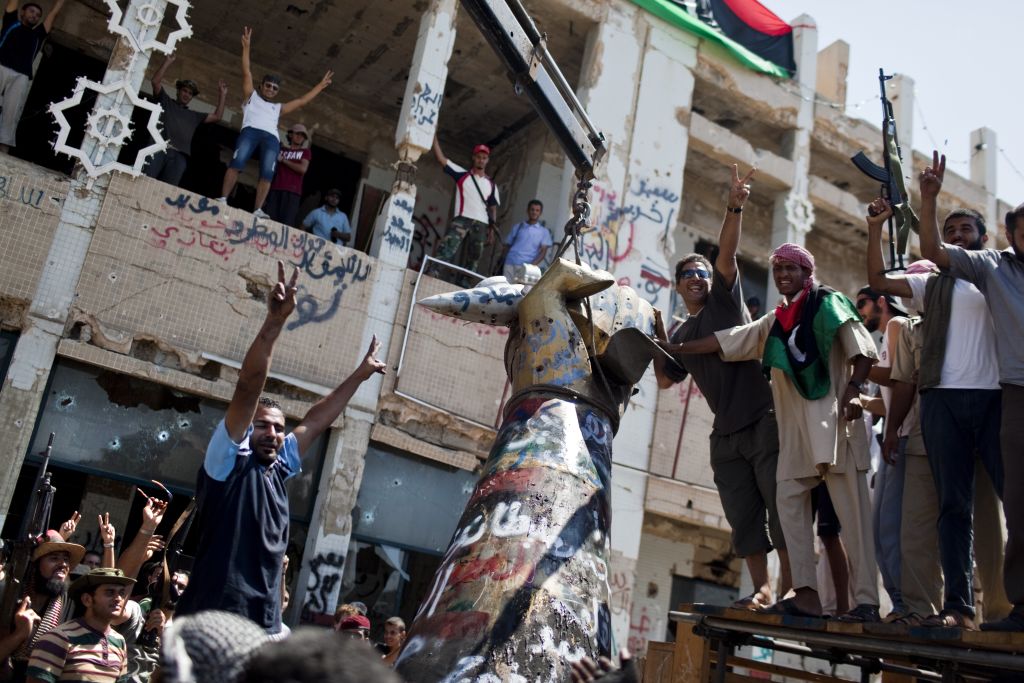
Libyans raise their arms in celebration as they tear down the infamous ‘hand crushing a plane’ statue in Muammar Gaddafi’s Bab al-Aziziya compound in Tripoli on August 26, 2011. Photograph by Benjamin Lowy/Getty Images.
A divided country and new players
The country gradually split into several rival centres of power and became a proxy battleground for regional and global powers. In the west, a government emerged in Tripoli that maintained its position largely thanks to Turkey’s decisive military intervention in 2020.
Ankara gained not only considerable political influence but also a strategic position in the eastern Mediterranean and access to energy projects. Meanwhile, in the east of the country, Marshal Khalifa Haftar consolidated his power, supported for years by Egypt, the United Arab Emirates and Russia.
Italy has also become an important player in the Libyan equation. Rome seeks to preserve its longstanding economic ties with the country and retains a key role in oil and gas extraction through the energy company ENI. At the same time, the Italian government pragmatically uses its influence in Tripoli to negotiate agreements aimed at limiting migration flows across the central Mediterranean.
Instead of a democratic experiment, Libya has thus become an arena of geopolitical rivalry in which European states have gradually lost the initiative while regional powers have assumed decisive influence. Western intervention, intended to pave the way for political stability, has paradoxically created space for new players who now shape the security and energy balance across the entire region.
Here is placeholder for Article excerpt Here is placeholder for Article excerpt Here is placeholder for Article excerpt Here is placeholder for Article excerpt
Here is placeholder for Article excerpt Here is placeholder for Article excerpt Here is placeholder for Article excerpt Here is placeholder for Article excerpt
Here is placeholder for Article excerpt Here is placeholder for Article excerpt Here is placeholder for Article excerpt Here is placeholder for Article excerpt
Welcome to the comments section of the Štandard daily. Please take note of our guidelines, comments are moderated by us. You can contact the moderators at [email protected].
Participate in the discussion
Comments are available to subscribers only. If you'd like to join the discussion, choose a subscription starting at €6.72 per month.
All comments 0
Register
Comments are available to registered users only. If you'd like to join the discussion, register here.