

The Iran crisis had one unexpected side effect for Europe. It dominated the media to such an extent that Europe’s familiar weak spots fell out of the spotlight for a while. But just because they were out of sight does not mean their problems have gone away. Quite the contrary. As soon as the geopolitical fog lifts, Europe’s old weaknesses will return with renewed force.
A Wake-Up Call from Paris
One such wake-up call came from France. The country’s statistics office announced that French public debt had surpassed the psychological threshold of €3.5tn ($4tn), reaching 117.5% of GDP. In other words, France is now roughly as indebted as it was when the economy was paralyzed by pandemic restrictions.
The difference is that there are no longer any lockdowns. What remains is a country that presents itself as a normally functioning European power, but whose public finances increasingly resemble those of a patient recovering from a long illness who has never fully recovered.
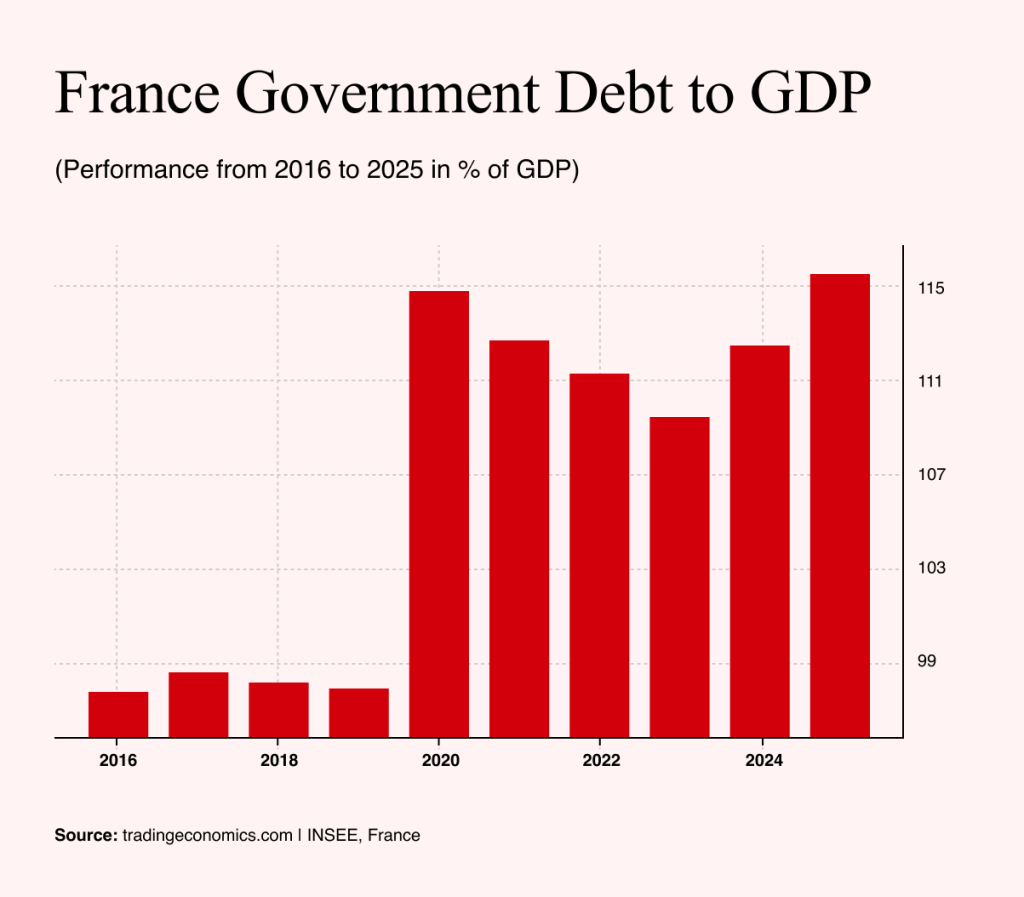
France’s debt now stands at €3.54tn ($4.02tn). The figure is probably already higher, as the statistics office used only data from the first quarter of 2026. For an individual or a company, a debt burden of this scale would amount to technical bankruptcy. In fact, even if France were to sell all its gold reserves, all its shares in companies, whether publicly traded or not, and all state-owned buildings, it would most likely not be enough to pay off the debt.
The immediate impact of rising public borrowing is reflected in the sums the French government spends on debt service. This item in the national budget grows every year. In 2020, it amounted to €35.8bn ($40.6bn) annually. Last year, it had already reached €50.9bn ($57.7bn). For 2026, the figure is estimated at €59bn ($66.9bn), rising to as much as €77bn ($87.3bn) in 2028.
The rise in the country’s debt-service costs is accelerating not only because of the absolute size of the debt, but above all because the eurozone abandoned its zero-interest-rate policy in mid-2022. Since then, bonds that are gradually reaching maturity have been replaced with new issues carrying significantly higher interest rates.
It is precisely this mechanism that explains why the debt burden does not appear all at once, but also why France will feel the pain more and more. Old, cheap debt is not refinanced immediately, but gradually. Every year, however, a portion of this debt matures and must be replaced with new, more expensive financing.
Even if the European Central Bank were to start cutting interest rates, the problem would not go away. France is not only burdened by high debt, but also by an ever-growing bill for the years in which it grew accustomed to borrowing money at virtually no cost.

France’s Budget Stalemate
The rising cost of servicing the debt reveals the Achilles’ heel of the current French crisis: the government’s budget deficit. The political crisis triggered by Emmanuel Macron, who called early elections after the ruling coalition’s defeat in the European Parliament elections, has left the government without a majority in parliament.
As a result, it is impossible to pass a national budget that would at least partially address France’s economic problems. All attempts at radical cuts are doomed to fail from the outset, as they risk the dissolution of parliament. In practice, budgets are therefore little more than maintenance budgets.
Although the current government wanted to bring the deficit back below 3% by 2028, the plan is likely to remain on paper. The reality is much harsher. According to David Amiel, France’s minister of public administration and the public budget, the government is still aiming for a deficit of 5% this year, but the European Commission expects France’s public finances to post a deficit of 5.7%.
The French daily L’Opinion reported, according to La Tribune, that Bercy was working with projections showing the budget deficit could reach as high as 6.2% in 2027.
The French budget will have to cope with higher debt-service costs, as well as the effects of the Iran crisis in the form of lower economic activity and higher energy prices. Disruption in the Middle East is a major obstacle for the luxury goods industry, which was one of the last strong manufacturing sectors in France.

The Politics of Paralysis
France is thus entering the final year before the presidential election with a deficit that would be problematic even for a government with a comfortable majority. For a country with a fragmented political landscape, however, this is almost a perfect recipe for paralysis.
The new president will not be able simply to present another austerity package and hope that this will appease both Brussels and the financial markets. Sooner or later, he will have to resort to deeper intervention in a system that has grown accustomed to high public spending, cheap debt and the belief that political pain can always be postponed until the next election cycle.
This is precisely where the economic problem becomes a political one. All the major candidates with a realistic chance of reaching the second round, Édouard Philippe, Gabriel Attal, Jean-Luc Mélenchon and Jordan Bardella, will have to reckon with the fact that a potential victory will not rest on the enthusiastic support of the country’s majority, but on a runoff in which a large share of voters cast their ballots against someone rather than for someone.
Such logic may be enough to secure the Élysée Palace. However, it may not hold in the subsequent parliamentary elections. Even if France has a new president, there is still a risk that his camp will not win a majority in parliament. The country could thus very quickly find itself in the same situation as today: with a president who formally governs, but without a government capable of pushing through major budgetary measures.
France does not need just another austerity package. It needs a government with the strength to tackle a system that has grown accustomed to living on debt for decades. But a government with such a mandate will not emerge for at least another year. France is therefore not heading toward a quick solution to its debt crisis, but toward another year in which the problem will only grow and the political courage to address it will be postponed once again.