
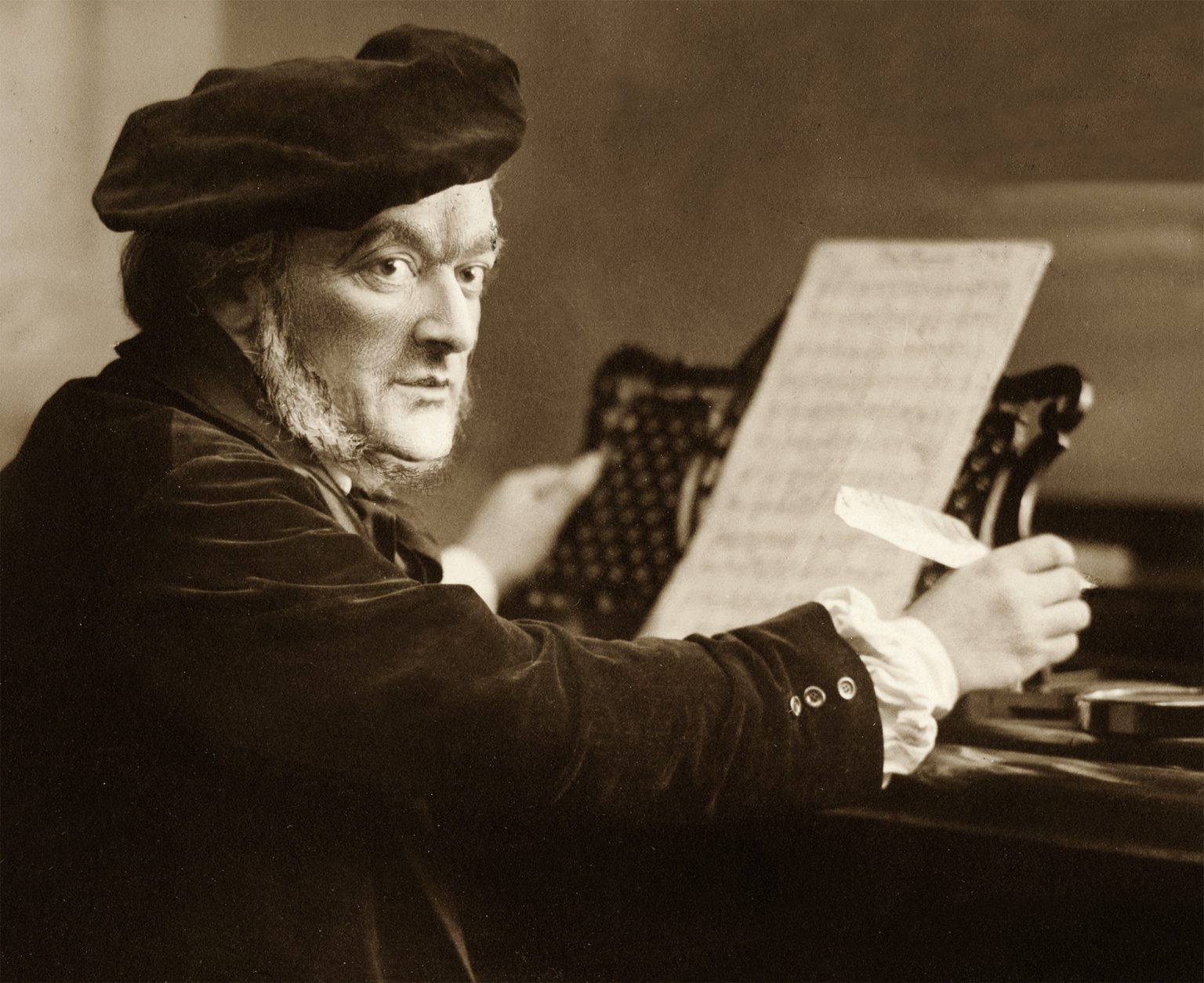
Richard Wagner’s The Ring of the Nibelung is one of the most monumental works in the operatic repertoire. First performed in full almost exactly 150 years ago, beginning on 13 August 1876, the four-opera cycle runs for roughly 15 hours. It is a drama of power, envy, treachery and megalomania – a struggle among mythical creatures, mortals and gods that culminates in the destruction of an entire world.
Wagner himself was anything but modest. He was narcissistic, egomaniacal, self-righteous, vindictive and boastful. What remains undeniably fascinating is that he managed to turn his grandiose ambitions into reality. He lived extravagantly, loved luxury, accumulated debts and repeatedly appealed to wealthy patrons for money.
Eventually, he found an extraordinarily generous benefactor in King Ludwig II of Bavaria. Ludwig not only financed Wagner’s lavish lifestyle but also helped make possible something even more audacious: a theater built specifically for the composer’s works.
The first Bayreuth Festival opened in August 1876 with the complete Ring cycle. Das Rheingold was performed on 13 August, followed over the subsequent evenings by Die Walküre, Siegfried and Götterdämmerung.
By the standards of 19th-century opera, the undertaking was anything but modest. But Wagner never intended merely to write operas. He wanted to explain society, revolutionize theater, create a new world for his audiences and redefine art itself.
A Myth About the Modern World
Even in Wagner’s time, the Ring could appear strangely romantic and archaic. At the height of industrialization, amid railways and factories, Wagner told a story drawn from the world of ancient Germanic myth. It fitted neatly with the young German Empire’s search for a national identity – and, for precisely that reason, troubled some contemporary observers.
Look more closely, however, and the Ring is far more than a costume drama of spears and Germanic helmets. It is a story about the creation of a social order and about power collapsing under the weight of its own foundations. It is about property, labor, debt, contracts and money.
In other words, the Ring is about the modern world.
At the beginning, the Rhinegold belongs to nature, hidden beneath the waters of the Rhine. No one has yet thought of tearing it from that world and claiming it as property. The Rhinemaidens guard it without seeking to profit from it.
Then Alberich arrives.
He is the first capitalist. Where others see beauty, he sees power. He renounces love and gains the Ring in return. Here Wagner reveals himself as an attentive student of Bakunin and other early socialist thinkers: money alienates. Wealth severs its owner from all other relationships and, in doing so, deforms him.
Alberich is therefore more than a villain. He is the first entrepreneur. Nibelheim is not merely a fairy-tale cave but a factory. The Nibelungs forge, hammer and produce while Alberich transforms the fruits of their labor into power. Anyone who sees in him only the ugly dwarf of a fairy tale misses Wagner’s point.
Then Wotan enters, the supreme god, and a story about economic power becomes one about political power.
Wotan has created contracts and made himself the guarantor of law. The agreements governing his world are carved as runes into his spear. His authority is not supposed to rest on force alone but on a binding legal order – on legal certainty.
Wotan believes his power guarantees the law. In reality, legitimate power depends on observing the law. That mistake will prove his undoing.
The God Trapped by His Own Laws
To build Valhalla, Wotan has struck a bargain with the giants. They will construct the gods’ fortress and receive the goddess Freia as payment. But when the giants demand their reward, Wotan discovers that honoring the contract would have distinctly unpleasant consequences. Freia supplies the apples that preserve the gods’ youth.
A contract that threatens his own existence, it seems, suddenly becomes a contract open to interpretation.
Wotan therefore obtains Alberich’s treasure, takes the Ring from him and uses the gold to pay the giants. Gold replaces love. The god of law breaks the law to preserve his rule.
Wotan understands the contradiction perfectly well. He laments: “Through treaties I am master; to the treaties I am now a slave”. But, as so often in tragedy, understanding the problem does nothing to save him from it.
Here Wagner emerges as a remarkably perceptive observer of modernity. A society that reduces every relationship to property, contract and exchange begins to undermine its own foundations. Eventually, even law becomes an instrument of power.
Wotan is the crucial figure. He possesses the power to create a legal order and then discovers that the same legal order constrains his power.
That is why the spear is ultimately more important than the Ring. The Ring represents the power of property; the spear represents the power of law. Wagner shows the two becoming intertwined. Wotan uses another man’s property to preserve his own legal order. Law protects property, while property stabilizes political authority. Capitalism and the legal order appear not as opposites but as ugly allies.
Siegfried the Anarchist
Then comes Siegfried.
At first, the hero appears as an anarchist capable of bringing the entire system crashing down. He knows nothing of contracts, recognizes no authority and has little regard for property. Siegfried is the only character who does not covet the Ring.
According to Wotan’s plan, Siegfried is meant to create a new order.
There is only one problem: Siegfried’s freedom is an illusion. He is a product of Wotan’s designs and therefore remains bound to the world Wotan created. He can become truly free only by destroying the divine order.
And so Siegfried shatters Wotan’s spear.
In doing so, however, he also destroys the law on which the old world rests. Siegfried is blind to the implications. He knows only his own strength – and his love for Brünnhilde.
Siegfried must fail because freedom alone cannot create a new society. He may be free, but he is politically naive. He does not understand the world into which he has been thrown. Precisely for that reason, the old system can still use him.
Wagner himself had learned something about failed revolutions. After participating in the revolutionary upheavals of 1848–49, he was forced to flee Germany. The Ring can be read in part as his attempt to come to terms with that failure.
The old order cannot be reformed; it must be overcome. Yet Wagner offers no new constitution, fair distribution of property or new democratic order in its place – only the apocalypse.
Valhalla burns. The gods disappear. The Ring returns to the Rhine.
What comes afterward is left unanswered.
From Wagner to Tolkien
It is hardly surprising that Wagner’s monumental work has inspired generations of artists. Dragons, treasure, dwarfs, smiths, magical swords, a cursed ring, ancient gods and the destruction of an entire world have become staples of modern fantasy.
The most famous comparison is inevitably JRR Tolkien’s The Lord of the Rings.
Yet the comparison also reveals how differently the two writers treat the Ring itself. In Tolkien, the One Ring is an instrument of evil, forged by Sauron to dominate others. It corrupts anyone who seeks to possess or use it – even someone who initially wants it for good purposes.
Wagner’s Ring works differently.
Here, evil does not originate in some ancient diabolical force. It lies within people themselves, in their desires. The Ring is not the fundamental problem. The problem is the human hunger for power, possession and property.
Tolkien’s novel can be read as a conservative defense of an older order: legitimate kingship and a clearly defined moral order ultimately help preserve society against evil.
Wagner the revolutionary arrives at a very different conclusion. The evil lies within the structures themselves – structures that protect those who possess power and property.
A Myth That Refuses to Grow Old
Wagner did not simply revive ancient mythology. He modernized it by placing one of the great problems of the 19th century at its heart: what happens when power, property and law become part of a system that no one can ultimately control?
Wotan knows the answer better than anyone. He created that system himself. He made the laws in order to rule the world.
In the end, the laws rule him.
And Valhalla burns.