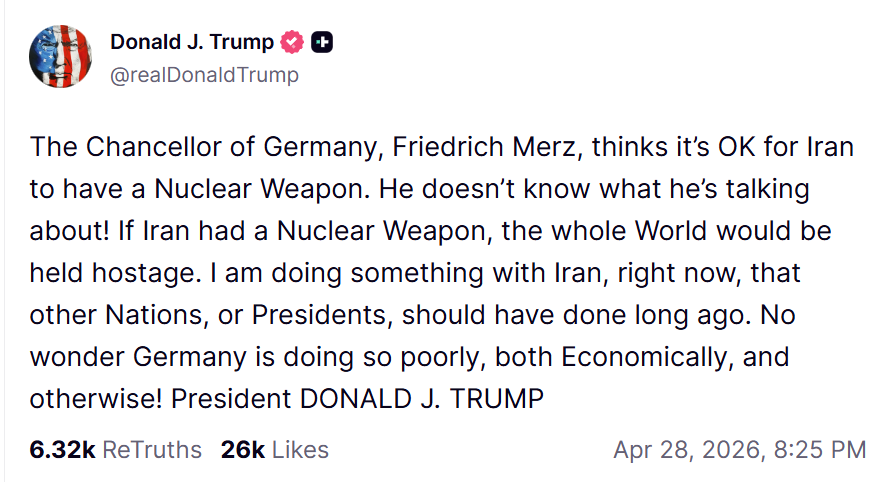
Donald Trump’s attack on Friedrich Merz of the Christian Democratic Union (CDU) may at first glance appear to be one of the impulsive interventions for which the US president is well known. In reality, it points to something larger. The public rebuke of a German chancellor does not come out of nowhere. It fits into a broader development in which tensions between Berlin and Washington have become increasingly visible.
The trigger was Merz’s criticism of the American course in the Iran war. Trump responded on Truth Social with striking sharpness, effectively accusing the chancellor of showing leniency toward a nuclear-armed Iran while also adding a pointed remark about the state of Germany itself. The tone was personal, but the message was political. For that reason, the post appears to be more than a spontaneous outburst. It is another sign that something in the transatlantic relationship has been shifting for some time.
An early indication came in the speech by US Vice President JD Vance at the Munich Security Conference. His criticism of Europe’s political culture, its approach to free speech and the self-image of Western elites was widely understood in Germany as a provocation. In the United States, it was seen more as a programmatic statement of intent.
Since then, points of friction have multiplied: over security policy, trade, China and now also the handling of Iran. What stands out is not that differences exist, but how openly they are now being expressed.