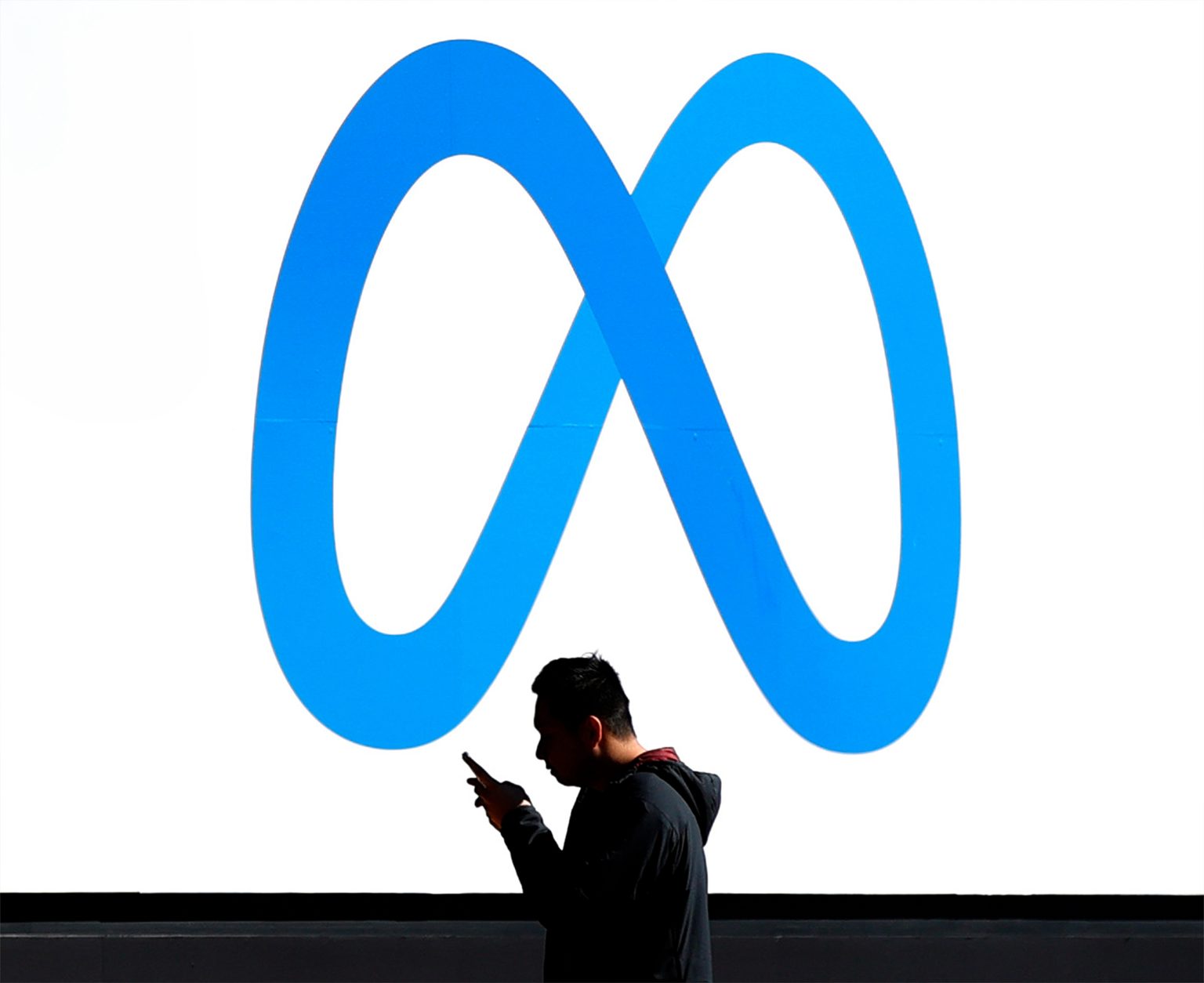
A pedestrian walks in front of a new logo and the name 'Meta' on the sign in front of Facebook headquarters. Photo: Justin Sullivan/Getty Images
Why Meta Is Fighting Europe's Digital Rulebook
Europe argues that its digital rulebook will make social media safer. Meta says it will undermine its business model. Critics warn the greater threat is to free speech, privacy and the open internet.
Tech giants like Meta and TikTok are potentially facing billions of dollars in fines under EU regulations that have been brought in with the claim that they will improve the safety of social media for children and tackle fake news. However, free speech and privacy rights advocates warn the regulatory moves would eradicate the anonymity of the internet, while enabling governments to control speech online.
The EU’s two key regulations regarding digital media are the Digital Services Act (DSA) and the Digital Markets Act (DMA).
The owner of Facebook and Instagram was slapped with a €200m ($228m) fine in 2025 under the DMA for its "pay or consent" option for users. The EU argued the binary choice failed to offer alternatives to Meta’s advertising business model.
More recently, on 10 July, the European Commission (EC) warned Meta it faced a fine of 6% of its total worldwide annual turnover for breaching the DSA. The EC said the American company failed to properly assess the risks associated with the "addictive design" of the platform for children and vulnerable people, pointing to features such as infinite scroll, personalized recommender systems and insufficient protections for children.
The California-based company is contesting both cases, arguing that it has already introduced protocols and protections that comply with both acts.
The EU is pushing strongly for stricter regulation of social media sites like Facebook and Instagram on the grounds of child safety and welfare.
Meta’s Business Model
At the crux of the issue for Meta – and most other social media sites like TikTok – is its business model, which is based on monetizing the data of users for highly targeted advertising.
The attraction of social media to advertisers is the level of personalized behavioral data these companies can collect. It enables better-targeted ads that are tailored to unique interests and have a greater chance of success than those offered by traditional media.
Thus far it has proven an exceptionally successful business model, as digital media companies hoovered up 73% of worldwide ad investment in 2025.
Global Regulatory Push
However, as the EU’s regulatory moves indicate, the manner in which the medium has developed to meet this business model is increasingly facing scrutiny. Critics argue that social media platforms are designed to capture and hold users’ attention for as long as possible, leading to optimization for engagement that encourages addictive use.
They say features like infinite scroll and autoplay functions for short videos create a never-ending supply of content optimized and personalized to hold the viewer’s attention, encouraging excessive use that has a negative impact on the lives of children and vulnerable people.
These claims are already being tested in the courts in the United States, where tech giants face more than 2,000 lawsuits over issues like addictive design and child safety.
One jury in Los Angeles already found the addictive nature of Instagram’s and YouTube’s platforms had caused harm. It required the platforms’ owners to pay $6m in damages to the plaintiff, a 20-year-old woman who sued Meta and YouTube over her childhood addiction to social media.
Meanwhile, another jury in New Mexico awarded $375m in damages against Meta for misleading users over child safety, after the US state sued the tech giant in 2023. It claimed the company "steered" young users to content that was sexually explicit, showed child sexual abuse or even exposed them to solicitation of such material and sex trafficking.
Besides these lawsuits, nations across the world have mooted proposals for stiffer regulations and in some instances bans in Europe, China, Australia and the United States.
Polling in the US and elsewhere consistently demonstrates popular support for introducing stricter regulations on children’s social media use.
High Stakes for Citizens
But while tech companies worry about how this will impact their bottom line, for citizens the stakes are even higher.
The benefit of social media’s present business model is that it offers people access to social media sites for free, enabling a broad exchange of information unparalleled in human history. These platforms remain important venues for news gathering and generation by citizens, with many arguing it has resulted in a more decentralized media environment and empowered those on the fringes of political and social life.
At a time when traditional media, governments and non-governmental organizations maintain a stifling groupthink, social media has offered dissidents the possibility of raising their voices, finding like-minded people and spreading their message to a large audience.
As a result, the increase in government control over access to social media sites has raised concerns from free speech and privacy advocates on both the political left and right. These developments come at a time when politicians are expressing frustration with the freedom people have to share their opinions online – and an interest in reining in their ability to do so.
For instance, the DSA not only regulates platform design; it also deals with content. So while most of the focus on the DSA has been on how it can combat features some describe as addictive, the act also gives the EU powers to regulate online speech.
Whereas at present the assessment of whether opinions are permissible or information dangerous has been judged on a case-by-case basis in the national courts, now the EU can effectively censor certain types of speech and certain content without recourse to the courts by claiming it is fake news, misinformation or simply dangerous.
Under the DSA, EU officials can pressure social media sites to remove certain kinds of speech, often without the individual or group expressing the views knowing it.
According to a 2025 report from the United States Congress, this is already happening across the continent, influencing the outcome of national elections by silencing conservative views.
In addition, while support for the safety of children is understandably high, the methods governments propose to achieve this would severely restrict the ability of citizens to maintain their privacy online.
Age-verification software, digital IDs, banning or restricting the use of privacy software like virtual private networks – these proposals are offered as a means of improving online safety for children. But they enable governments to become the gatekeepers of access to the internet and increase their powers of surveillance over their citizens’ online activities.
So while citizens appear well informed about the allegedly exploitative business practices of tech giants, the exploitative practices of their own governments fly under the radar; and while the deficiencies and dangers of social media are widely advertised, their benefits are less well understood.
The advantages of social media need to be weighed carefully against its pitfalls, and efforts at regulation must be scrutinized closely. This is not happening; instead, governments and the media establishment present the regulatory tussle as being between the EU’s David and big tech’s Goliath, when it is not at all so clear-cut.
The stakes extend far beyond Meta’s business model. If power over online speech and access continues to shift toward increasingly autocratic governments, the future of a free society in Europe and the wider West will be at risk.
Welcome to the comments section of the Štandard daily. Please take note of our guidelines, comments are moderated by us. You can contact the moderators at support@statement.com.
Participate in the discussion
Comments are available to subscribers only. If you'd like to join the discussion, choose a subscription starting at €6.72 per month.
All comments 0
Register
Comments are available to registered users only. If you'd like to join the discussion, register here.