
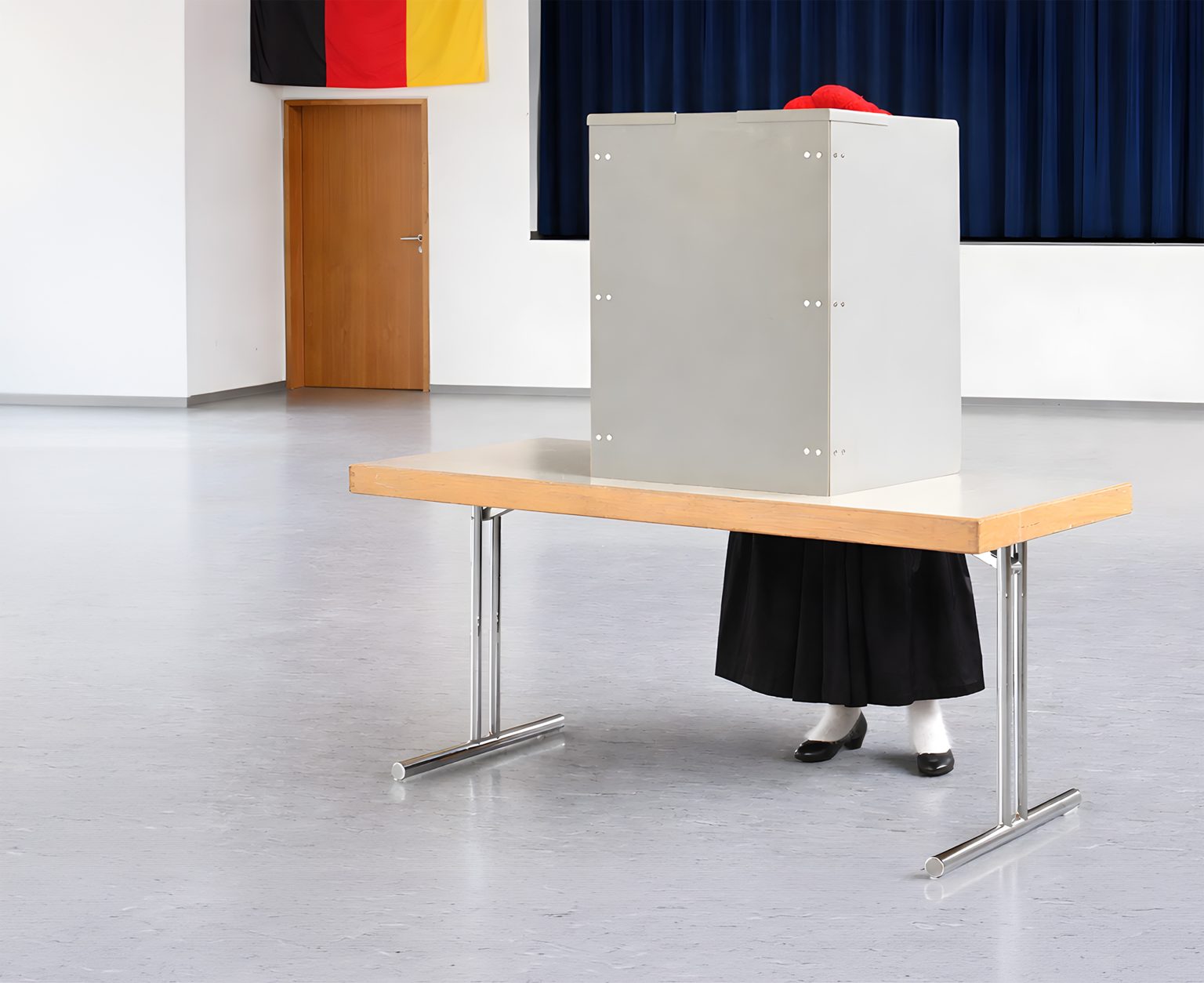
Two of the most important democratic principles are “one man, one vote” and “one vote, one value”. Each citizen has a single vote, and every vote is meant to count equally.
In theory, that sounds straightforward. In practice, it rarely works out that way. Most European states impose so-called threshold clauses, setting a minimum share of the vote that a party must win to enter parliament. Fall short, and every vote cast for that party is simply discarded. Does every vote really count equally? Clearly not.
The Debate over Germany's 5% Rule
It is a question now being fiercely debated in Germany. The country has operated under a 5% hurdle since 1953, a threshold it shares with Estonia, Croatia, Latvia, Lithuania, Poland, Romania, Slovakia and the Czech Republic.
Austria, Bulgaria, Norway, Slovenia and Sweden set the bar slightly lower, at 4%, while Greece and Italy, among others, require just 3%.
The German debate is unfolding at a turbulent moment. For the first time since the founding of the Federal Republic, the country finds itself in a state of genuine political uncertainty. The old era of perpetual stability has ended, the party landscape is shifting, and many now fear for the health of democracy itself.
Against this backdrop, Hans-Jürgen Papier, a former judge on the Federal Constitutional Court, has questioned the hurdle in a recent interview. His argument is straightforward: if several parties fall just short of the 5% mark, millions of votes are lost. That, he contends, is undemocratic and risks fueling disillusionment with democracy itself.
That such criticism should come from a German constitutional judge is striking, given that the Federal Republic is widely credited with inventing the threshold clause in the first place.
The Roots of Political Fragmentation
The problem of splinter parties is, in fact, a relatively modern one. It emerged only at the start of the 20th century, as modernizing European societies saw their three great political camps splinter into factions. Left-liberals and national-liberals, moderate and reactionary conservatives, a moderate left and a radical left soon existed in most European countries.
Even this fragmentation, however, proved unable to capture the full range of interest groups that modern societies were producing.
In Germany especially, the number of parties exploded after the First World War. A legal rule barred small parties that won fewer than 60,000 votes from taking a seat in the Reichstag, yet between 12 and 15 parties still entered parliament at every election of the Weimar Republic.
The "Bogeyman" of the Weimar Republic
After the Second World War, this abundance of parties in parliament was blamed for the collapse of democracy and the political instability of the Weimar Republic. The thesis does not withstand close scrutiny. The first German republic did not fail because it had too many parties, but because of the Treaty of Versailles, the reparations demanded by the victorious powers, rising inflation and the Great Depression.
Nevertheless, the specter of Weimar conditions was enough to see a 5% threshold clause written into law in the Federal Republic in 1953. The clause worked, from the outset, like a sieve. Ten parties had been represented in the first Bundestag of 1949. After the 5% hurdle took effect, only six remained.
By 1961, just three parties were left. It was not until 1982 that a fourth, the Greens, entered the Bundestag. A fifth followed after German reunification in 1990, when the successor to East Germany's Socialist Unity Party (SED) entered parliament. The Alternative for Germany (AfD) has been represented since 2017.
Forming a majority has not become any harder as a result. Indeed, the balance of votes between the left-wing and conservative camps has barely shifted at all. That largely left-wing policy continues to be pursued in the Federal Republic, despite a conservative majority at the last election, has nothing to do with the 5% hurdle or with forfeited votes. It has everything to do with the CDU's reluctance to tear down its firewall against the AfD.
What Saxony-Anhalt Could Decide
Still, Papier's point is not wrong. At the last federal election, 6.8 million of the 49.6 million votes cast were forfeited because of the 5% hurdle. For a democracy built on the idea of representation, that is not without its problems.
On top of that, it distorts the result. The more votes discarded for small parties, the easier it becomes for the remaining parties to secure an absolute majority in parliament, even without winning more than 50% of the vote themselves.
The issue is being debated with particular urgency in Germany, given the closely watched state elections due in eastern Germany this September. The AfD itself fought against the 5% hurdle for years, arguing that it was undemocratic and served only to entrench the established parties.
This autumn, however, offers the AfD a first chance to win an outright majority in an East German state. The scenario requires two parties to narrowly miss the 5% threshold and fail to enter the state parliament. In that case, just 41% of the vote could be enough to hand a one-party AfD government to leading candidate Ulrich Siegmund in Saxony-Anhalt. Opinion within parts of the AfD on the threshold clause has shifted accordingly, even as the party leadership continues to call for its outright abolition.
It is not entirely selfless, however, that the current debate over the 5% hurdle is being stirred up precisely by parties that risk being ejected from parliament themselves. The governing SPD faces a particular reckoning: for the first time, it could fail to win a single seat in a state parliament.

A Question Bigger Than One Election
The looming prospect of a one-party AfD government is now forcing into the open arguments that few previously wanted to make.
On fundamental questions, however, one should not be guided by short-term, tactical considerations. Threshold clauses represent a significant intervention in the formation of political will. The 5% figure, moreover, is a relatively arbitrary one, as the patchwork of different rules across Europe demonstrates. There is also a natural blocking minority, arising from the minimum number of votes needed to win a single seat, which depends on the size of parliament itself. In a 100-seat parliament, even without any threshold clause, a party would need at least 1% of the vote to win a seat. In a 400-seat parliament, just 0.25% would suffice.
Supporters of threshold clauses warn of a fragmented parliament, more difficult government formation and administrations paralyzed by constant compromise. Yet a number of European governments struggle to act decisively even with stable majorities, or, as in England, despite a majority voting system. Parliamentary democracies, for this reason too, are increasingly in a crisis of legitimacy.
The social conditions underpinning parliamentary democracy have also changed fundamentally over the past 100 years. Individualization and globalization have transformed once-homogeneous communities into highly heterogeneous ones.
Parliamentary institutions must adapt accordingly. An increasingly diverse society, with its many different worldviews and milieus, needs to be represented in parliament, or parliamentarism itself will lose legitimacy and support. That voters are ultimately forced to grudgingly back a major party, simply because it is the only one with a realistic chance of success, is not democratic.
In a ruling published on Thursday, the German Federal Constitutional Court once again upheld the 5% hurdle, a decision that had been widely expected. But Germany is not the only country where the party landscape is in upheaval. It would be surprising if threshold clauses across Europe were to survive this transformation unscathed.