Europe’s Elites Lose Their Bearings
Europe’s political establishment and its non-governmental organizations sounded the alarm about a new Hitler. Orban was accused of undermining the rule of law, denying refugees their rights and resorting to nationalist rhetoric. His government was duly condemned as “fascist”.
A decade later, Europe has quietly come round to his position. Its leaders have never admitted that he was right, nor have they withdrawn the label they attached to him. They have simply adopted, one by one, his prescriptions for protecting the continent against uncontrolled waves of migrants – not refugees.
At the time, even the term “economic migrant” was virtually forbidden. Yet anyone standing at Europe’s borders could see that the overwhelming majority of those arriving were young men. There were few women, children or elderly people among them. They had come to claim what they had been persuaded to regard as their human right to live in Europe.
That belief did not arise by accident. It was systematically encouraged by an extraordinary alliance between people smugglers and European politicians: the former offered passage, while the latter issued the invitation and held open the door.
Angela Merkel’s Willkommenskultur became the obligatory creed of a supposedly hopeful new age that everyone was expected to embrace. Europe’s disoriented elites repeated it endlessly, too consumed by ideological fervor to consider where their policy might lead.
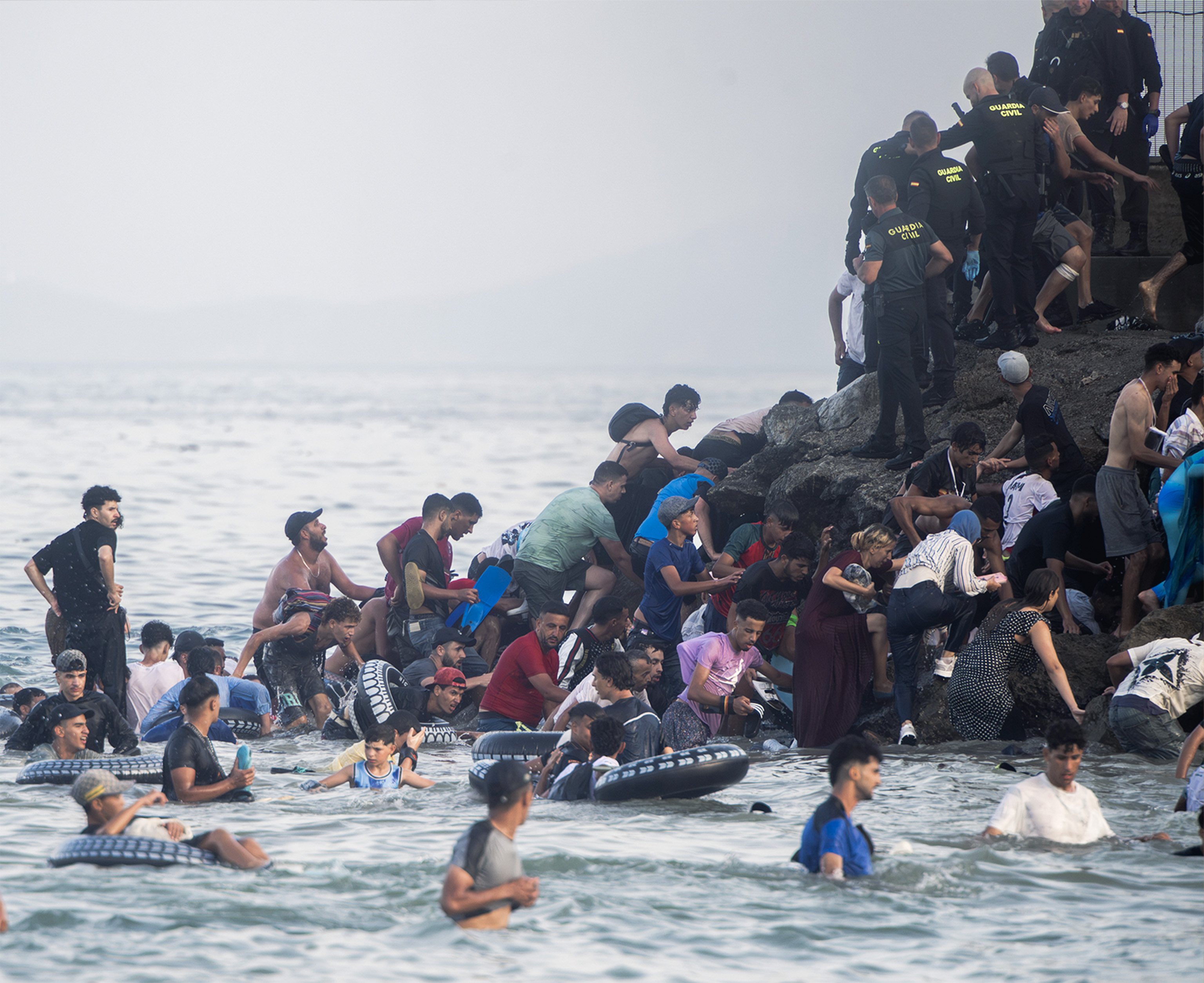
The consequences are now on display in Ceuta. The time for reflection has passed. Europe can respond to a migrant invasion only by resorting to the very methods its liberal establishment once denounced as fascist – and, in some cases, going even further.
An uncontrolled flood of migrants overran nearby towns and villages, leaving local residents bitterly disillusioned. Their own country failed in one of the duties on which its legitimacy rests: protecting its territory and citizens. It failed because political forces had tolerated and supported mass migration for years.
Europe has now changed its tune. The alarm bells are ringing, and governments are dusting off measures once portrayed as relics of fascism: closing borders, returning migrants to where they came from and acting decisively to regain control.
The fences once condemned by Europe’s elites can now be seen in footage from Ceuta. Even they failed to hold back tens of thousands of migrants from North Africa. Judged by the rhetoric its leaders used in 2015, the European Union itself has now become fascist.
What does that tell us about Europe’s politics?
Ceuta Shatters Europe’s Illusions
The invasion of some 50,000 migrants into Spanish territory late last week – possibly coordinated by criminal gangs – terrified the Eurocrats. They must now confront their own failures. Their policies opened the door to the smugglers, and they are once again facing the consequences of another insane policy with which they became obsessed.
Predictably, many of them now boast of having taken a “decisive” stand.
At EU level, European Commission President Ursula von der Leyen represents this new approach. In Slovakia, SaS Chairman Branislav Gröhling has now embraced the position once taken by his predecessor, Richard Sulik.
Sulik’s reasonable skepticism about migration once led even members of his own party to call him a fascist. It was one of the reasons the party’s founder gradually became unwelcome in the movement he had created.
Gröhling now says Europe must act decisively to protect its borders and preserve the Schengen Area. He has also demanded strict enforcement of the rules governing the return of migrants.
The very idea of returning migrants could scarcely be mentioned during the annus horribilis of 2015. Liberal propaganda had created the impression that a return policy was little more than a euphemism for sending people to Nazi concentration camps. Gröhling now insists that Europe must use every tool at its disposal to secure its external borders.
Von der Leyen was equally unequivocal:
“The images coming from Ceuta are unacceptable. We cannot allow anyone to come to our Union without abiding by our rules. Dangerous crossings must stop immediately. Smuggling networks must be dismantled. And returns must be swift, as our rules allow.”
Ten years ago, almost no one in the political mainstream – not even Orban – would have contemplated holding migrants in special reception camps. Europe has reached this point because of the naivety of its statesmen and liberal delusions about human rights. Those who once cast themselves as their foremost champions have become more zealous in defending Europe than Orban or Sulik ever were.
Fascism as a Weapon against Democracy
It is revealing that analysts and politicians now support measures they themselves were calling fascist only a few years ago.
The specter of fascism was revived 10 years ago not to defend democracy but to destroy it – or, more precisely, to shut down free political debate.
“Fascist” became an all-purpose term for anyone who supported sensible – meaning anti-liberal – policies. The tactic was not confined to migration. It was used against critics of climate alarmism, the LGBTQ+ agenda and almost every other progressive cause. The underlying logic was always the same: anyone who is not with us is on the wrong side of history and must be condemned as an extremist.
Once an opponent has been declared a fascist, his arguments no longer need to be heard. Fascism is the ultimate evil, so any policy associated with a fascist must be excluded from respectable political debate, however reasonable it may be.
The progressive position is simple. No major political question is genuinely open for discussion. Progressive policy is the only permissible future, and it must be imposed in every area of life.
There was once a largely fruitless debate over whether the relentless abuse of the word fascism would eventually have the opposite of its intended effect. If every political opponent is portrayed as a dangerous radical, genuine extremism will inevitably come to seem less threatening.
Fascism represents one of the darkest periods in modern history. Warnings about a “new fascism” should therefore be reserved, if the phrase is to be used at all, for genuinely dangerous forms of radicalism.
But when journalists and politicians apply the word to anyone advocating legitimate and often reasonable policies on Europe’s most important questions, they manufacture fascists out of large sections of society.
What will young people make of the term? Most know little about history and feel no personal connection to it. If every ordinary person can be described as a fascist, fascism itself will cease to sound dangerous.
That argument, however, has now been overtaken by events.
How Progressives Defanged Fascism
The question now is what happens when the supposed fascists keep turning out to have been right.
This is where progressives and their hysterical media have led us. They have spread hoaxes and coordinated disinformation campaigns about the most important issues facing Europe. At the same time, they have misused a term from one of history’s darkest periods – a word that should have been preserved as a warning.
Consider the issues that have prompted accusations of fascism: migration, green policies, the LGBTQ+ agenda, skepticism about war and caution over vaccines. More often than not, the supposedly fascist position was the more reasonable one.
These were precisely the subjects that could not be openly debated. Had an honest discussion been allowed, the absurdity of liberal propaganda would have been exposed. Debate therefore had to be suppressed, while dissenters were branded radicals and driven out of respectable society.
Fascism has thus become a label for people who say the right thing at the wrong time.
In 2015, uncontrolled mass migration could still have been stopped. Europe could have acted before the damage was done. But no one was allowed to propose sensible measures because doing so meant challenging liberal dogma.
Only after liberals are forced by catastrophe to reverse their position do closed borders and firm action become acceptable. Such policies can suddenly be proposed without attracting the label of fascism.
But the change comes too late. The dam has burst, and the flood can no longer be contained.
In progressive parlance, a fascist is therefore a reasonable and far-sighted person who advocates the right policy before the mainstream is prepared to accept it. The establishment begins to think rationally only when its own naivety ends in disaster.