For its part, the government is resolute in its view that such a decision could not possibly be arrived at. It claims that the present position – which applies only to state-provided treatments – does not prevent parents who wish to acquire puberty-blocker treatment for their children from doing so on a private basis, paying for it themselves. It says that for the state to be compelled to provide a treatment at taxpayer expense would constitute an intolerable judicial intrusion into an area of policy universally regarded as a matter for the legislature and the executive.
It is on these questions, rather than the morality or ethics of the medicine itself, that the case is likely to turn.
A Culture War Battle Magnified
Yet make no mistake: the question of the morality and ethics of puberty-blocker treatment for children is set to be elevated yet further in the political arena by the mere existence of the case.
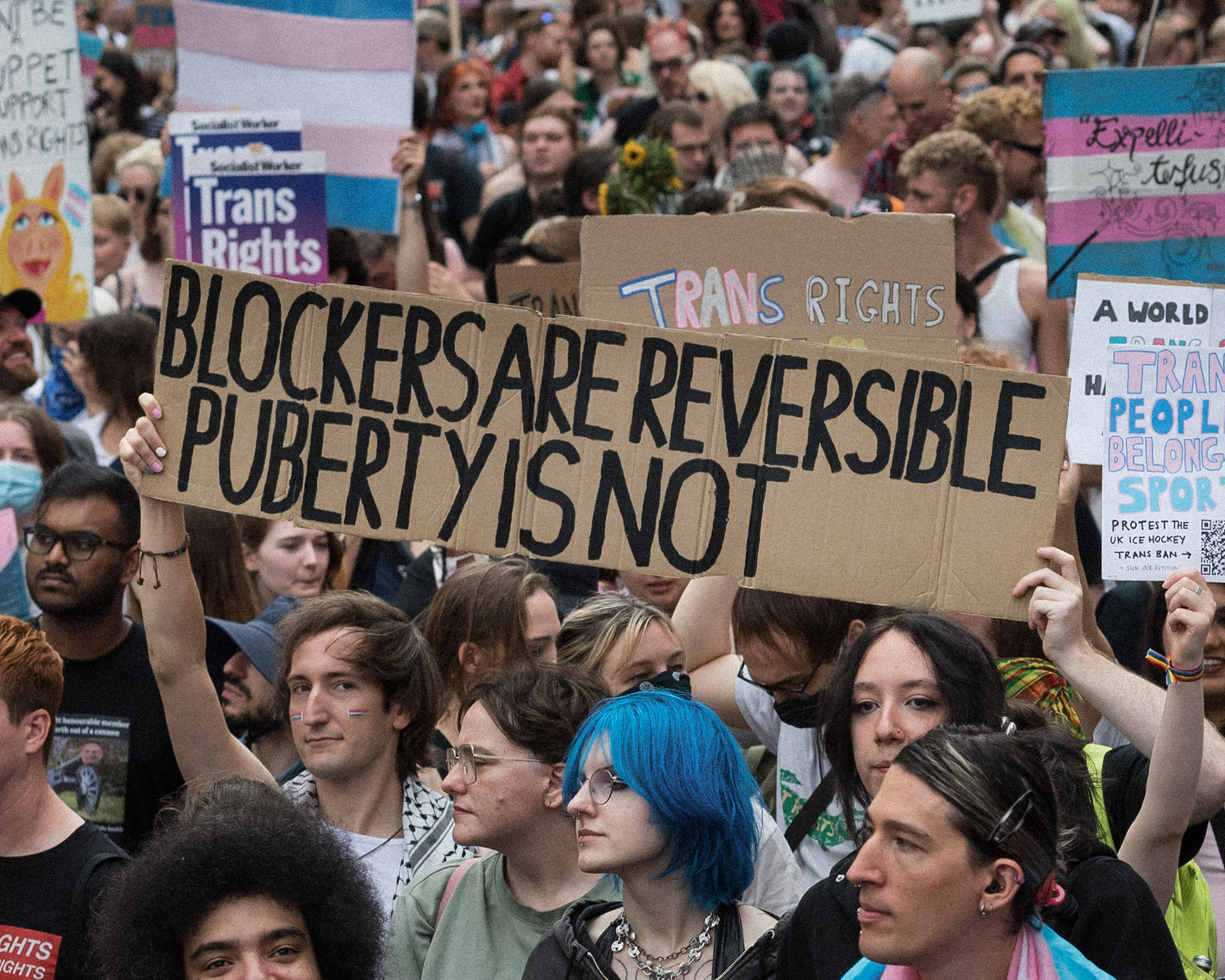
For the applicants, the position is straightforward: a medicine exists which, they claim, could alleviate suffering and mental torture for hundreds of children, and the state is refusing to provide it for base ideological reasons. This, they claim, is a fundamental breach of their human rights.
For opponents, meanwhile, puberty blockers are an irreversible treatment with long-term consequences for those who take them, used to treat a condition which cannot be properly or finally diagnosed in childhood and constituting a barbaric medical experiment on children.
This is a familiar battle, increasingly being waged on a global basis. In the UK, for example, the Cass Review of 2024 recommended that puberty blockers be prescribed only as part of a research protocol. But the government is now reintroducing them in what it calls a “controlled trial” to establish their efficacy. This trial will involve hundreds of children, and many campaigners against the drugs see it as a cynical end-run around the Cass Review recommendations.
Likewise, puberty blockers are increasingly at the heart of the American culture wars, with their provision or denial now linked to whether a person lives in a deep-blue state run by Democrats or a deep-red one controlled by Republicans.
Will the Tribunal Make the Choice for Voters?
With the transgender issue at the heart of the West’s culture wars, it is therefore somewhat unsurprising that the tribunal, rather than voters, should be asked to make a major policy decision on the matter.
But it also shows how a fundamentally medical question – namely, whether puberty blockers constitute medication or bodily harm resulting in irreparable damage – is being taken out of the purview of medical professionals and thrust into the midst of a culture war that seeks to define the best interests of the child not on the basis of medical facts, but rather on the basis of ideological beliefs.
For transgender campaigners, there is reason to think the court route might be profitable: Australian courts have tended, in general, to take a very progressive and left-wing approach to the transgender issue in the round, with the most notable example being Tickle v Giggle. In that case, Australia’s courts decided in favor of the applicant’s view that the existence of a social-media platform which restricted membership to biological females only was discriminatory against transgender women – that is, people born male who now call themselves female.
Given that and other lesser decisions which have trended in the same direction, it would not be an enormous surprise were the tribunal to decide, ultimately, that puberty blockers are a human right which taxpayers are obligated to fund.
A State Issue – But Only for Now
Regardless of which way the tribunal ultimately goes, the battle is not likely to end. Indeed, at Australian federal level, the transgender issue may become a key battleground in the next election. At present, Labor is clinging to a narrow but sustained poll lead, benefiting from a divided right, with the old guard Liberal-National Coalition shedding significant support to the insurgent One Nation Party, led by Pauline Hanson.
If elected, Hanson has pledged to impose a total nationwide ban on puberty blockers and recognize biological sex in law. Labor’s position is close to that of its sister party in the UK, favoring further research and review on the issue. Meanwhile, the Coalition appears to be struggling to articulate a clear position – with the Queensland ban at one end of the Coalition’s spectrum, but a reluctance to endorse it at national level causing some confusion about party policy.
As the issue’s salience rises, voters in Australia will soon have to make a decision. Unless, of course, the tribunal takes it from their hands.