Too Much of Everything
Volkswagen is under pressure on several fronts. In China, it is being squeezed out by domestic manufacturers that have gone from students of European automakers to their most dangerous competitors. Meanwhile, the European market remains weak, the pressure to invest in electric mobility is enormous, and US trade policy is taking its toll. The result is too many factories, too many models and costs that are too high.
Volkswagen is therefore preparing to cut another 50,000 jobs, on top of 50,000 positions already being eliminated. The future of the plants in Emden, Zwickau, Hanover and Neckarsulm is in doubt, while the group needs to reduce excess annual production capacity in Europe by more than 500,000 vehicles.
Some of that output will indeed disappear, and some models will be discontinued altogether. But Volkswagen will not stop making cars. It will still need to decide where to build the models that remain. And that is precisely where an opportunity arises for the Czech Republic and Slovakia.
If one of the main problems facing German plants is cost, it stands to reason that future model allocations will increasingly favor factories that can build cars more cheaply and flexibly without compromising on quality.
Volkswagen already has precisely such plants just a few hundred kilometers to the east.
Bratislava’s Unique Position
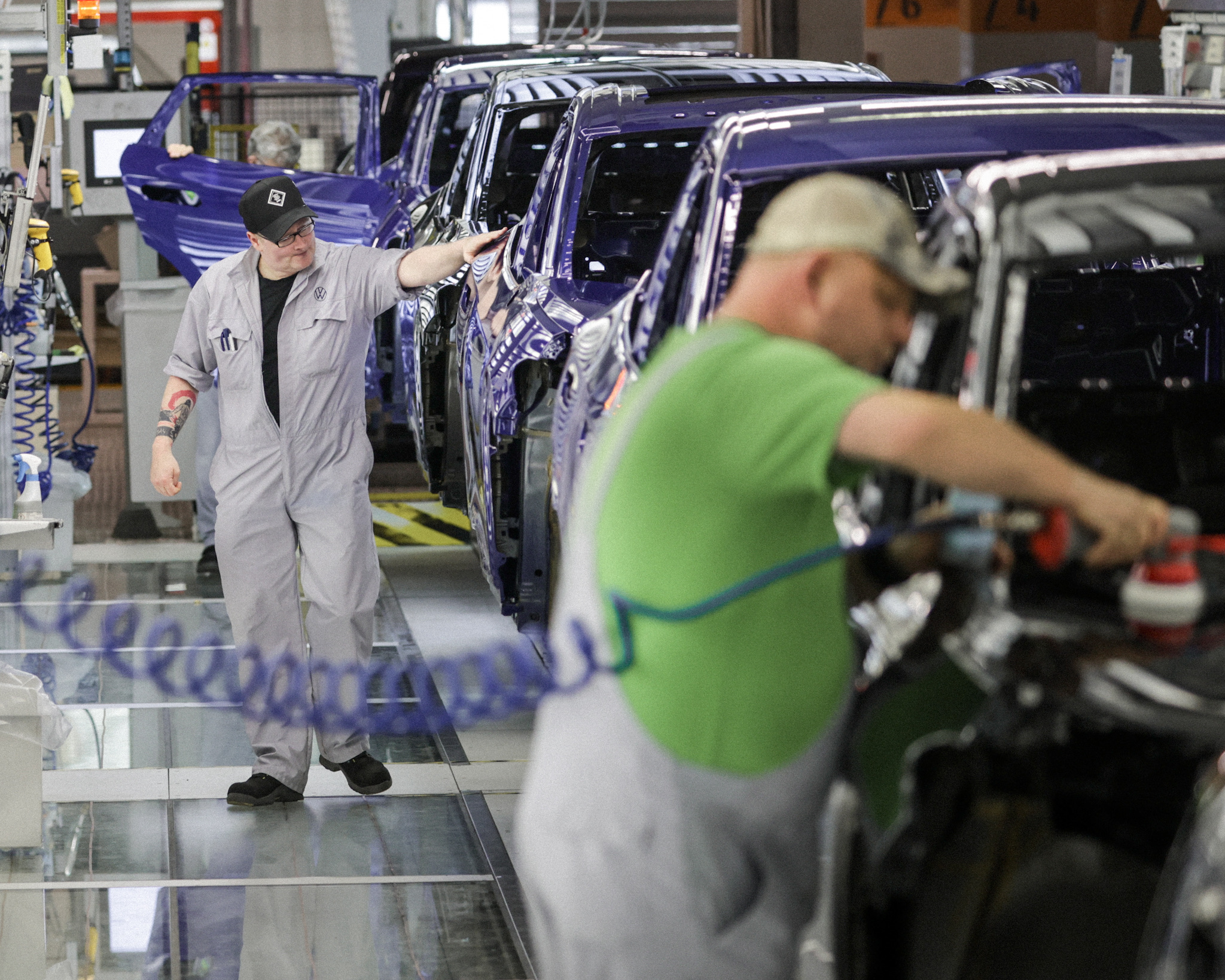
The Bratislava plant is now one of the most distinctive factories in the entire group. Under one roof, it manufactures vehicles from four Volkswagen Group brands: Volkswagen, Skoda, Audi and Porsche. The Volkswagen Touareg and Passat, Skoda Superb, Audi Q7 and Q8 and Porsche Cayenne are all built there. The plant produces gasoline, hybrid and electric models.
Slovakia is no longer merely a low-cost assembly location. Its automotive industry is capable of producing some of the most complex and expensive cars Volkswagen makes.
There is also an important precedent. Volkswagen has already shifted Passat production to Bratislava. That makes it entirely plausible that further consolidation in Germany could send more production to Slovakia.
The Czech Republic is similarly well placed.
Mlada Boleslav is becoming one of Volkswagen’s key hubs for electric mobility. Skoda builds internal-combustion and electric models on the same production line there while significantly expanding battery-system production. Annual capacity now runs into the hundreds of thousands of units, serving not only Skoda but other group brands as well.
This is exactly the type of production Volkswagen will need in the coming years: a highly flexible factory where the mix of internal-combustion and electric vehicles can be adjusted quickly to match actual demand.
Kvasiny adds another layer of flexibility. Skoda already shifts production between Mlada Boleslav and Kvasiny depending on where it needs to free up capacity for new models. Within the group, the Czech automaker therefore offers a degree of production flexibility that costlier, more rigid German plants struggle to match.
The Czech Republic and Slovakia may therefore emerge as winners from Germany’s automotive crisis.
Two Trends Converge
Slovakia has another potential advantage.
Prime Minister Robert Fico has said he held talks with a major Chinese investor interested in building an auto plant in Slovakia. The automaker’s name has not been disclosed, and no investment has yet been confirmed. But the interest itself is telling.
Slovakia may find itself where two very different trends meet.
From the west, Volkswagen and other European automakers are under pressure to cut costs and shift some production out of expensive German plants to more competitive locations. From the east, Chinese manufacturers want to move in the opposite direction, bringing production directly into the European Union.
Slovakia is well placed to benefit from both.
For Chinese automakers, the country is close to ideal. They do not have to build an entire automotive ecosystem from scratch. They have access to a skilled workforce, an extensive supplier network, logistics infrastructure and experience producing vehicles for Volkswagen, Porsche, Audi, Kia, Stellantis and Jaguar Land Rover.
Slovakia could thus become one of the main European bases for the Chinese automotive industry.
For both the Czech Republic and Slovakia, additional automotive production would mean more than factory jobs alone. Every major automaker sustains an extensive network of suppliers, engineering firms and manufacturers of electronics, plastics and metal parts, as well as logistics, research and development and other business services.
There is, of course, another side to the coin. Slovakia is already extremely dependent on the automotive industry, and additional factories would further increase that concentration. Moreover, if Volkswagen were to lose the long-term global competition with China, the problems would eventually reach its Czech and Slovak plants as well.
Nevertheless, the underlying trend is unmistakable.
The German automotive industry can no longer assume that everything it has traditionally produced at home will continue to be made there. As production becomes increasingly decentralized, productivity, flexibility and costs will play an ever greater role in deciding where models are built.
In these areas, the Czech Republic and Slovakia have one huge advantage over Germany.
They are cheaper.
Originally published on the author’s personal website lukaskovanda.cz.