When Welfare Spend Tops Tax Take: The Coming Fiscal Crisis
Across Europe, welfare spending is ballooning, and in many countries it now outstrips income tax revenue. No amount of political maneuvering can make that math disappear.
Europe’s pension systems were designed for a younger population than the one they now have to support. Photo: Oli Scarff/Getty Images
|
What happens to a society, in the end, when it can no longer raise enough from its working population to cover what it has promised to those who are not? That question is becoming harder for Europe to avoid, as social spending and income tax figures make clear.
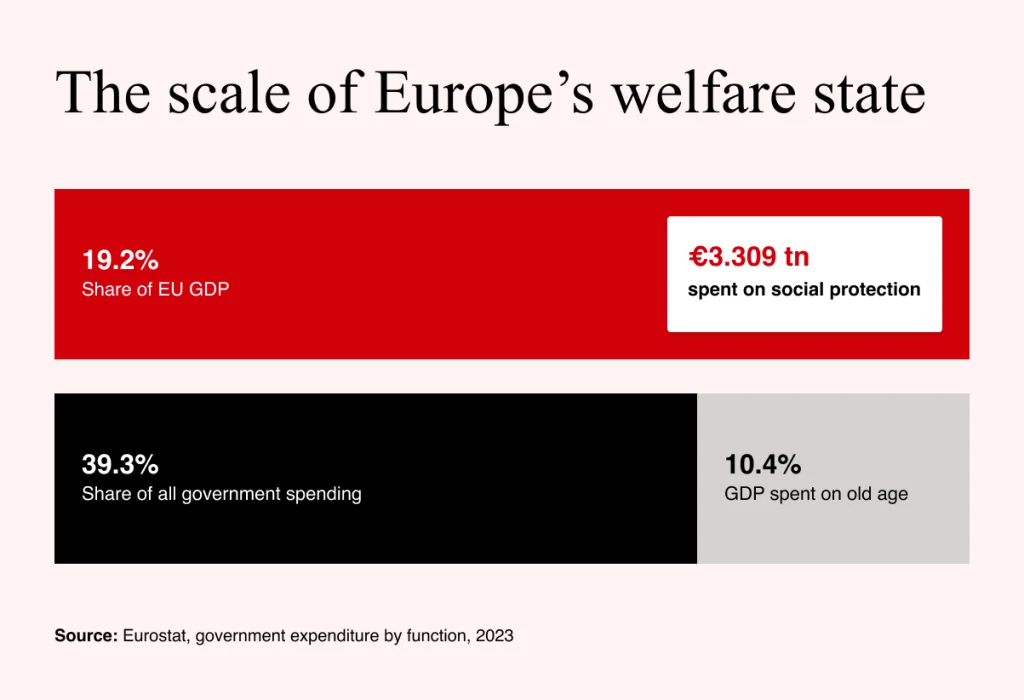
About 40% of all government spending across the continent now goes on welfare, a category that includes old-age pensions along with unemployment insurance, disability benefits, child benefits and other support for the vulnerable. As Europe grows older, that bill keeps rising, and the pressure on taxpayers rises with it.
Source: Eurostat, government expenditure by function, 2023
The UK: Where the Welfare State Costs More Than It Collects
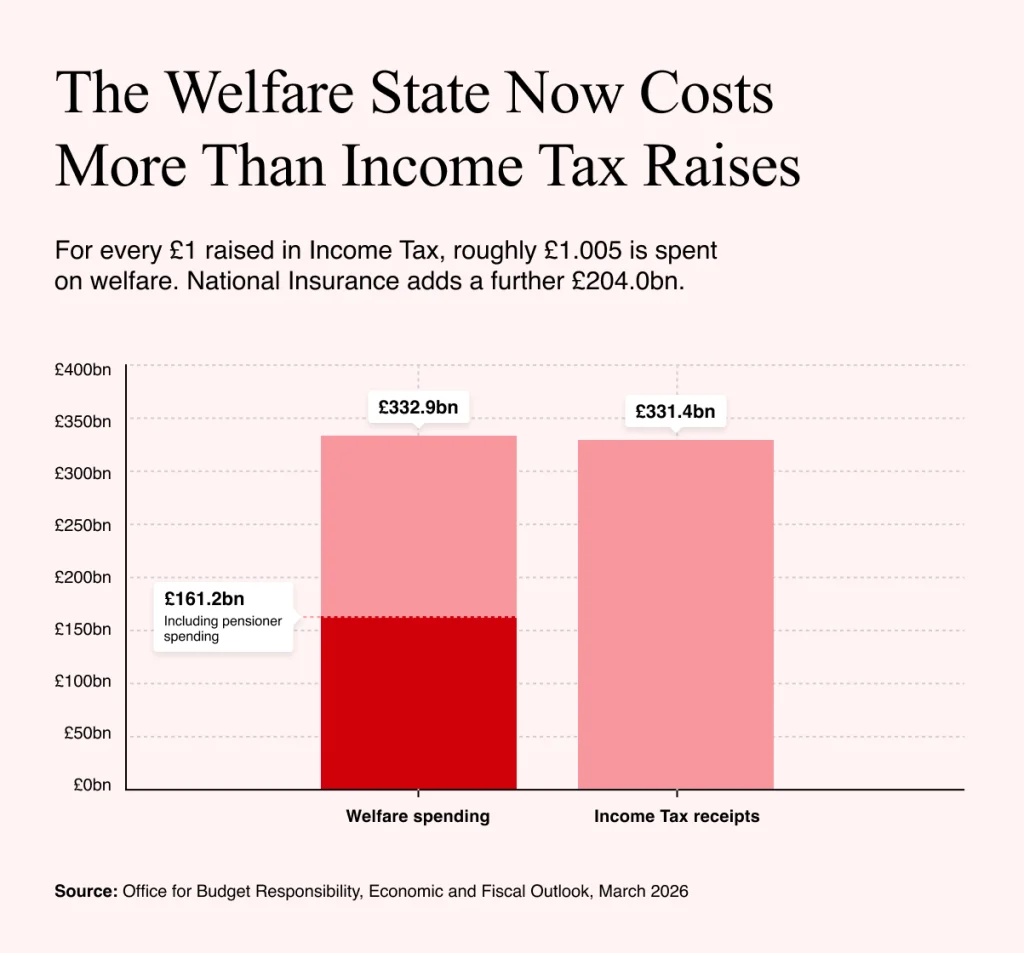
Though it is not an EU state, the United Kingdom may provide the cleanest example: last year, the welfare bill alone exceeded the total amount recouped by His Majesty's Treasury in income tax. Everything else: defense, infrastructure, roads, policing and so on, had to be met either from other taxes or from borrowing, with the UK's debt now reaching levels that have the international bond markets in open revolt.
Source: Office for Budget Responsibility, Economic and Fiscal Outlook, March 2026
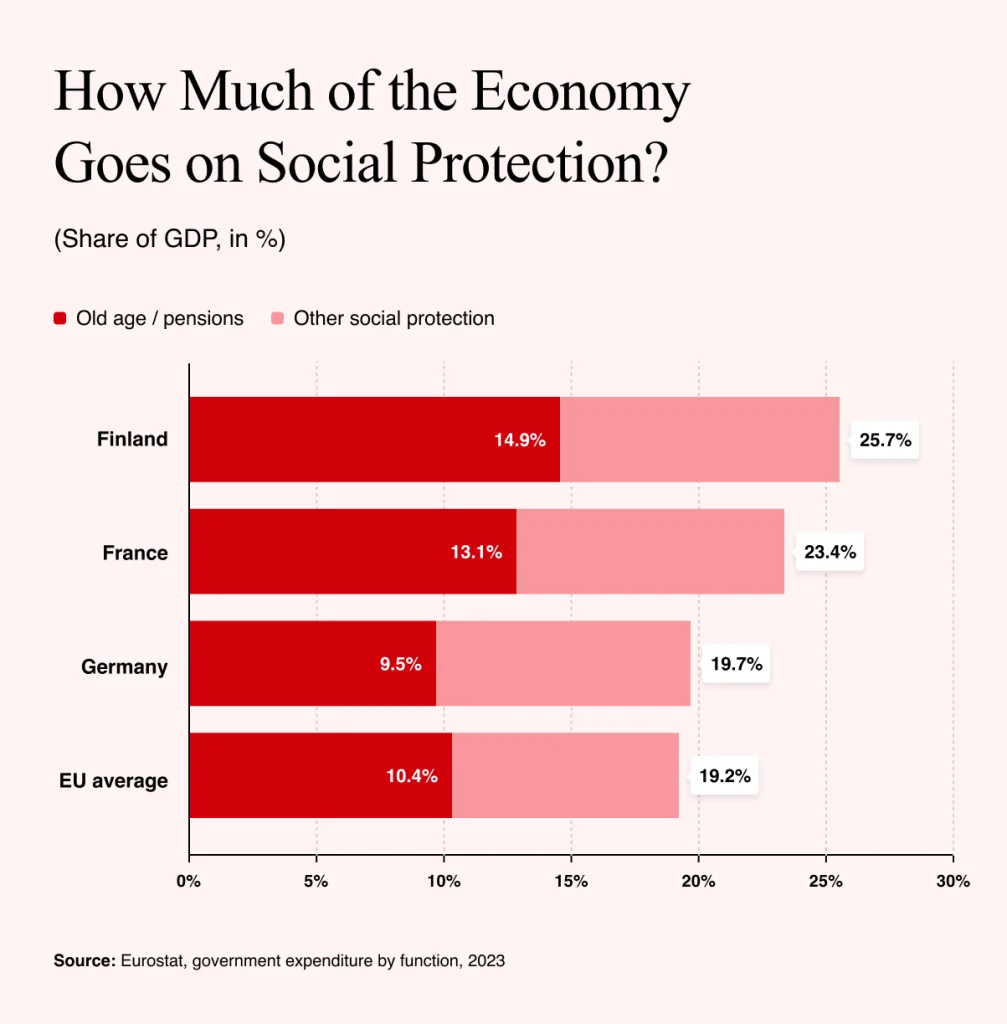
Elsewhere in Europe, the same underlying pressure can be seen in a different set of numbers. In Finland, one of every four euros generated in the economy is spent on welfare, social protection or pensions. In France, the figure is 23%. Even in Germany, long stereotyped for its supposed fiscal efficiency and ruthlessness, the welfare bill now consumes just shy of 20% of all income generated in the economy.
Of these figures, pensions are of course the greatest consumer of cash. And the demographic pattern of Europe makes it clear that pension obligations are set to rise consistently over coming decades, even as the number of working-age people falls. The math, in short, does not add up.
Source: Eurostat, government expenditure by function, 2023
No Easy Choices
Broadly speaking, there are only a handful of ways to solve that problem: governments can tax more, spend less, limit benefits or pin their hopes on immigration.
France tried the second option. President Macron learned the hard way how fiercely people guard their pension entitlements when he pushed through a rise in the country's retirement age, from a strikingly low 62 to 64, a change that would still have left the French working some of the shortest careers in Europe. The result was uproar, months of protest, and a reform that has since been partly shelved.
One reason for that uproar is not confined to France. Across Europe, a great many people regard the state pension not as a benefit handed out by the government, but as something closer to a personal retirement account, one into which they have paid taxes over a lifetime of work. It is a view that politicians themselves have long encouraged, and one that, paradoxically, now makes any attempt at pension reform far harder to achieve.
In practice, politicians have proved almost incapable of persuading their electorates that the welfare entitlements they have grown accustomed to can no longer be afforded in their current form. There will always, besides, be voices willing to trade votes for the more comforting story that corruption, rather than mathematics, explains why cuts are being demanded of ordinary people.
It is this paradox, in all likelihood, that has pushed Europe's political class toward immigration as the preferred solution.
Immigration as an Escape Route
On the face of it, and in theory, it works neatly: bring in hundreds of thousands of new workers, have them pay tax, and suddenly all of the problems of demography no longer exist. Even where politicians recognize that migration will be unpopular, there is a cold calculation to be made that immigration might be substantially less unpopular than telling ten million French pensioners that their entitlements will no longer be paid. Look closely, and you can see the outlines of quite a hard-nosed strategy: take the political pain of populism on immigration, because it is substantially less poisonous than the political pain of populism on pensions and welfare cuts.
The problem, alas, is not political: it is that the economic case for fixing Europe's budgetary problems via migration is inherently dubious.
First, migrants themselves are not economic units, but people: they come with basic needs such as housing, education and health that, increasingly, Europe is incapable of providing. Indeed, one of the paradoxes of having an older population is that health services, for example, become more strained and require more spending. A migrant recruited as a nurse or a doctor to meet the ballooning health needs of an aging population may relieve a labor shortage, but this does not magically solve the fiscal problem: the state has acquired another taxpayer, certainly, but also another salary to pay.
Second, migration is perhaps not the universal economic balm politicians imagined: it certainly can be, while the migrants in question are highly educated, skilled workers coming to work in high-performing industries. But some forms of lower-skilled migration do not produce the fiscal dividend politicians promise. Denmark's ministry of finance, for example, has found that Western migrants are net contributors, while non-Western migrants and their descendants, taken collectively, impose a substantial net cost on public finances.
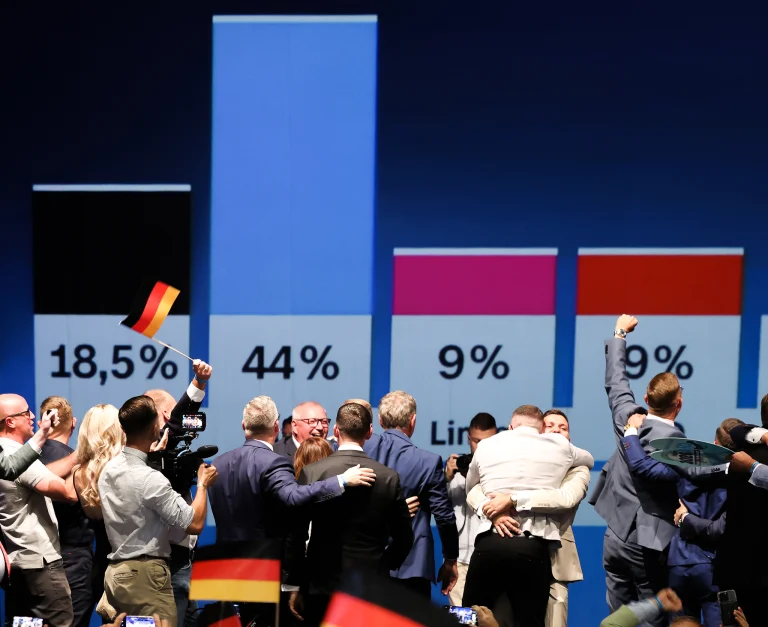
And third, there are the social costs, about which this article need say little beyond waving in the general direction of the opinion polls in Germany and France.
Only One Way Out: Math
Ultimately, Europe's social spending problems will be resolved only through the ruthless application of mathematical principles. If governments will not impose those principles themselves, and that includes the many populists who appear to believe mathematics can be waved away with enough national flag-waving, then markets will impose it on their behalf.
This past week alone, the bond markets have already been sending a clear warning about what is sustainable and what, increasingly, is not. Europe's welfare spending figures are a large part of the reason why.
Welcome to the comments section of the Štandard daily. Please take note of our guidelines, comments are moderated by us. You can contact the moderators at support@statement.com.
Participate in the discussion
Comments are available to subscribers only. If you'd like to join the discussion, choose a subscription starting at €6.72 per month.
All comments 0
Register
Comments are available to registered users only. If you'd like to join the discussion, register here.