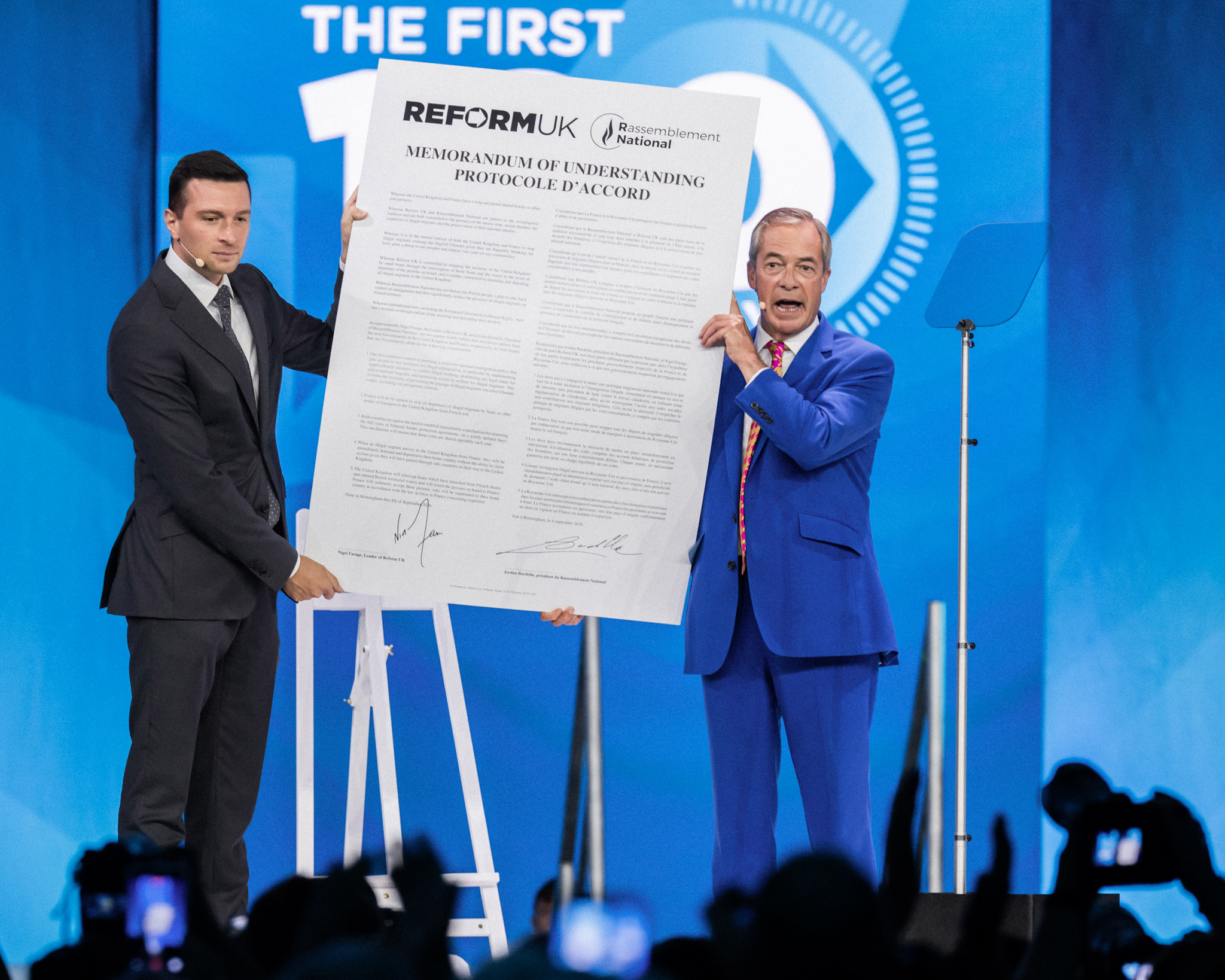
This convergence did not begin in Birmingham. For several years, the RN and Reform UK have been drawing closer over shared positions on immigration, national sovereignty and opposition to the political establishment. Farage has gradually integrated Bardella and Marine Le Pen into his European network of sovereigntist parties, while the RN sees Reform as a natural partner in the fight against illegal immigration.
The English Channel provides the ideal setting for this cooperation. For more than a decade, the French and British governments have been passing the buck regarding crossings by small boats. London wants to prevent arrivals on its territory; Paris refuses to allow the United Kingdom to unilaterally decide to return migrants intercepted in France. Emmanuel Macron, in particular, had rejected British plans for pushbacks as a violation of French sovereignty.
The Bardella–Farage agreement therefore proposes to do exactly what the current governments have so far refused to do, but in the form of a political commitment between their potential future successors – which explains the British enthusiasm.
A Political Victory for Farage
For Reform UK, the image is ideal: the British migration problem would no longer be presented as an exclusively British issue. It would become the result of cooperation between two patriotic governments ready to close the Channel route.
Farage was thus able to present the agreement as a new “Entente cordiale”, promising that the crossings would be stopped “forever”. In a country where small boats have for years been one of the main symbols of the migration crisis, a future French government’s commitment to cooperate with London represents a considerable political gain.
This is all the more valuable for Farage given that Reform UK has recently seen its lead in the polls narrow and its leadership weakened by financial controversies. Bardella thus put him in the international spotlight at a time when his party convention risked being dominated by internal difficulties.
Can the RN say the same? From the French perspective, the benefits are less immediately apparent.
The party, however, has a well-developed argument to defend the agreement. Bruno Gollnisch, a longtime figure in the RN, articulated the logic particularly clearly: “The whole world will know that there is no point in coming to France anymore.”
The idea is simple: if France becomes a dead end for migrants seeking to reach the United Kingdom, Calais’s appeal as a crossing point will disappear. The goal, therefore, would not be to manage more migrants in Calais, but to prevent Calais from continuing to attract them.
Charles-Henri Gallois, who is close to the RN, elaborates on this reasoning. According to him, the agreement changes the current situation: “At present, in certain situations, people who have entered the United Kingdom illegally from France can be returned to France. With the agreement in place, the United Kingdom will be able, within the established framework, to detain the individuals concerned on its territory and initiate their removal to their country of origin.”
The RN’s logic is therefore twofold: on the one hand, France should simultaneously tighten its own immigration policy in order to reduce immigration and the influx toward Calais; on the other hand, the possibility for London to carry out pushbacks would serve as a sufficient deterrent to reduce attempts to cross.
Gallois emphasizes this point: “The authority granted to the United Kingdom to carry out push-backs will therefore affect relatively few people. Above all, it should help reduce the influx of migrants to Calais.” In other words, the success of the agreement would be measured less by the number of migrants actually returned to France than by the number of people who would give up attempting the crossing.
Finally, he puts forward a third, economic argument: the mechanism provided for in the agreement would, in his view, establish “a more balanced cost-sharing arrangement in France’s favor”.
For the RN, this is a political gamble. Bardella does not present the agreement as a deal in which France would simply agree to take back migrants returned from Britain. He asserts that a future, much tougher immigration policy would precisely prevent these people from ending up in this situation.
During his trip to Cernobbio, Italy, on Saturday 5 September 2026, to attend the Ambrosetti Forum – following his visit to Birmingham – he stood by his decision, explaining that the agreement “upsets” his opponents because they are “fanatical pro-immigration advocates” who created the conditions for “migration and security chaos” in Calais.
The problem is that this mechanism relies entirely on the assumption of effective deterrence – a claim his opponents dispute.
Left and Right: France Stands to Lose
On the left, the criticism is obviously head-on. Far-left candidate Jean-Luc Mélenchon accuses the RN of turning France into “the British’s gatekeeper”. The accusation is clear: two populist parties have allegedly found common ground by making France bear part of the human and material cost of British migration policy.
But it is on the right that the attack is potentially the most dangerous for the RN, because it specifically targets the issue of sovereignty.
Bruno Retailleau, a candidate and former minister with Les Républicains (LR), denounced Bardella’s “amateurism”. According to him, the agreement risks “turning France into a vast deportation center for all illegal immigrants who attempt to cross the English Channel.”
The objection from the national right is even more sovereignty-focused. The risk would be that France would accept a principle that, in practice, primarily benefits London: the United Kingdom intercepts migrants, decides whom it wishes to send back, and then France would have to deal with the consequences of those returns.
The symbolism is all the more sensitive given that Calais was once an English possession. The scene in Birmingham can therefore easily be turned against the RN: after seeking to restore France’s sovereignty, would Bardella have agreed to turn Calais into Britain’s migration dumping ground?
European Law Remains the Other Blind Spot
Finally, the blind spot in the agreement lies in the concept of migrant return. The text provides for their return to France under the agreed-upon framework, followed by their removal to their country of origin. But this removal cannot be automatic; it must comply with French, European and international law. The safeguards related to asylum, the principle of non-refoulement and the prohibition against returning a person to a country where they would face treatment that violates their fundamental rights constitute real obstacles.
Unlike in previous years, the RN no longer calls for withdrawal from the European Convention on Human Rights. Its proposal must therefore operate within the legal constraints it now intends to respect.
This is what lends weight to the criticism that Bardella has accepted a mechanism whose first step is very clear – the United Kingdom intercepts the boats and returns their occupants – but whose second step, removal from France, is much more uncertain.
It would, however, be simplistic to conclude that the agreement is simply empty. For Farage, this is a major symbolic victory: he secures the photo opportunity and the political commitment of a future French partner on his key campaign issue. For Bardella, it is an attempt to demonstrate that the RN can forge international alliances and propose a coordinated solution to a problem that successive governments have failed to resolve.
But the imbalance remains. Farage can immediately present the agreement as a promise that the boats will be sent back to France. Bardella, on the other hand, must convince people that the real goal is precisely to ensure they no longer leave from France. In this regard, the task ahead is immense.