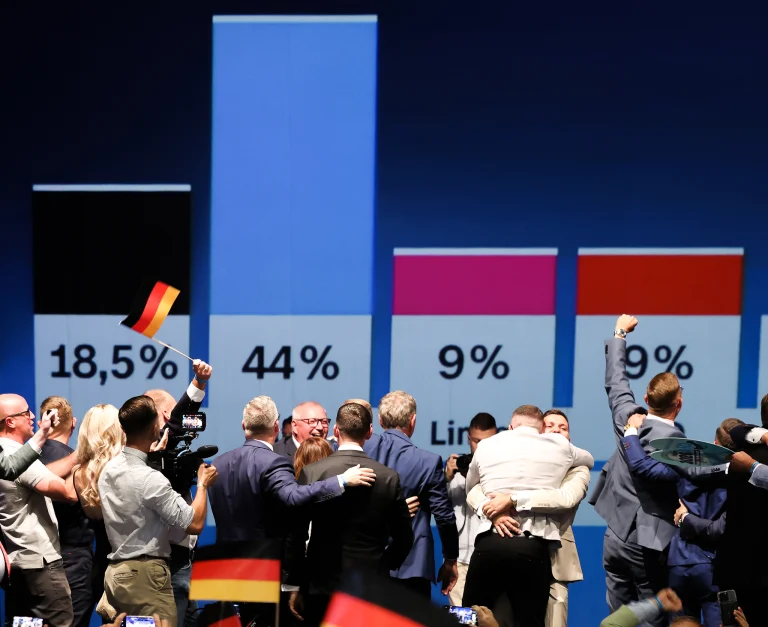
The phrase “if we take responsibility” is therefore more than political boilerplate in this context. And the economic test of that responsibility is already staked out on the outskirts of Magdeburg.
The €30bn Project Intel Left Behind
In the Eulenberg industrial park, US chipmaker Intel originally planned to build two state-of-the-art semiconductor factories. More than €30bn ($34.8bn) was to be invested. The plans envisaged 3,000 permanent jobs at Intel, 7,000 construction jobs and tens of thousands more among suppliers.
Olaf Scholz, then chancellor and an SPD politician, described the project as the largest foreign direct investment in German history. Berlin offered almost €10bn ($11.6bn) in subsidies. The fields outside Magdeburg were to become nothing less than Europe’s answer to its dependence on Asian and American chips.
The project was first delayed and eventually canceled. Intel itself halted the plans in July 2025. The company had committed too early to too much production capacity worldwide, while the expected demand failed to materialize. Projects in Poland and Costa Rica were also scrapped at the time, while expansion in the US state of Ohio was slowed. Magdeburg’s loss was therefore not solely the result of Germany’s business environment. That did not, however, make the empty site any smaller.
On 22 May 2026, a state-owned company bought back the roughly 400-hectare Intel site. It is now part of a high-tech park covering a total of 1,100 hectares. Instead of one global corporation, Saxony-Anhalt is now seeking several companies in microelectronics, artificial intelligence, energy and environmental technology.
The first prospective investors have emerged. Only last week, the state signed letters of intent with two interested parties. One is Dresden-based memory-chip developer FMC, which is planning a €3bn ($3.5bn) factory. The second is a semiconductor manufacturer whose name has not yet been disclosed. FMC has yet to secure its financing. The site still lacks the necessary electricity and water infrastructure.
Musk’s Billions and the Subsidy Question
This is where Siegmund’s outreach to Musk becomes politically interesting. In its state election manifesto, the AfD calls for support for small and medium-sized businesses rather than the “subsidizing of globalist corporations”. It explicitly cites Intel as a cautionary example. Almost €10bn ($11.6bn) in state support for 3,000 direct jobs would have amounted to more than €3m ($3.5m) in subsidies from German taxpayers for each worker.
Siegmund is therefore courting one of the world’s most powerful entrepreneurs even as his party promises to stop luring corporations of precisely this kind to empty greenfield sites with billions in subsidies. The two are not necessarily contradictory. The AfD argues that it can attract investment in the future through better conditions rather than ever larger payments from the public purse.
To put that into practice, it wants, for example, to consider creating special economic zones with lighter regulation, cut state bureaucracy and repeal two existing rules for every new one introduced. If authorities miss their decision deadlines, an application would automatically be deemed approved. A state government could also provide infrastructure for the high-tech park, accelerate permitting and help ensure that enough skilled workers are available.
It cannot, however, unilaterally reduce nationwide energy levies or lift European sanctions. Decisions on multibillion-euro funding packages and state aid are also made in Berlin and Brussels, not by a state government. Even FMC, the potential successor to Intel, is therefore negotiating with the federal government and the EU over financial support, not with the government of Saxony-Anhalt.
For Siegmund, Musk would offer the clearest possible proof that his strategy can work. Tesla has already built its first European Gigafactory in neighboring Brandenburg.
If Siegmund does indeed become minister-president, his economic promise already has a 400-hectare test case waiting outside Magdeburg. On X, Musk needed only two words. At Eulenberg, the AfD and the US billionaire could turn them into action.