Europe Cuts Carbon While Asia Doubles Down on Coal
For years, Europe assumed that if it moved first on climate policy, the rest of the world would eventually catch up. That bet has not paid off. Brussels is now trying to reconcile its emissions targets with the growing threat to its own competitiveness.
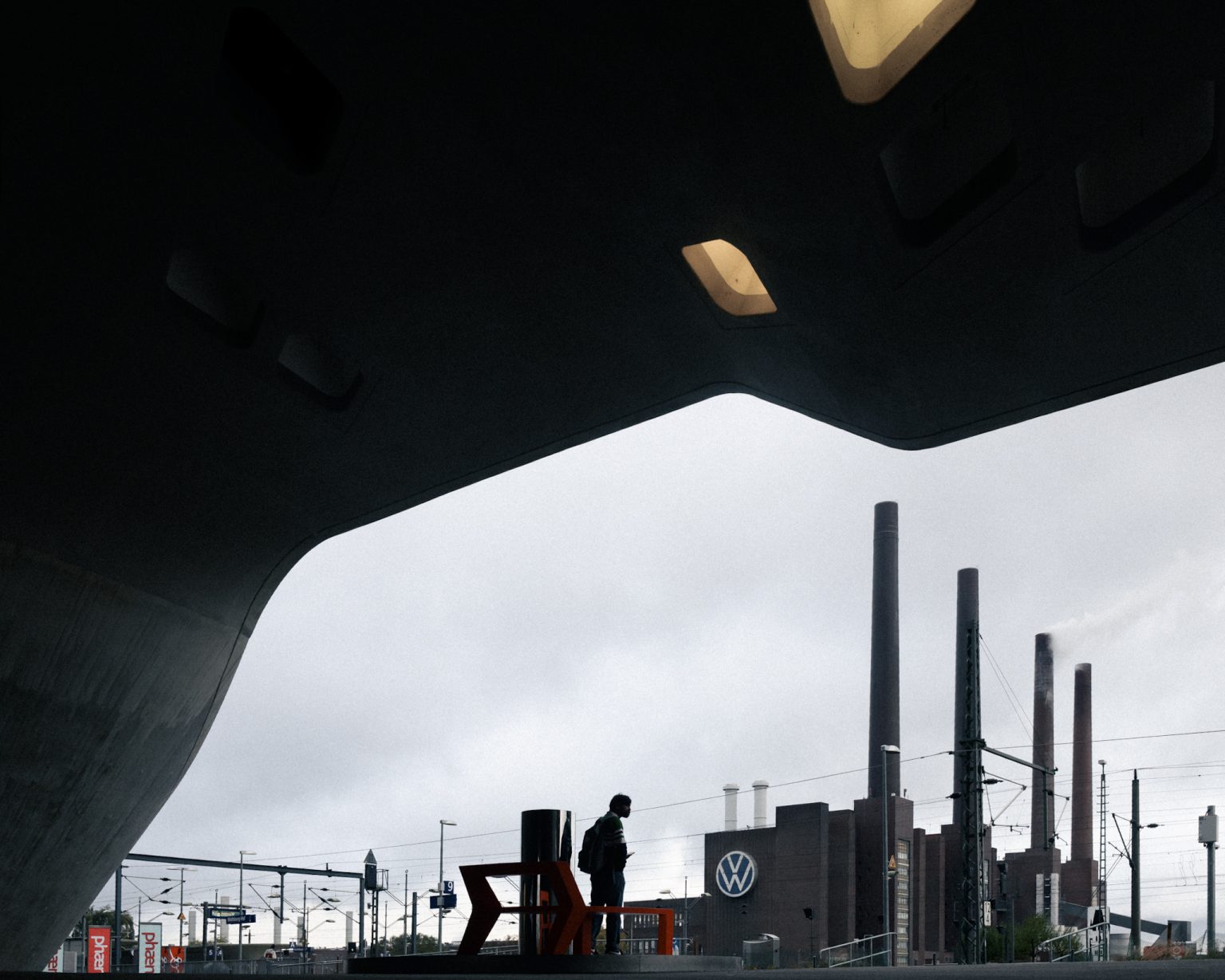
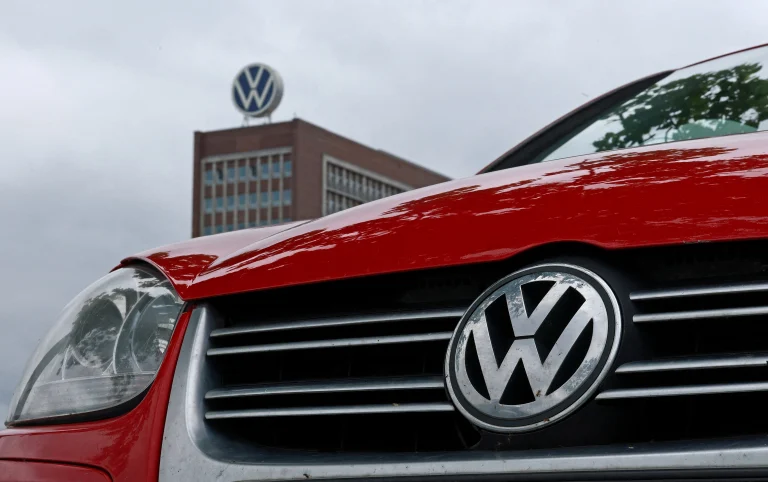
Automakers like Volkswagen are among the industries most exposed to Europe\'s rising cost of decarbonization. Photo: Julian Stratenschulte/picture alliance via Getty Images
|
In mid-July 2026, with its industry buckling under pressure, the European Commission offered a tactical concession: a reform of the Emissions Trading System (ETS 1). Brussels has not abandoned its goal of cutting net emissions by 90% by 2040, but the proposal marks the first real admission that its climate model is reaching its limits.
For decades, the European Union has subordinated economic policy to the fight against climate change, pushing through ever stricter regulations. The rest of the world has not followed suit.
The economic data lay bare the gap between European doctrine and global reality. Even a successful ETS reform will do nothing to change the state of the global climate. What it will do is accelerate the outflow of capital from Europe, the deindustrialization of the Old Continent and the relocation of production to Asia.
The Global Divide: Sacrifice for Europe, Reward for Asia
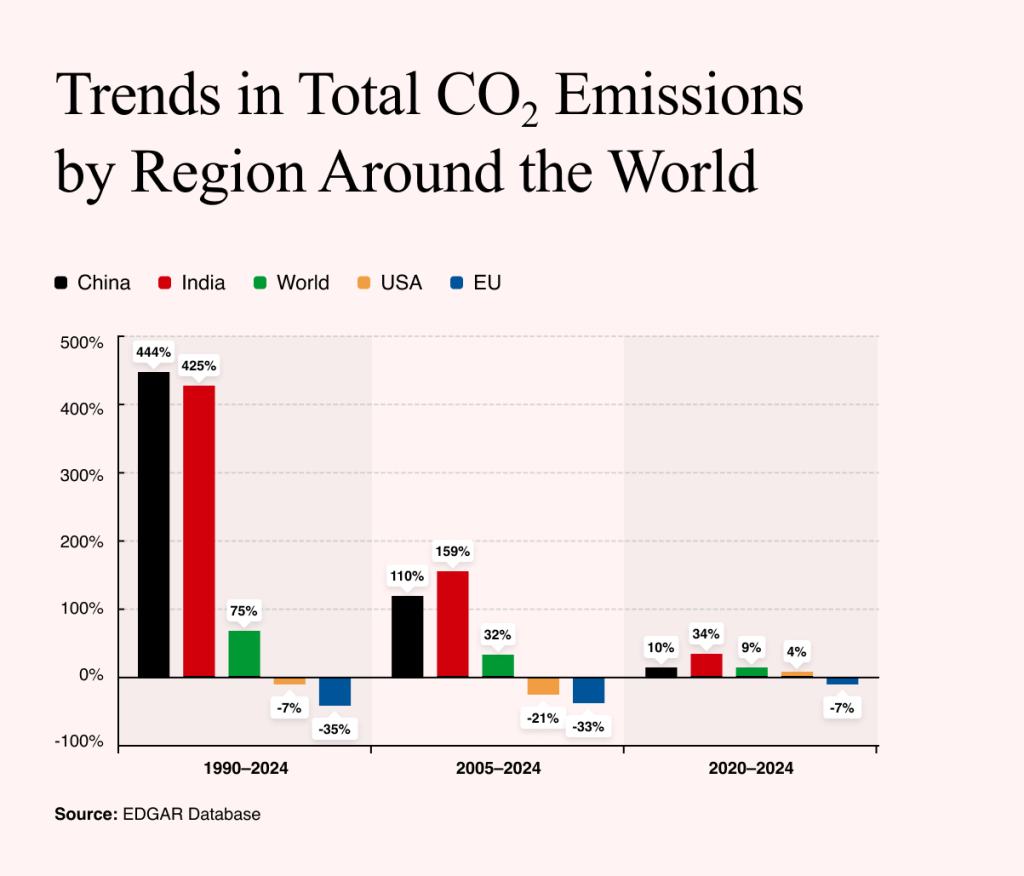
A detailed analysis by Diana Motuzova of Klub 500 shows how drastically the distribution of global emissions has shifted over the past three decades. Since 1990, CO2 emissions in the European Union have fallen by approximately 35%, while global emissions have risen by 75%.
Asia's economic miracle has come at a price that dwarfs anything Europe has achieved. In China, emissions were approximately 444% higher in 2024 than in 1990. In India, they were 425% higher.
The same pattern holds for the more recent past. Between 2020 and 2024, the EU cut emissions by a further 7%, while China's rose by 10% and India's by as much as 34%.
In absolute terms, China emitted 10.7 billion more metric tons of CO2 in 2024 than in 1990, an increase that alone accounted for nearly two-thirds of the total global rise. Over the same period, the EU's emissions fell by approximately 1.3 billion metric tons.
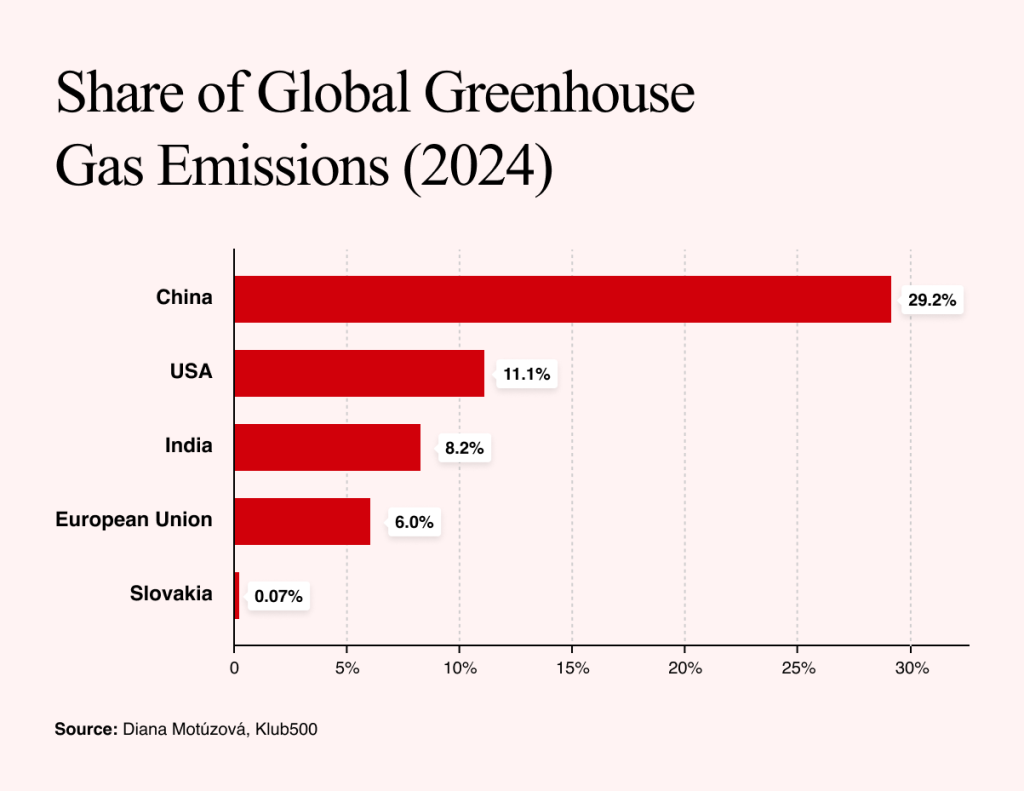
China now emits nearly five times as much as the entire EU. A single year's fluctuation in Asian output can easily wipe out the savings that European households and businesses achieve annually, at the cost of enormous financial sacrifices.
Cutting Emissions by Closing Factories
The claim that strict regulation fuels green growth does not survive contact with the data. Between 1990 and 2023, value added by China's industrial sector grew by nearly 5,000%, even as emissions from fuel combustion in manufacturing and construction rose by 357%. In the European Union, emissions fell by more than 30%, but industrial value added grew by only 109%.
Institutions including the European Central Bank (ECB), the Brussels-based European Roundtable on Climate Change and Sustainable Transition (ERCST) and the research organization Enerdata have repeatedly warned that the EU's falling emissions owe less to technological progress than to the decommissioning of industrial capacity and shrinking output. Europe is not using less energy because it has become dramatically more efficient. It is using less energy because its factories are shutting down.
Asia has taken the opposite path. While the EU phases out coal-fired power and burdens its businesses with steep fees, China alone commissioned 1,196 gigawatts (GW) of coal-fired capacity between 2000 and 2025, compared with just 27 GW added across the entire EU.
As of January 2026, China had more than 500 GW of coal capacity under construction or in planning, some 70% of the global total. China and India together consumed 71% of the world's coal last year.
The atmosphere, as Motuzova's analysis makes clear, does not distinguish between a metric ton of CO2 emitted from a steel mill in Kosice, Beijing or Mumbai. Green regulations, however, are felt very differently depending on where they are enforced.
Brussels Blinks on Its Own Climate Rules
Facing the prospect of a systemic collapse of its industrial base, the European Commission unveiled its long-awaited proposal to reform the ETS 1 on 17 July 2026. It is a pragmatic attempt to keep strategic production within the EU without formally abandoning the target of cutting net emissions by 90% by 2040.
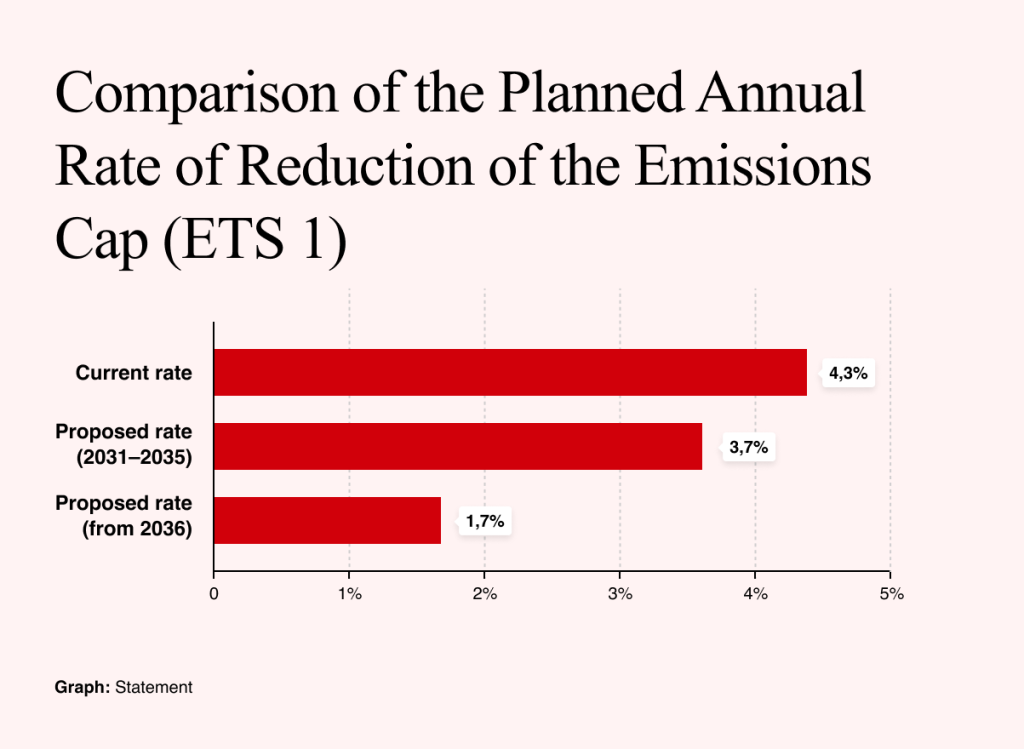
The reform would slow the annual reduction in the emissions cap, from the current 4.3% a year to 3.7% starting in 2031, and to 1.7% starting in 2036. In practice, that means allowances will disappear from the market far more gradually than planned.
The Commission also proposes extending free allocation of allowances for key sectors, such as steel and cement producers, until 2038, four years later than originally scheduled.
Companies that submit a decarbonization plan for the EU would receive 80% of their free allowances upfront, with the remainder made available only once the investments are made. At least half of the roughly €260bn ($296bn) raised by the ETS since 2013 would be channeled into modernizing industry through a planned Industrial Decarbonization Bank.
The reform would also expand the ETS to cover smaller ships and international flights departing the EU for destinations up to 5,000 km away, a change aimed primarily at routes through Turkey and the Middle East. Flights to the US, notably, are not covered.
Inside the EU's Three-Way Fight over Climate Policy
The Commission's proposal immediately ran into political resistance. Three camps have formed within the EU, and their negotiations over the coming year will determine the reform's final shape.
The first camp, defenders of the "green" doctrine, includes Denmark, the Netherlands, Sweden, Finland, Ireland, Spain, Portugal, Luxembourg, Austria and France, the last of which conditions its support on recognition of nuclear power. These countries want the strict rules preserved, arguing that any retreat would penalize companies that already invested in green technology and shift the burden onto agriculture instead.
A second, larger bloc of 14 countries, grouped under the banner of "economic realism" and including Slovakia, the Czech Republic, Poland, Italy, Hungary, Romania, Bulgaria and Greece, is pushing for far more significant concessions. Ten of them also object to making free allowances conditional on investment.
Their objection has a budgetary logic. Governments currently keep ETS revenue in their own accounts, which flatters the public finances. Tying allowances to modernization plans would force factories short of capital to draw on state funds instead, meaning governments would actually have to spend that ETS revenue on industry, making their budgets look worse on paper.
Slovakia's ministry of the environment, led by Tomas Taraba, has repeatedly insisted that allowance revenue must not end up in speculative funds but should go directly to domestic companies such as US Steel and chemical producers.
The Visegrad Group (V4) has also categorically rejected the planned 2028 launch of ETS 2, which would impose charges on gasoline, diesel and natural gas for households and drive up prices significantly.
The third camp is an undecided center, represented by Germany and Belgium. Their governments remain publicly committed to the green agenda, but with their automotive and chemical sectors under strain, both are quietly pressing for exemptions to protect domestic industry.
The logic behind the ETS was sound: put a price on emissions and let the market find the cheapest technological way to cut them. Europe bet that this would make it a global leader others would follow. That bet has not paid off.
The US chose a different route, relying on massive government subsidies through the Inflation Reduction Act and cheap domestic natural gas. China, meanwhile, has paired state subsidies with a build-out of coal-fired power alongside renewables.
Europe has been left to enforce its strict green rules alone. Compounding the problem, emissions allowances, now trading at around €79 ($90) per metric ton of CO2, have become a financial asset in their own right, bought up by speculative funds in New York and London whose trading artificially inflates prices and piles further costs onto European industry.
Even if the EU eliminated its emissions overnight, 94% of the world's emissions would remain untouched. Absent coordinated action by the world's major emitters, Europe's self-imposed restrictions do little for the climate while doing serious damage to its own economy.
If Europe wants to offer the world a genuine model for a successful green transition, it needs to prove it can produce steel, cement, fertilizers, cars and chemicals more cleanly while staying competitive, not simply produce less of them. A model built on industrial decline will hold no appeal for China, India or other developing economies.
Welcome to the comments section of the Štandard daily. Please take note of our guidelines, comments are moderated by us. You can contact the moderators at support@statement.com.
Participate in the discussion
Comments are available to subscribers only. If you'd like to join the discussion, choose a subscription starting at €6.72 per month.
All comments 0
Register
Comments are available to registered users only. If you'd like to join the discussion, register here.