War, it seems, has only been postponed, yet Wall Street is already celebrating record highs. Depleted missile stockpiles and the promise of a fragile 60-day ceasefire with Iran turned out to be enough to fuel the rally.
Optimism over a truce with Iran has been enough to send global markets to record highs. Photo: Timothy A. Clary/AFP/Profimedia
|
Financial markets around the world responded to the prospect of an agreement between Iran and the US with an enthusiasm that sat oddly against the events of the past few days. Only days earlier, Donald Trump had threatened the entire Iranian regime with overthrow or with what he called the largest attack since the start of World War II.
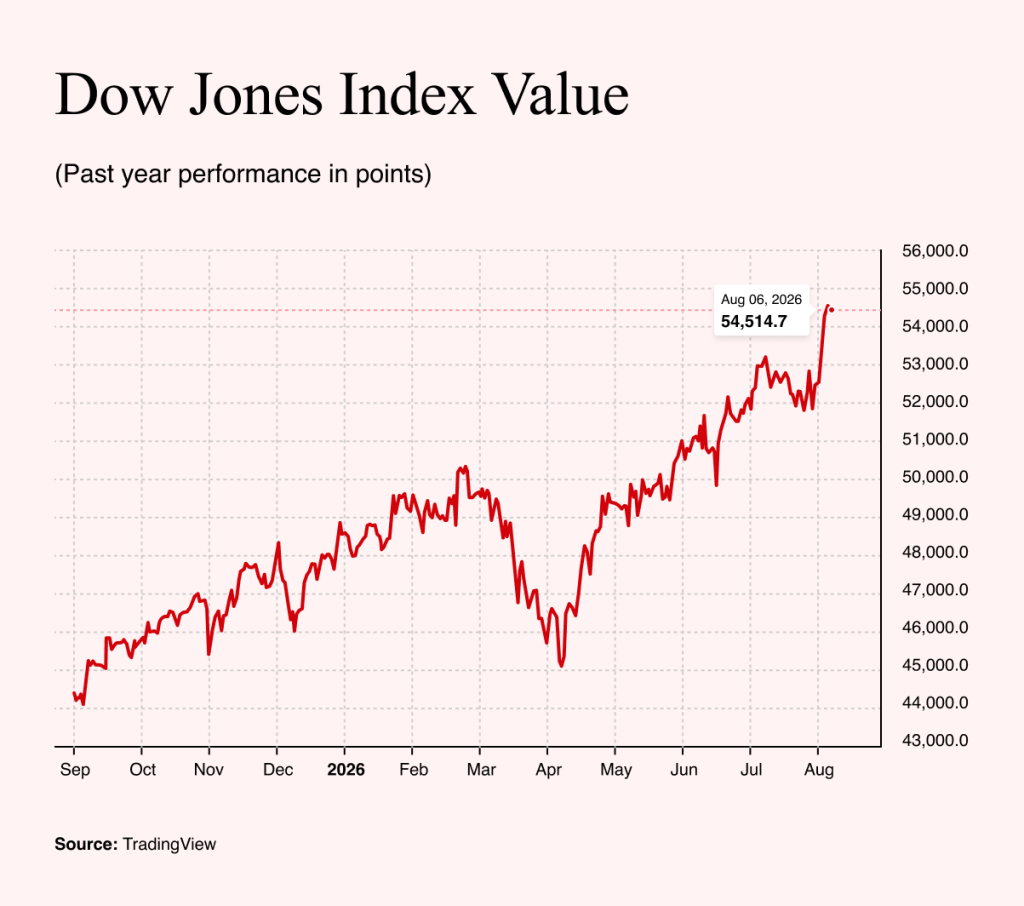
None of the threatened military action has come to pass. On the contrary, a new peace agreement, valid for 60 days, appears close. The Dow Jones Industrial Average surpassed the 54,000-point mark for the first time in its history.
Source: TradingView
The S&P 500 also closed at a record. More striking still, European stock markets reached record highs of their own, despite an economic outlook that remains bleak. Taken at face value, a chart of global markets would suggest that the world economy is thriving and a boom is close at hand.
Markets Are Betting on Optimism, Not Certainty
A positive catalyst was, of course, the news of an impending agreement that would reopen the Strait of Hormuz to shipping.
What is interesting about the situation is that since Sunday, the US has insisted a deal is close, while the Iranian regime has denied any negotiations are underway.
It was difficult to make sense of this information fog from the start, but the markets, as so often in this conflict, opted for the more optimistic scenario. Oil prices plummeted, inflation expectations eased, and everyone could breathe a sigh of relief.
America's Clock Is Ticking Faster Than Iran's
On the positive side, there are reasons this agreement might last longer than the last one.
The first is military supplies. Reuters reported that the US has used up "virtually all" of its long-range precision-guided missiles, meaning Washington no longer has the resources to continue the conflict with Iran as it has done so far.
The White House, naturally, denied this. Trump declared that the US military still has large stockpiles. But he could hardly have said otherwise. Publicly admitting that ammunition depots are empty would weaken his own negotiating position, and a man who has built his career on negotiation would not make such a schoolboy error.
The Reuters report therefore seems credible, and did not arise by chance, even if it is not entirely accurate. The exact size of the stockpile is undoubtedly a military secret, but the shortage is confirmed above all by the transfer of weapons from other bases. No stockpile is inexhaustible, and America must already be conserving what it has left. The US thus has every incentive to reach an agreement.
The second reason is the approaching political calendar. With the November elections drawing near, and given the lag between oil prices and prices at the pump, now is the moment for fuel prices at American gas stations to start falling. The Iranian Revolutionary Guards are surely aware of this too. Their negotiating position is therefore stronger for now, and they may try to press their advantage further to extract concessions.
At its core, the entire conflict comes down to freedom of passage through the Strait of Hormuz, and the right to collect tolls from ships transiting it. There is something absurd in that: before the conflict began, ships passed through the strait freely, without paying a cent.
Tech Stocks Ride the Wave Once More
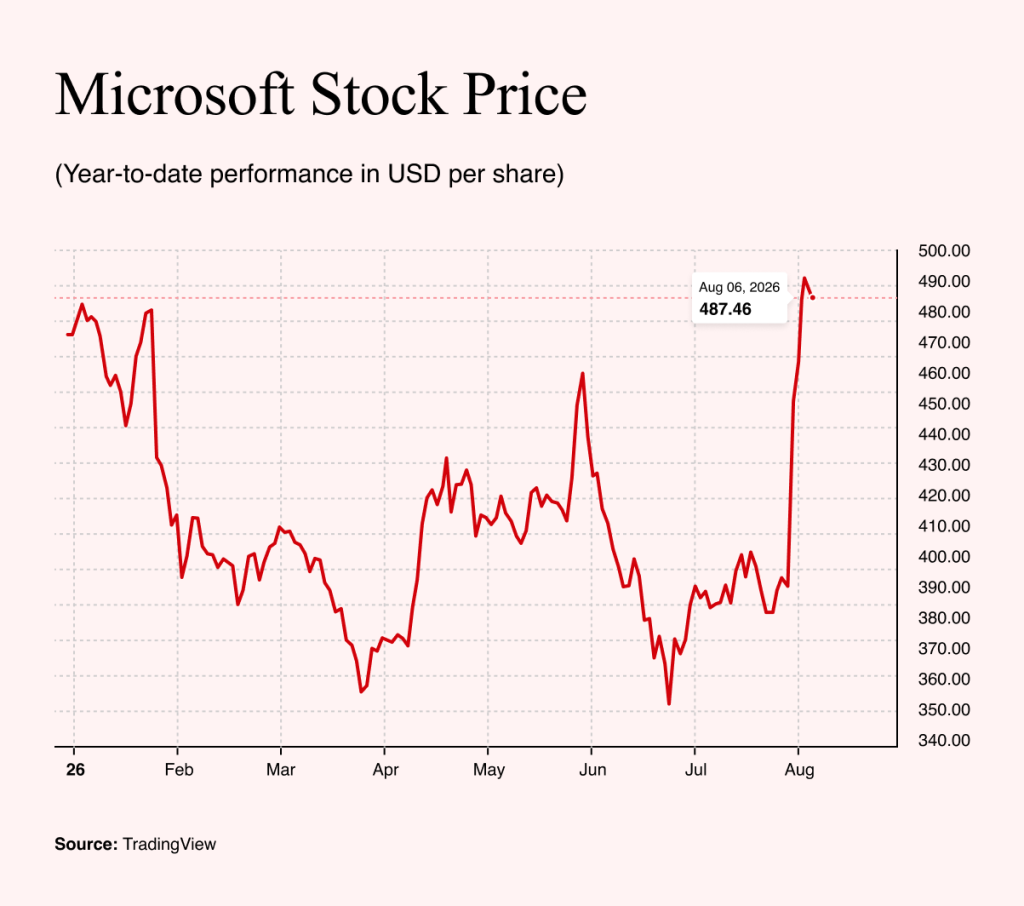
Falling oil prices and the emerging peace agreement have given tech stocks further room to run. The frenzy surrounding Microsoft shares continued unabated, with the stock climbing more than 26% over the past few days. Given that Microsoft is not a small company but the fourth-largest firm in the world by market capitalization, that gain represents a staggering increase in value. Microsoft has effectively pulled the entire tech sector along with it, which has added $1.8tn in value over the same period, an increase roughly equivalent to Italy's annual GDP.
Source: TradingView
This growth owes less to any fundamental reassessment of the artificial intelligence narrative than to investors' fear of missing out. Last week's sell-off in tech stocks has, for now at least, created a temporary bottom.
After several waves of declines across the tech sector and AI-related companies, the market claimed its first victim: the Situational Awareness fund, led by Leopold Aschenbrenner, a young former OpenAI researcher.
Aschenbrenner had wagered very aggressively on continued growth in AI-related stocks. The problem was not so much the bet itself as its scale and the heavy use of financial leverage. Once tech stocks began to fall, the losses multiplied quickly. The fund's portfolio value plummeted by 67% in July, forcing it to sell most of its publicly traded shares to Citadel.
It has always been the case that markets find a bottom once a major fund collapses. That is the sign the market has claimed its victim, and this time it got one. This matters for understanding the current rally. For now, it need not signal a new wave of euphoria around artificial intelligence. Part of the movement is simply technical: forced selling has ended, investors have closed out their short positions, and those who sat on the sidelines during the sell-off have begun to return.
This rally will likely continue until another fund betting on endless stock price growth collapses in turn. There may be nothing wrong with that, but the fall of the Situational Awareness fund is a reminder of a fundamental rule of leveraged trading: success on the stock market does not mean an investor understands everything, or is wiser than the rest of the market. More often, it simply increases their appetite for risk. The hardest part is not letting past success convince you that you can no longer make a mistake.
In short, the past week has shown just how little the market needs today to reach new all-time highs. It does not need a permanent peace agreement, only the promise of a temporary memorandum. It does not need confirmation of a shift in the inflation trend, only a few days of falling oil prices. It does not even need a new narrative around artificial intelligence. For tech stocks to rise, it is enough that investors feel they are missing the boat.
All problems have simply been set aside. And so the path to new stock market records has opened up once again.
Welcome to the comments section of the Štandard daily. Please take note of our guidelines, comments are moderated by us. You can contact the moderators at support@statement.com.
Participate in the discussion
Comments are available to subscribers only. If you'd like to join the discussion, choose a subscription starting at €6.72 per month.
All comments 0
Register
Comments are available to registered users only. If you'd like to join the discussion, register here.