Will Germany’s Baby Boomers Finally Make Homes Cheaper?
Younger buyers hope millions of inherited homes coming onto the market will finally bring down prices. But forecasts suggest the biggest bargains will emerge mainly where demand is already weak.
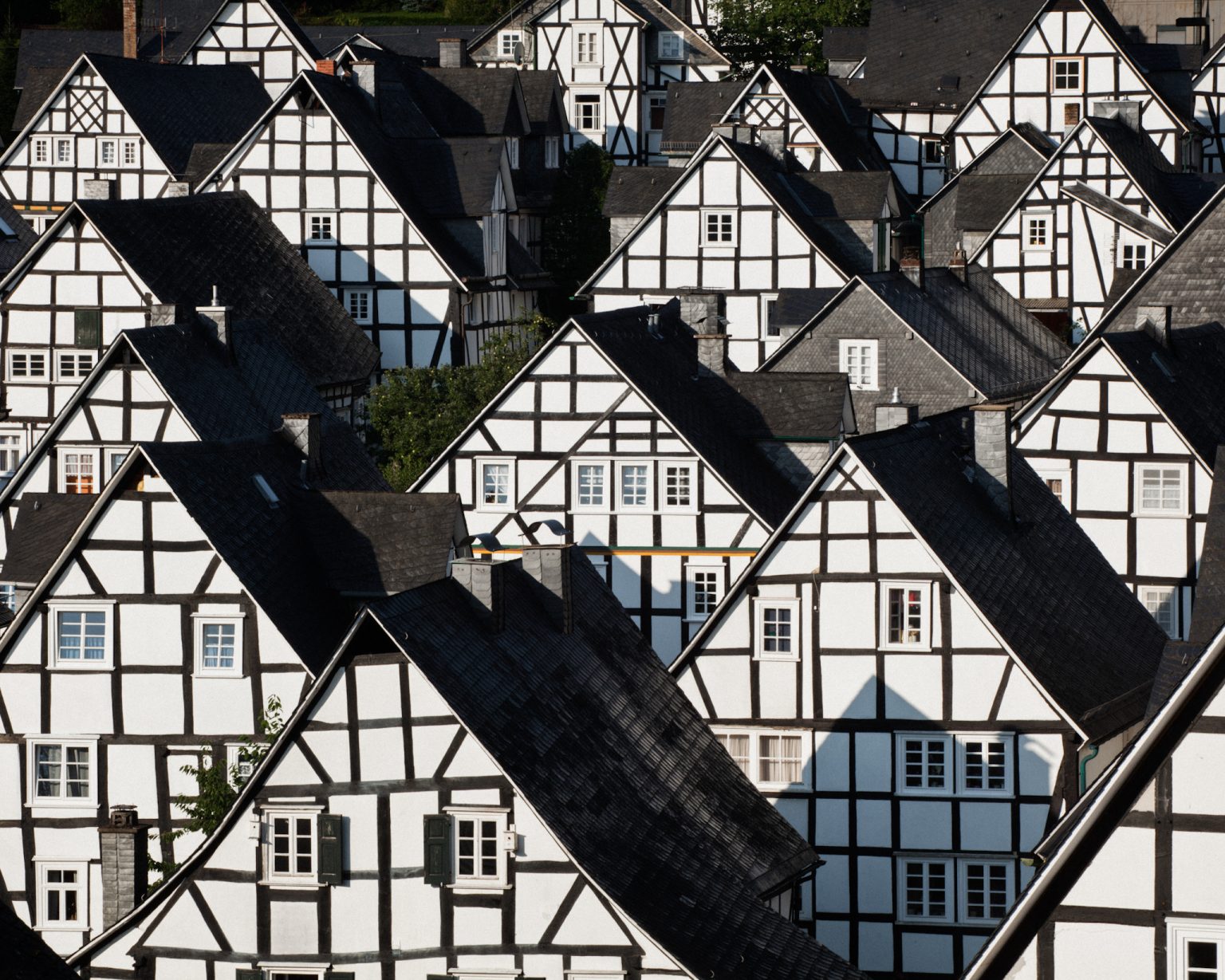
Old houses in Freudenberg, Germany: inherited homes may be cheaper, but often sit in low-demand areas and require costly renovations. Photo: Jorg Greuel/Getty Images
|
The hopes of many young people are based on a simple demographic calculation: millions of baby boomers own houses and apartments. As these properties come onto the market, supply will increase and prices will fall. For younger families who have been priced out of homeownership in recent years, this might create a long-awaited opportunity. Based on the data currently available, however, those hopes may prove misplaced. The coming transfer of property ownership will unfold over decades and will be concentrated particularly in regions where buyers are already scarce.
For now, residential property prices in Germany are rising again. In the first quarter of 2026, the house price index was 1.4% higher than a year earlier. Since 2010, prices for single-family and two-family homes as well as apartments have risen by around 82% nationwide, according to the Federal Statistical Office’s Construction and Real Estate Price Index.
The age of Germany’s baby boomers also argues against an imminent flood of properties coming onto the market. The commonly used birth years of 1946 to 1964 refer to the US. In Germany, the particularly strong birth cohorts span the years from 1955 to 1969. Births peaked in 1964 at 1.36 million, according to official birth statistics. Germany’s actual baby boomer generation is therefore between 57 and 71 years old in 2026.
An analysis by real estate platform Jacasa estimates that baby boomers own around 4.8 million residential properties. That would represent 32% of owner-occupied properties under the model. In parts of eastern Germany and traditional industrial regions in the west, the model attributes more than 40% of owner-occupied properties to the baby boomer generation.
The estimate is based on a combination of census data, regional homeownership rates and demographic data. Germany has no nationwide registry that identifies property owners by year of birth.
The Slow Boomer Sell-Off
Berlin-based research institute empirica considers the image of a “Silver Tsunami”, currently circulating widely in the media, misleading. The baby boomer generation spans around 15 birth years. Deaths within each cohort will also be spread over many years. According to the institute’s calculations, the transfer of baby boomer properties will therefore take place over roughly 35 years. The transfer of wealth will come in many smaller waves that the market can absorb more easily.
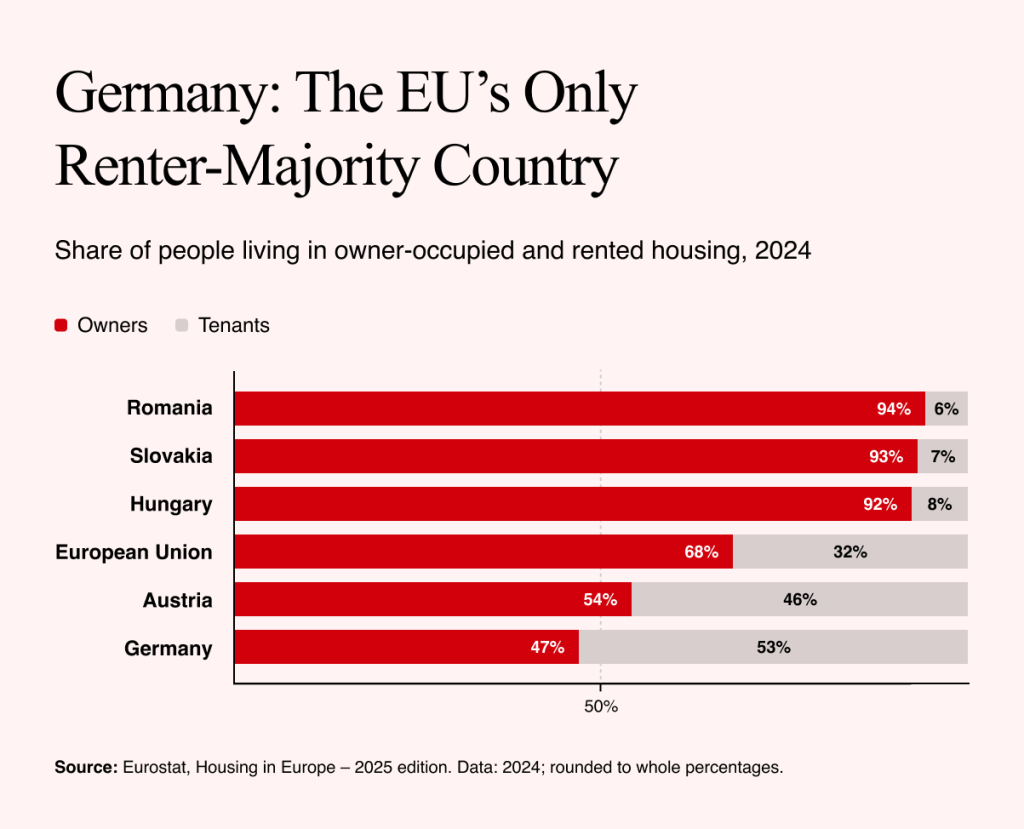
In Germany, inheriting a house can provide a path to homeownership. In 2024, 53% of the population lived in rented accommodation, making Germany the only EU country where a majority of people rented their homes. By contrast, 94% of people in Romania lived in owner-occupied households, compared with 93% in Slovakia and 92% in Hungary, according to Eurostat.
That is in part because German's tax code penalizes those who buy a property to live there, rather than to rent it out. A recent study by the German Economic Institute (IW) found that buying a €300,000 ($346,200) apartment in a major city in order to live there would cost the owners as much as €87,000 ($100,400) over 15 years compared to a landlord who bought the same property to rent. Unlike owner-occupiers, landlords can claim for certain costs, like interest on loans.
Source: Eurostat, Housing in Europe – 2025 edition. Data: 2024; rounded to whole percentages.
It is also worth asking why the heirs should sell properties they inherit from their Boomer parents. There is no automatic reason to do so. Often, the surviving partner initially remains in the house. The children may later move in themselves or rent out the property.
A sale becomes more likely if the heirs live far away, if several heirs need to divide the value of the property or if renovation and care costs require additional funds. Inheritance tax can also create pressure to sell, although it does not apply to every home.
Each child is entitled to a tax-free allowance of €400,000 ($462,000). A family home can also remain exempt from inheritance tax if a child moves in without delay and uses it as their own residence for 10 years. For children, the exemption is limited to a living area of 200 square meters.
The 4.8 million residential properties therefore represent an estimated stock of homes that could change ownership. They are not a forecast of 4.8 million properties coming onto the market.
The Cheapest Homes Are Often in the Wrong Areas
For property prices, location matters more than the owner’s year of birth. In major urban areas, homes coming onto the market face strong demand driven by population growth, jobs and years of insufficient new construction. A forecast by the German Economic Institute (IW) and the National Association of German Cooperative Banks therefore expects prices to rise nationwide despite demographic change.
The median price per square meter is projected to increase from €3,024 ($3,490) in 2025 to €4,092 ($4,720) in 2035. Assuming inflation of 2%, that would correspond to an average real increase of 1.1% per year. For Germany’s seven largest cities, the study forecasts annual real growth of just over 2%, rising to 2.4% in Berlin.
Price declines are likely to be concentrated in shrinking regions where buyers are already scarce. The IW forecast expects real prices to fall by 2035 primarily in Saarland, Saxony-Anhalt and Thuringia. Rhineland-Palatinate, Saxony and North Rhine-Westphalia are projected to see little change.
Even these state-level figures conceal stark differences. Brandenburg is expected to record average real growth of 1.6% per year, even though the Uckermark has the highest estimated share of baby boomer-owned properties. Berlin’s pull and weak demand in some rural districts effectively create two very different property markets within the same state.
The condition of older properties adds another factor. A low purchase price can quickly lose its appeal when a property requires a new roof, a heating system or extensive energy-efficiency renovations. According to Destatis, residential construction prices rose by 89% between 2010 and 2025, compared with overall inflation of 38% during the same period. In May 2026, construction costs rose by another 5% from a year earlier.
The biggest discounts are therefore likely to emerge in the 14 districts where a high share of baby boomer-owned properties already coincides with high vacancy rates. In Altenburger Land, almost one in seven homes already stands empty, 18 years before Germany’s largest baby boomer cohort turns 80.
Welcome to the comments section of the Štandard daily. Please take note of our guidelines, comments are moderated by us. You can contact the moderators at support@statement.com.
Participate in the discussion
Comments are available to subscribers only. If you'd like to join the discussion, choose a subscription starting at €6.72 per month.
All comments 0
Register
Comments are available to registered users only. If you'd like to join the discussion, register here.