EU’s New Packaging Rules May Well Send Small Businesses Packing
It is too early to say whether the European Union's latest packaging regulation will reduce packaging waste. It is not too early to say it will add considerably the red tape businesses are required to navigate.
Part of the European Union's founding purpose, pursued chiefly through the creation of the Single Market, has been to simplify the business of trading across the bloc's member states. This week's latest round of regulation, aimed at Europe's packaging waste, looks set to undercut that very aim for small businesses, burying them instead under a fresh layer of red tape.
Businesses, unions and associations have already come out swinging against the Packaging and Packaging Waste Regulation (PPWR), which came into force in February last year and became generally applicable across the EU this week.
Europe's largest ecommerce association, Händlerbund, is sounding the alarm over several of the PPWR's mandatory requirements. Chief among them is the obligation of producers to appoint an authorized representative in every country they plan to ship to, in order to ensure compliance with the new packaging regime.
"The EU Packaging Regulation requires one authorized representative per destination country – without minimum quantities or exceptions. For small and medium-sized retailers, cross-border shipping is therefore often no longer worthwhile", the German association warned.
Producers, or anyone shipping goods to another EU country, were already required under the previous EU scheme to register and license their packaging in the destination country.
The new arrangement goes further: an authorized representative will now be required in every country a producer plans to ship to, regardless of shipment volume or unit quantity. The obligation applies from the very first item a company sends.
The reality of the PPWR looks set to run counter to the EU's own claims, embedded in the regulation itself, that it confers something of a harmonization benefit on companies.
Being a regulation rather than a directive, the PPWR does not need to be transposed into national legislation. It is directly applicable across the EU. In theory, that means one set of rules instead of 27. In practice, it means one harmonized legal framework, but many separate national systems for companies to navigate as they sell into countries other than their own.
Händlerbund is far from alone in raising the alarm. The inconvenience of the PPWR is dawning on small businesses across the continent, and national media in member states are increasingly reporting on their concerns.
Deutsche Welle reported that the owner of Monstaas Workshop, a small online store, described the cost of appointing an authorized representative in each EU country he shipped to as "simply not affordable".
A German Bitcoin education organization, Blocktrainer, has likewise suspended its shipping service to other EU countries, citing a "regulatory project" involving different registries, reporting obligations and fees.
In Ireland, meanwhile, an island economy heavily reliant on exports, the media reports small retailers describing what they now face as an "effective export ban".
A Sudden Change of Heart
Forced to respond to a wave of concern, the European Commission has apparently backtracked since the regulation began applying on Wednesday, doing so via comments on Instagram posts complaining about the PPWR.
The Commission's solution? National authorities responsible for enforcing the regulation should avoid sanctioning non-compliant companies and issue a warning instead. In other words, it is advising them to overlook its own regulation because that regulation has proven wildly unpopular.
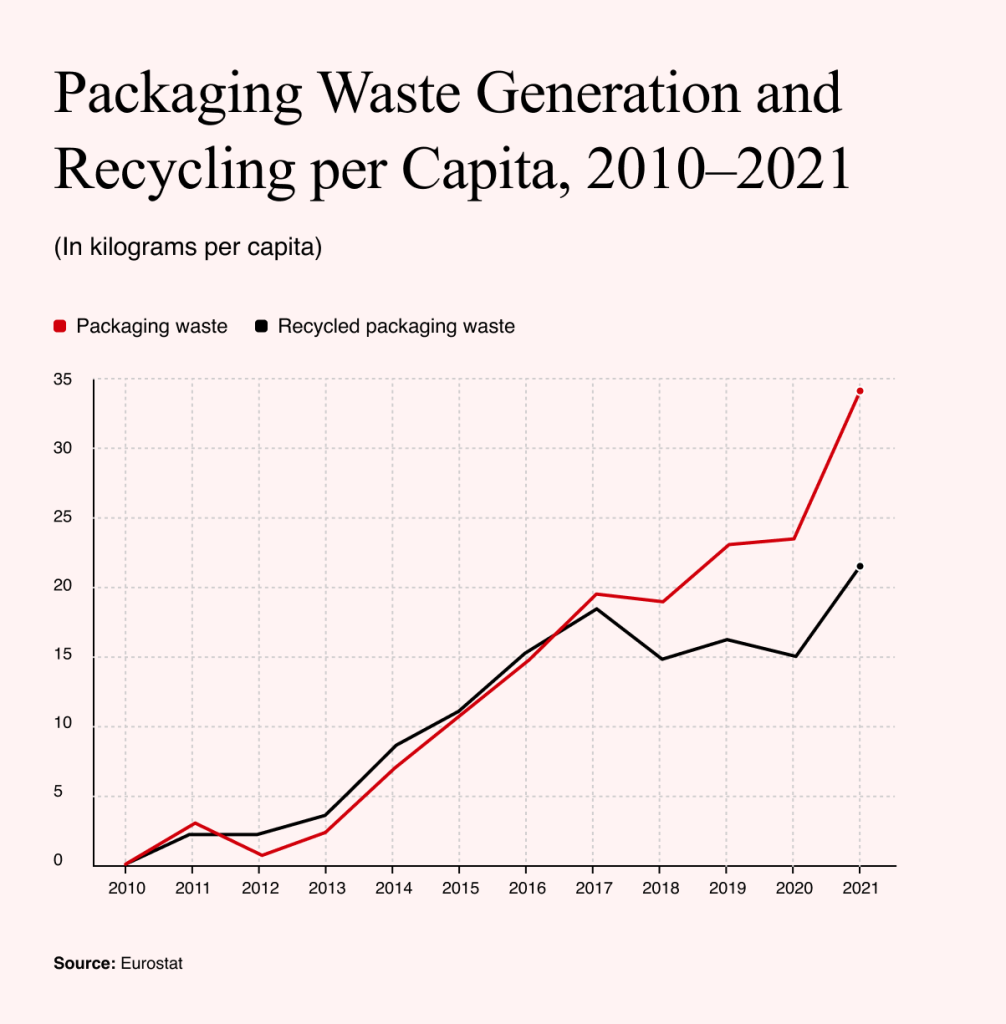
The Council of the European Union justifies the PPWR by pointing out that, without action to tackle packaging waste, the total could rise by 19% by 2030, on top of a 24% increase between 2010 and 2021. In 2021 alone, EU countries generated 84 million tonnes of packaging waste.
That rise came despite a 23% increase in the EU's recycling rate over the same 11-year period.
Source: Eurostat
Nevertheless, such statistics are unlikely to calm European businesses and consumers, who find their lives complicated once again by a poorly conceived regulation whose effects on everyday life will soon be felt.
The Council's initial social media post held up, as one of the regulation's selling points, the fact that from 2027 consumers would be expected to bring their own containers for takeaways and similar products.
It is remarkable that, in the years-long process required to steer a regulation through the European Union, problems immediately apparent to the public caused so little alarm among its drafters.
Emblematic of the blind bureaucratic spirit currently stifling the continent, the PPWR may or may not succeed in reducing packaging waste across Europe. But if the early indicators are any guide, it will also dampen industriousness and entrepreneurial spirit, an outcome that seems to be the by-product of practically every regulation to emerge from Brussels of late, whatever its stated intention.
Welcome to the comments section of the Štandard daily. Please take note of our guidelines, comments are moderated by us. You can contact the moderators at support@statement.com.
Participate in the discussion
Comments are available to subscribers only. If you'd like to join the discussion, choose a subscription starting at €6.72 per month.
All comments 0
Register
Comments are available to registered users only. If you'd like to join the discussion, register here.