The performance of an economy depends on many factors. One of them is government spending as a percentage of gross domestic product (GDP). A well-known remark attributed to former German chancellor Helmut Kohl holds that socialism begins once the state’s share exceeds 50 per cent. The higher the proportion of money managed by the state, the greater the influence of public finances on the wider economy. As a general rule, welfare states tend to have higher spending levels than more economically liberal systems such as the US, where the figure stands at just under 38 per cent this year.
A commonly cited argument is that every euro passing through the state ultimately loses value. Of each euro administered by the state, collected through taxes and levies and then redistributed according to its own criteria, experts estimate that between 5 and 15 per cent is absorbed by administrative costs. In other words, of every euro in tax revenue, only 85 to 95 cents return to citizens in the form of investment or social benefits. The higher the level of government spending, the greater the losses relative to GDP – and thus the amount no longer available to households and businesses.
Welfare Systems Generate High Costs
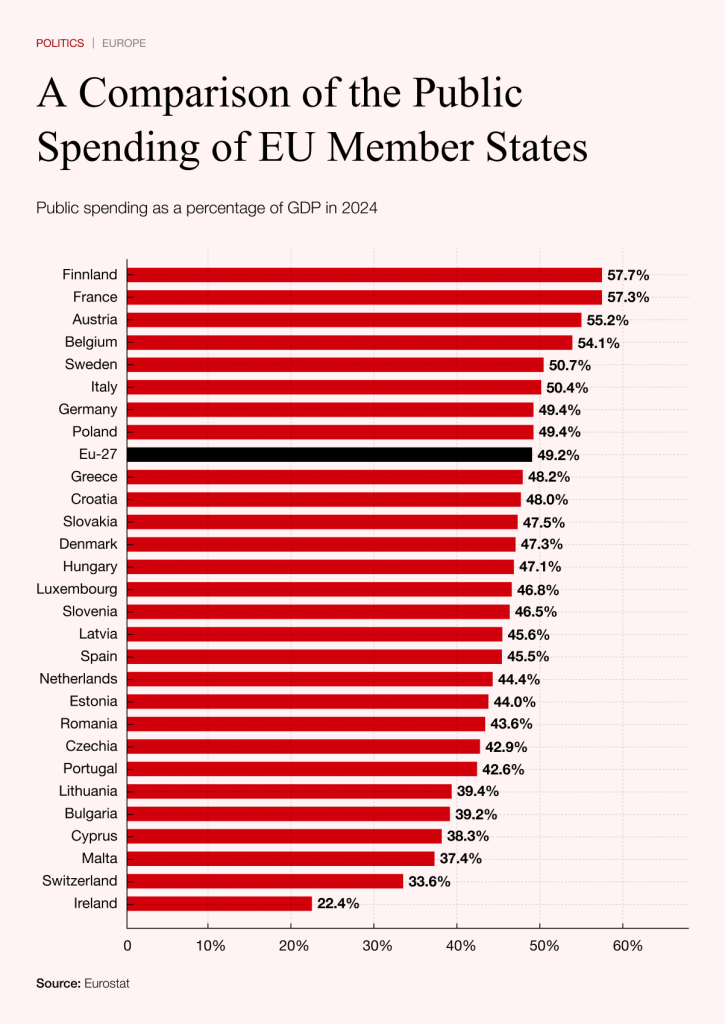
European countries, with their extensive welfare systems, generally rank well above that level. Germany’s government spending is forecast to reach 51 per cent this year, up from 49.4 per cent in 2024 (see chart). In some market-oriented economies, efforts have been made to place legal limits on the size of the state. For more than a decade, Germany’s Federal Constitutional Court (Bundesverfassungsgericht, BVerfG) upheld the so-called ‘half-sharing principle’, which stipulated that the state should not claim more than 50 per cent of citizens’ income in taxes. The principle was also intended as an indirect constraint on overall government spending.
In 2006, the same court revised its position, effectively opening the way for significantly higher spending levels. Even so, an informal ceiling of around 50 per cent persisted for many years in German economic and fiscal policy.