Pro-Russian disinformation targeting French politicians has reached few voters, while warnings about the campaign have spread far more widely.
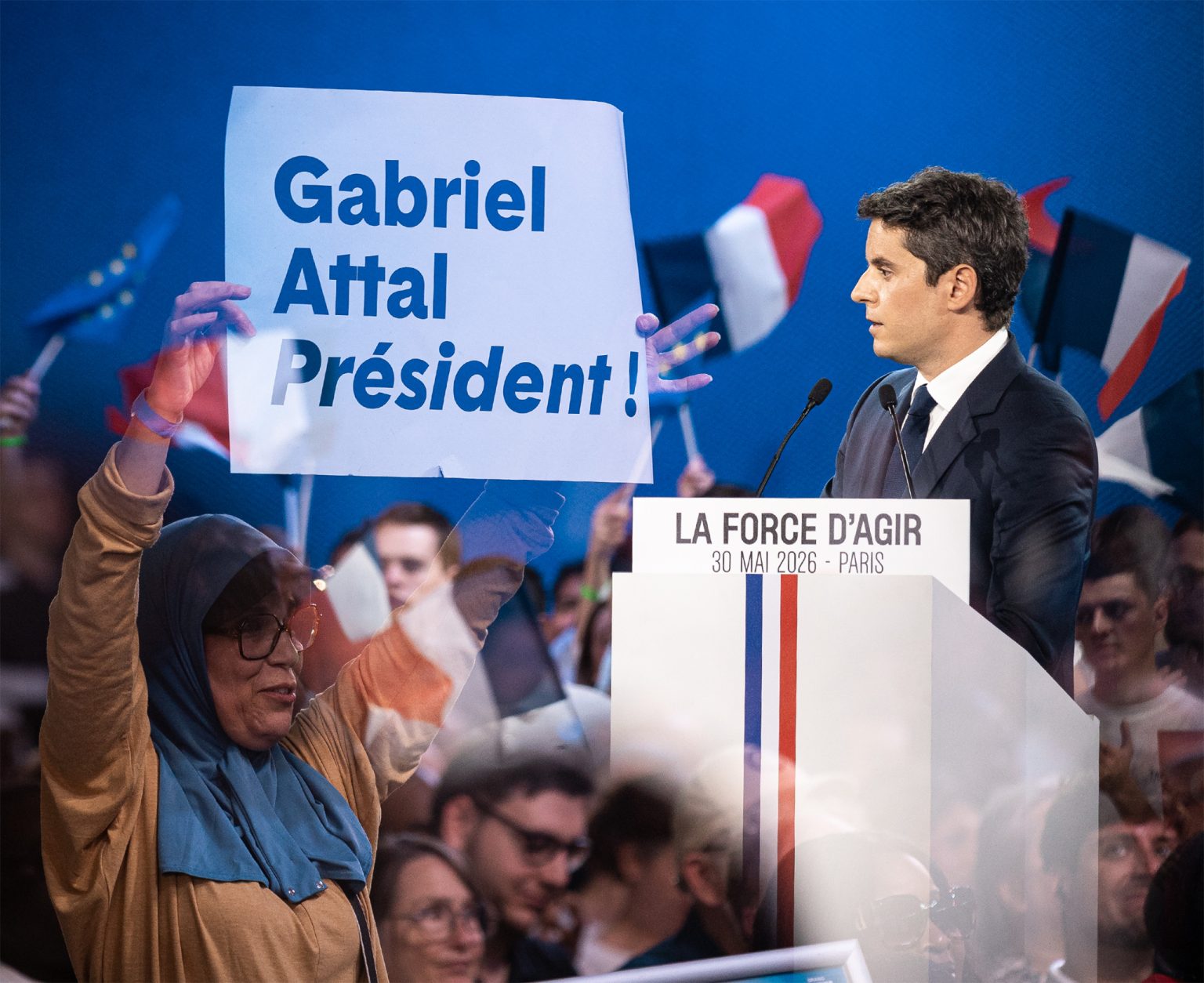
Fake posts targeting Gabriel Attal have included fabricated claims about his health and family. Photo: Telmo Pinto/NurPhoto via Getty Images
|
Since early August, an interference campaign attributed to pro-Russian networks targeting several political figures has been causing a stir in France, amid preparations for the 2027 presidential election. The French press coverage suggests that the political and media establishment may have less-than-innocent motives of its own.
The campaigns have been identified by Viginum, the French government agency responsible for detecting foreign digital interference.
The most recent target is former Macronist Prime Minister and presidential candidate Gabriel Attal.
A series of fake posts has been circulating, primarily on X, in recent days. The perpetrators copied the visual identities of well-known French media outlets – including RFI, BFM TV, Le Parisien and even AFP – to lend an air of credibility to their posts. The messages spread false information about the former prime minister’s health, claiming, for example, that he was showing signs of Parkinson’s disease or that his father had died of a cocaine overdose. The content took the form of fake news articles, screenshots mimicking media websites, edited videos and coordinated posts designed to be widely shared on social media.
Storm-1516 Comes to France
Investigators note that the strategy is by now well established. Viginum emphasizes that these campaigns are increasingly using artificial intelligence to rapidly produce credible texts, images or videos tailored to the country being targeted. French authorities attribute these operations, with a high degree of confidence, to the Russian Storm-1516 modus operandi. Already identified in several previous campaigns, it relies on the CopyCop system, which provides the infrastructure needed to copy the visual identity of legitimate media outlets in order to make the fake content more credible.
The Attal operation is part of a series of similar campaigns. Several candidates were targeted by disinformation operations during the 2026 municipal elections.
The cases involving Édouard Philippe and Raphaël Glucksmann are two of the most recent to precede that of Gabriel Attal, although the operations differed in content and sophistication.
Former Prime Minister Édouard Philippe, who is also a candidate, was targeted in late July by a campaign based primarily on coordinated posts on X and other social media platforms claiming that he was suffering from a serious neurological disease. The messages alleged that he had a brain condition that could jeopardize his presidential bid. As with Gabriel Attal, the perpetrators used coordinated French-language accounts and visuals mimicking those of French media outlets to lend an air of credibility to these claims. French authorities view this operation as a disinformation campaign attributable to networks linked to Russian military intelligence (GRU), although its reach remained limited.
The operation targeting Raphaël Glucksmann was more elaborate. The perpetrators created a fraudulent copy of the Blast media website, hosted at a different address but faithfully replicating its design. The article fabricated a corruption scandal involving Léa Salamé, a France Télévisions journalist and Raphaël Glucksmann’s partner, all based on an audio recording generated by artificial intelligence.
Raphaël Glucksmann stated that he had been officially informed by the General Secretariat for Defense and National Security (SGDSN) that he was the target of a foreign interference operation, and publicly condemned what he described as an attempt to “make an absolute lie go viral” in order to discredit a public figure considered hostile to the Kremlin.
These three operations share common characteristics: impersonation of French media outlets’ visual identities, distribution primarily on X, use of fake news sites, proliferation of coordinated accounts and, in the Glucksmann case, the use of artificial intelligence tools to produce a fake audio recording. French authorities believe that the objective is not so much to convince people of the truth of a specific accusation as it is to flood the information space with content credible enough to prompt media coverage, fuel confusion and undermine trust in institutions and the media in the run-up to the 2027 presidential election.
A Real but Limited Threat
The existence of Russian bots and the spread of false information about these three presidential candidates are well established. The networks exist, they have been identified and their methods are well known. It seems quite clear that Russians are indeed attempting to interfere in French political debate. Whether Vladimir Putin is directly involved is another matter. It is not certain that the fake story about Gabriel Attal’s Parkinson’s disease ranks particularly high among his concerns amid Russia’s continuing drone attacks on Ukraine.
What deserves particular attention, however, is the way the political class and French press interpret and exploit this Russian interference.
There is broad agreement in the media that the manipulated content was, on the whole, seen by very few people in France. And this was intentional, as BFM TV journalist Paul Conge admits. When asked, “Who actually saw the original content of this Russian operation against Attal?”, he replied: “We saw it. We chose not to broadcast them so as not to give them visibility.” Official figures cite “a few thousand views”. In this case, it is difficult to speak of a large-scale destabilization operation. We are dealing with digital interference so discreet that it is virtually nonexistent in public discourse, yet so serious that it warrants an immediate political response.
The only content that actually circulated, therefore, was not the fake video about Gabriel Attal – it was the press release announcing that a fake video about Attal existed.
When the Story Becomes the Story
The disparity between the reach of the original content and its coverage by the mainstream media raises questions.
On social media, from X to the forums of major news outlets, reactions from French social media users were nearly unanimous, crying foul and calling it doctored or a fake. Why would Russia be so obsessed with insignificant candidates who, in any case, have virtually no chance of being elected – or almost none?
It is worth keeping this in perspective: it is plausible that this content exists. But it is even more certain that the way it’s being used clearly serves the interests of the French establishment.
The first interpretation is that appearing to be a target of Russian interference can raise a politician’s profile and bolster his stature as a potential statesman. The main figures involved – Glucksmann, Philippe and Attal – would therefore have every incentive to amplify the rumor to gain traction and inject momentum into their campaign, which has so far been completely lackluster.
A Romanian Scenario?
A second – and more consequential – reading is that these interference claims may gradually provide the narrative framework for contesting the legitimacy of a future electoral outcome, as happened in Romania. This is not entirely a figment of the imagination and the argument is already familiar: Russia is meddling in the French campaign because it wants Marine Le Pen to win.
Shortly after filing his complaint, Gabriel Attal told Le Figaro, leaving little doubt about his interpretation: “There will also be interference on behalf of certain candidates, such as Marine Le Pen.” On BFM TV, he went further, accusing the Kremlin of supporting Le Pen. He then warned: “If we do nothing to protect ourselves, this election could be rigged – stolen from the French people.”
The message could not be clearer: if Marine Le Pen is elected, it will be the Russians’ fault. The Rassemblement National has reacted angrily to what it sees as a crude maneuver.
But that irritation could turn into serious concern: in Romania, suspicions of foreign interference contributed to the annulment of an election.
Fortunately, a few – all too rare – voices are calling for restraint. “Don’t feed the troll” is a well-known adage in the digital world, as noted in an article by the leading daily Le Monde. The editorialist remarks ironically: “If, with less than a year to go before the presidential election, you are a candidate – or a putative candidate – for a centrist party and you haven’t issued a statement denouncing a Russian interference operation targeting you, you’ve clearly missed something.” The best response may simply be to say nothing and allow these provocations to die down on their own.
Meanwhile, on the other side of Europe, Icelanders are alarmed by another form of interference: the attempt, originating in Brussels, to tell Icelanders how to vote in the referendum that will decide their application for European Union membership. But this particular form of interference isn’t making headlines.
Welcome to the comments section of the Štandard daily. Please take note of our guidelines, comments are moderated by us. You can contact the moderators at support@statement.com.
Participate in the discussion
Comments are available to subscribers only. If you'd like to join the discussion, choose a subscription starting at €6.72 per month.
All comments 0
Register
Comments are available to registered users only. If you'd like to join the discussion, register here.