The greatest threat to democracy today is not the extremes, but a far center claiming a monopoly on reason, virtue and political legitimacy.
What if the true extremism of our time were hiding in the center? The term “far center” – in French, "extrême-centre" – sounds like an oxymoron or a provocation. Yet the term is gaining traction in French political debate to describe a major political phenomenon: a movement that presents itself as moderate, reasonable and pragmatic, but which seeks to exert ever-tighter control over society while delegitimizing those who challenge its assumptions.
The Monopoly on Respectability
The concept is not entirely new. Historian Pierre Serna developed it based on French political history, identifying three key characteristics in particular: a claim to moderation, great ideological flexibility and the concentration of executive power. He called it “a French poison“.
Today, the far center is embodied primarily by Macronism. Since coming to power in 2017, Emmanuel Macron has made it a priority to move beyond the traditional divide in French politics between the right and the left. His successors are now preparing for the presidential election by continuing in the same direction, stigmatizing two enemies: the far left and the far right, while steadily expanding the boundaries of both labels.
The phenomenon extends far beyond Macron's camp and is gradually gaining ground among parts of the so-called republican right. It is therefore not simply a matter of designating a position in the middle of the political spectrum. The term instead describes a stance that claims the virtues of moderation while dismissing its opponents as extremists.
Journalist Jean-Dominique Merchet offers a particularly illuminating definition: “The far center is the term used to describe those who claim a monopoly on responsibility and consistency. And thus on the exercise of power, which they already hold.”
That says it all. The far center does not merely claim to be right; it claims to be the only reasonable camp. Its opponents may be on the right or the left, conservative or socialist, but they are all lumped into the same category: the irresponsible.
This tactic is particularly effective against the right. On issues such as immigration, public safety, sovereignty, the family or even freedom of expression, it is often easier to label a proposal as far-right than to debate its merits. The label then becomes a rhetorical weapon: once an opponent is branded as far-right, their argument no longer needs to be refuted.
The far center is thus defined less by its own ideas than by the boundaries it draws around legitimate debate. It can absorb certain proposals from the right – tightening immigration laws, for example – while continuing to regard those who previously advocated for them as unsavory. It can also adopt certain ideas from the left – social progressivism, to take another example – while presenting itself as the antidote to radicalism.
A Strategy of Control
Its true guiding principle is therefore not so much the definition of the middle ground as control over it.
This claim to moderation then becomes the justification for control. This is where the label extreme – or far – center comes from. The far center is not content merely to monopolize respectability; it can also justify, in the name of that respectability, ever-greater state interventionism.
Today, the extremism of the center is not necessarily measured by the aggressiveness of its rhetoric, but can be gauged by the intensity with which a system seeks to impose its norms. Those who speak most about moderation now defend the most intrusive control mechanisms.
Digital identity, social media surveillance, the fight against online hatred, content regulation, efforts to combat disinformation – these are all policies that can each be defended in the name of supposedly legitimate objectives. Taken together, they point to a more troubling trend: that of a society in which the state and its institutions seek ever-greater powers to monitor, identify, filter and correct citizens’ behavior.
At the heart of this is a battle over language. As the Confucian adage has it, words must be set right. It is never a matter of controlling the population, but of “protecting citizens“. It is not a matter of restricting freedom of expression, but of “combating hate“. It is not a matter of censorship, but of “moderating content“. The vocabulary of protection makes coercion acceptable, and restrictions end up being presented as guarantees of freedom.
Soft Methods, Hard Goals
But all of this is not just a matter of words. As demonstrated by the Quebec essayist and French-speaking conservative thinker Mathieu Bock-Côté, the far center is helping to build “totalitarianism without the gulag”, using methods that are anything but innocent.
Pierre Sautarel, founder of the identitarian website Fdesouche, takes this analysis further. He defines the far center as an “extremist and totalitarian ideology that presents itself as moderate, reasonable, and pragmatic”. According to him, its extremism lies precisely in its determination to pursue certain policies – the erosion of borders, the primacy of supranational institutions, the weakening of national sovereignty – despite their negative consequences for the population. Ruling in the name of competence and the claim that there is no alternative, the far center turns each of its failures into a justification for intensifying the very same policies.
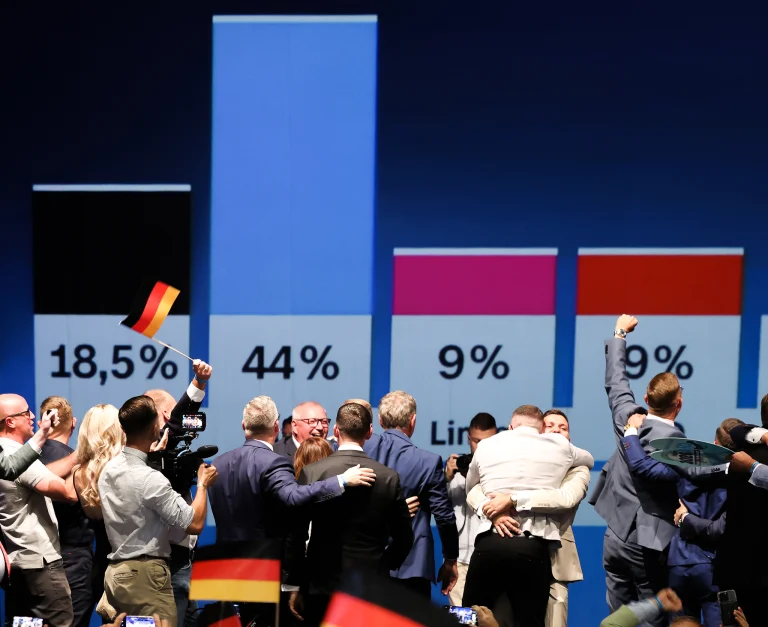
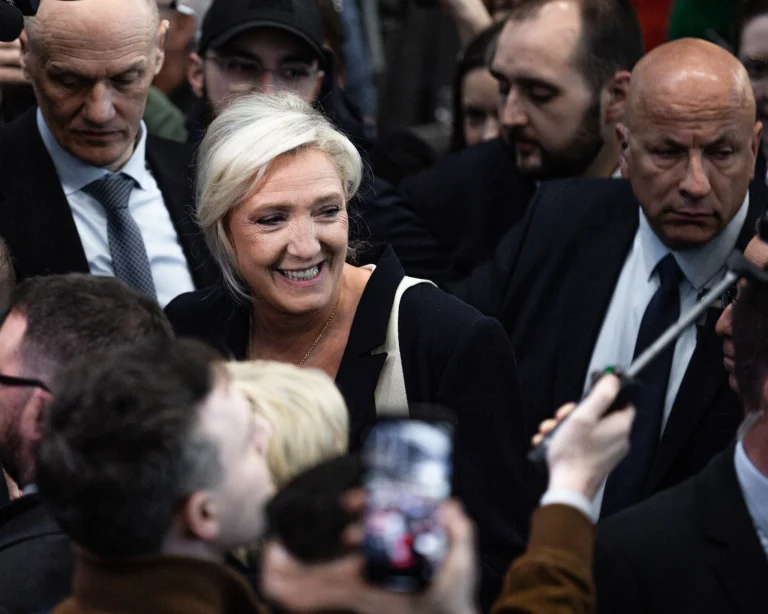
Convinced that it must defend reason and democracy, the center no longer hesitates to cancel elections, as happened in Romania; to bar populists from running, as evidenced by the legal actions against Marine Le Pen in France and the Alternative für Deutschland (AfD) in Germany; or to imprison or fine citizens in the name of an increasingly broad definition of hate speech.
For now, the term far center – which is becoming increasingly common in France, so much so that even the left is beginning to adopt it – is hardly used elsewhere in Europe. Yet the term could also prove useful outside France, as a way to denounce the monopoly on respectability claimed by those who define themselves as part of the republican arc – an expression used in Germany and Spain, for example. The concept exists there to refer to the privileged circle of political forces that refuse any alliance with other groups deemed despicable.
In any case, the issue is not merely ideological. It is institutional: whoever defines the boundaries of the respectable camp gains considerable power over the very functioning of democracy. Yet liberal democracy rests precisely on the opposite idea: no camp holds a monopoly on reason, virtue or democratic legitimacy.
In its eagerness to protect democracy from its supposed enemies, the far center has come to view pluralism itself as a threat. Those dismissed by the center must now expose this dynamic and reclaim the ground of reason and freedom. The task is more daunting than ever.
Welcome to the comments section of the Štandard daily. Please take note of our guidelines, comments are moderated by us. You can contact the moderators at support@statement.com.
Participate in the discussion
Comments are available to subscribers only. If you'd like to join the discussion, choose a subscription starting at €6.72 per month.
All comments 0
Register
Comments are available to registered users only. If you'd like to join the discussion, register here.