SpaceX Investors Take a Hit – with the Toughest Test Still Ahead
Investors face a volatile summer as geopolitical turmoil pushes up energy prices and an impending share unlock threatens to put further pressure on SpaceX.
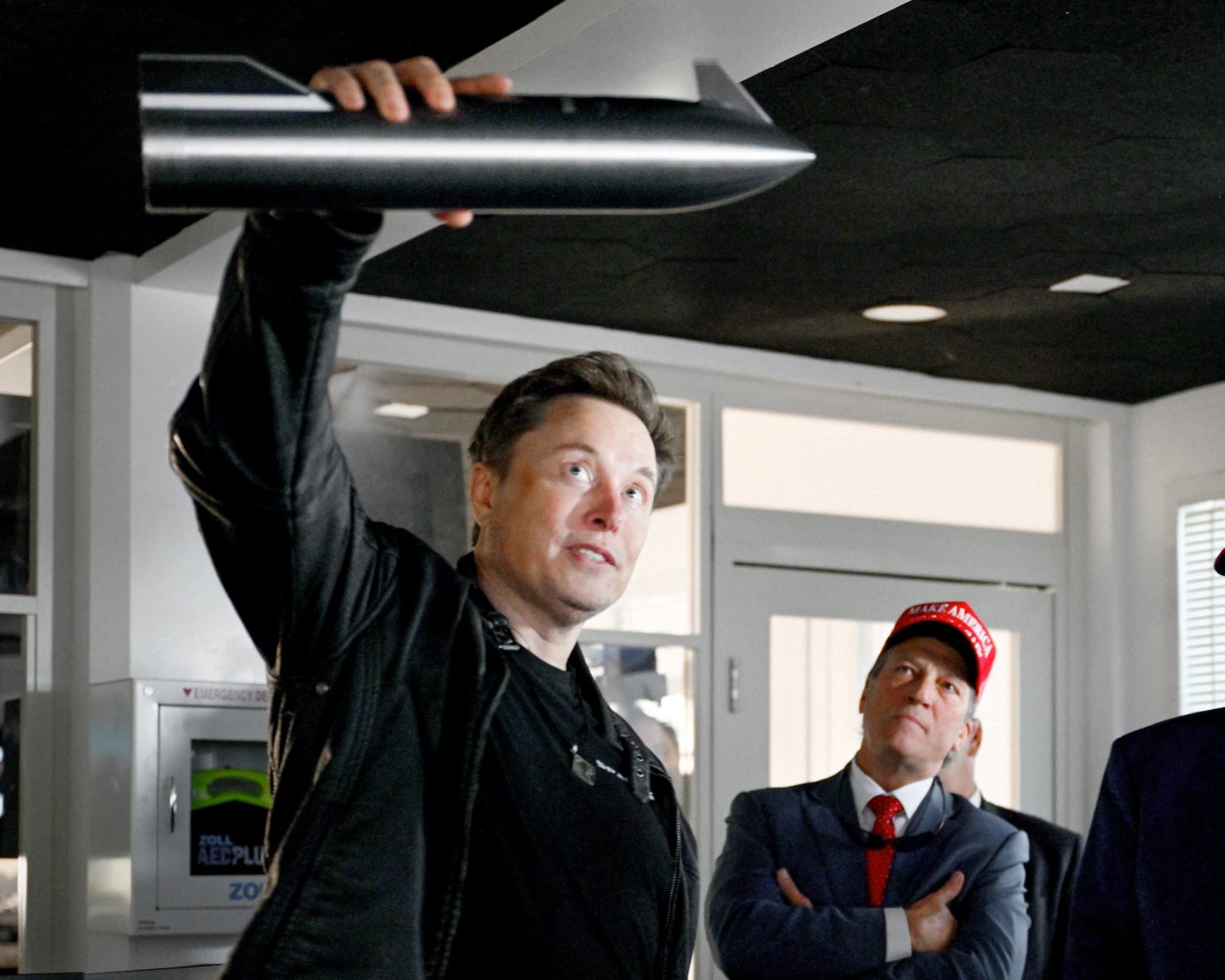
Elon Musk tours SpaceX’s control room ahead of Starship’s sixth test flight. Photo: Brandon Bell/Getty Images
|
The United States has once again been striking targets in Iran for more than a week. Iran has retaliated against US targets and those of its allies across the Middle East. The memorandum of understanding between Washington and Tehran therefore appears all but dead.
Any new agreement would have to be negotiated from scratch. The situation could deteriorate further, with Iran making clear that it is prepared to escalate by calling for the Bab el-Mandeb Strait to be blocked. If that happened, this year’s oil-price high would almost certainly be surpassed.
Oil prices are already climbing. Although they remain well short of this year’s highs, the upward trend is strong. The rally comes just as the Czech government has announced the end of price controls on diesel and gasoline and abolished the tax break on diesel.
Babis’s cabinet has thus merely underlined how sidelined European countries are – both as actors and in terms of the information and analytical capabilities available to their governments.
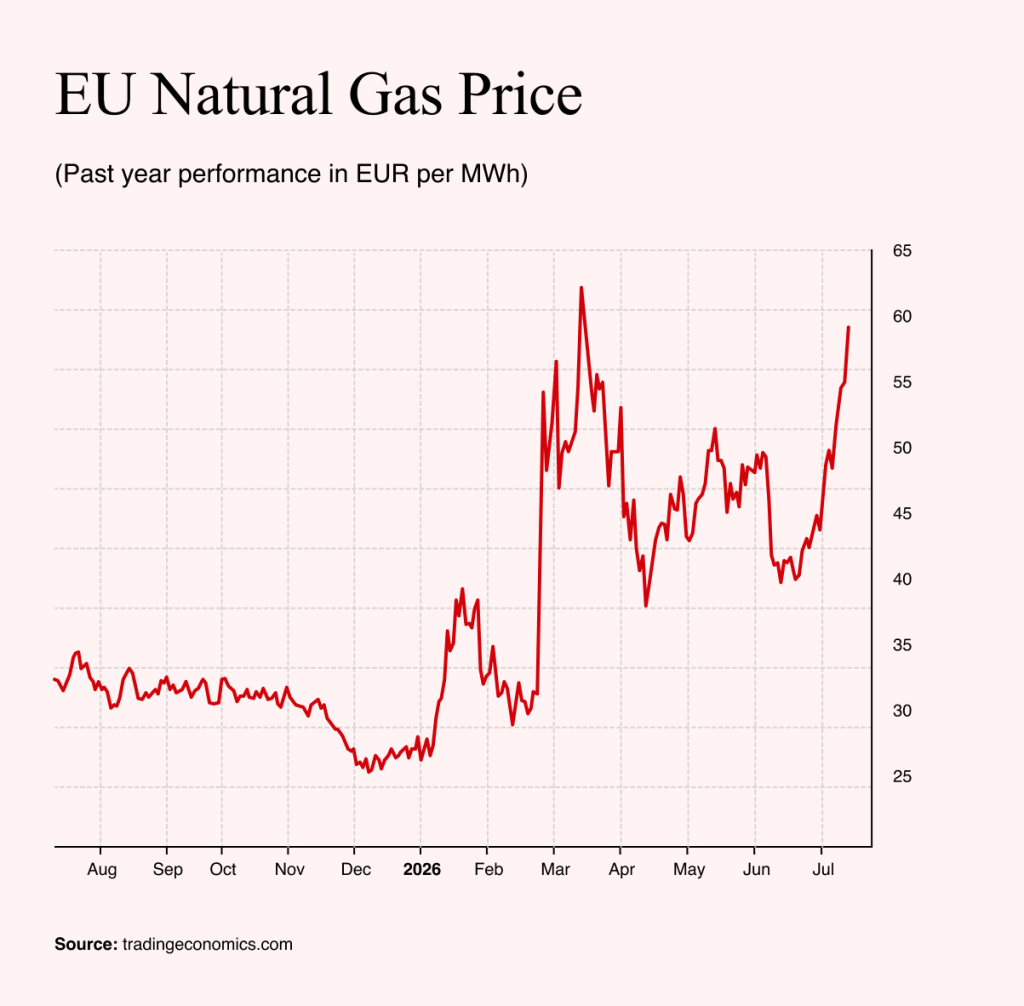
For Europe, however, the rise in natural gas prices on the Dutch TTF market is far more worrying than the increase in oil prices. Gas is currently trading at around €58 ($66) per megawatt-hour (MWh) – only slightly below this year’s high of €61 ($70) per MWh.
At the outset of the conflict in Iran, there was no urgent need to replenish gas storage facilities. That has now changed. Europe has entered the period when reserves are traditionally built up ahead of winter. In the spring, gas companies could delay purchases and replenish stocks more slowly in the hope that the crisis would end and prices would improve. They now have little choice but to fill storage quickly enough to reach the required level before winter.
The European Union has lowered its storage target ahead of the heating season from 90% to 80%. Even with this reduction, however, it will be a race against time. In the Czech Republic, facilities are currently around 52% full, compared with 68% at the same point last year.
Within weeks, European markets could come under intense pressure from extremely high gas prices. That would deal a severe blow not only to households but above all to European industry.
Source: tradingeconomics.com
Energy markets are therefore under severe strain. Reserves were drawn down during the initial Iran crisis and remain very low. Attacks on Russia’s oil-producing and refining infrastructure are adding to the pressure. Russia is struggling to meet domestic fuel demand, leaving less available for export.
Europe Pays, America Profits
Investors can at least take comfort in one relatively clear pattern: European markets are likely to suffer far more than those in the US. The US stands to benefit from the crisis, despite domestic anger over gasoline prices once again exceeding $4 (€3.50) per gallon, equivalent to about $1.06 (€0.93) per liter.
The United States is the world’s largest crude oil producer and largest exporter of liquefied natural gas (LNG). Europe, by contrast, can do little more than watch anxiously as prices climb.
US stock indexes are dominated by technology companies that are largely insulated from fluctuations in oil prices. The main threat to them is a shift in monetary policy, which is a longer-term concern than the immediate energy shock.
Energy stocks are therefore likely to perform well, while airlines will once again come under severe pressure. Gold prices are expected to fall and government bond yields to rise as global inflation expectations increase.
Investors are not in for a quiet summer. On the contrary, they will have to monitor events more closely than ever. The previous crisis showed that as soon as the economic risks became too great, Trump made his infamous about-face. The same pattern is likely to recur.
The precise pain threshold remains unclear. Moreover, the more damage is done to infrastructure in the Middle East, the longer it will take for energy prices to return to normal.
SpaceX Shares Face a Crucial Test
For stock market veterans, the plunge in SpaceX’s share price came as no surprise. It is almost an iron rule that a highly anticipated market debut produces an initial wave of euphoria before reality sets in.
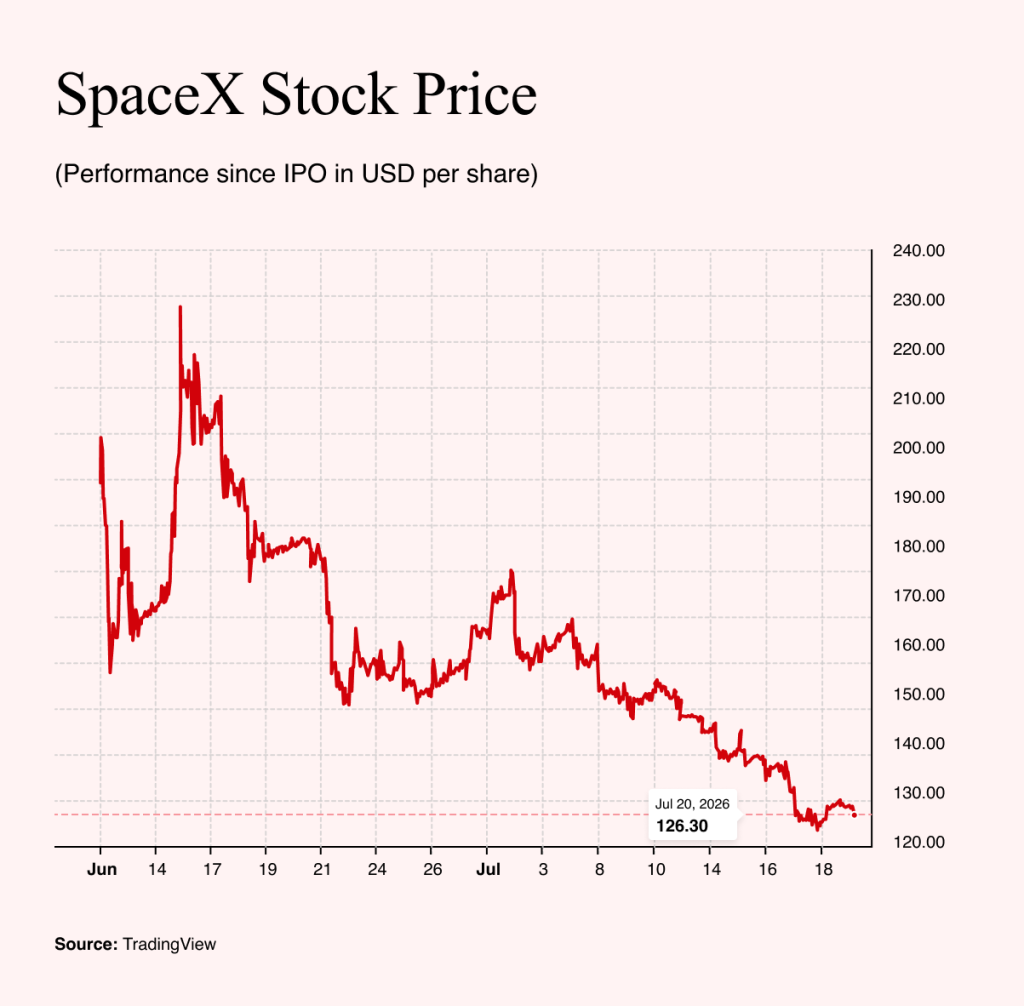
SpaceX has proved no exception. Its shares are now trading below their offering price of $135 (€118), only 38 days after their Nasdaq debut. The company set the price on 11 June and trading opened the following day at $150 (€131).
Source: TradingView
This is hardly unusual. It would be as foolish to conclude that SpaceX is heading for bankruptcy as it was to believe a few weeks ago that its stock could rise indefinitely. Many other major companies have suffered a similar fate after going public. Facebook’s shares, for example, lost more than half their value following its initial public offering before later rising many times over under parent company Meta.
The present slump has at least delighted enthusiasts of stock market statistics. More than $1tn (€875bn) has been wiped from SpaceX’s market capitalization – roughly equivalent to the entire valuation of pharmaceutical company Eli Lilly, which ranks 14th among the world’s largest companies. SpaceX has slipped to 10th place in the ranking but remains one position ahead of Tesla.
The postponement of the Starship launch also weighed on the shares. This was not the result of a failed flight or another rocket explosion, however. The automated system stopped the countdown before lift-off because of problems with the Super Heavy engines. According to Elon Musk, two Raptor engines had to be replaced.
Is the sell-off nearing its end? No one knows. A major test will come in early August, when some of the stock held by employees and other early shareholders becomes eligible for sale.
When SpaceX went public, the company sold only a small fraction of its stock. Including the over-allotment option, approximately 639 million shares entered the public market – just under 5% of the total.
This unusually small free float helped drive the sharp rise immediately after the IPO. Retail investors and major funds competed for the limited supply. Index-tracking funds also had to buy SpaceX shares following the company’s inclusion in the Nasdaq-100.
The first major unlock is expected after the publication of second-quarter earnings, due around 6 August. On the second full trading day after the announcement, up to 20% of the stock covered by the lock-up could become eligible for sale.
According to company filings, this would allow employees and other early shareholders to sell up to 1.37 billion shares. A further 319 million could follow later in August.
This does not mean that all these shares will be sold immediately. It simply means that their owners will be able to offer them on the market for the first time. Even a much smaller wave of selling, however, could significantly alter the balance between supply and demand. Together with the approximately 639 million shares sold during the IPO, the first unlock could more than triple the amount of stock potentially available for trading.
This is when the true depth of demand for SpaceX will become clear. The post-IPO rally was partly driven by an artificial scarcity of shares. Once employees can turn some of their paper wealth into cash, the market will reveal what investors are prepared to pay for SpaceX without that constraint. This could bring the company’s valuation closer to a more realistic level.
Welcome to the comments section of the Štandard daily. Please take note of our guidelines, comments are moderated by us. You can contact the moderators at support@statement.com.
Participate in the discussion
Comments are available to subscribers only. If you'd like to join the discussion, choose a subscription starting at €6.72 per month.
All comments 0
Register
Comments are available to registered users only. If you'd like to join the discussion, register here.