Democrats Distance But Do Not Disavow
Weeks on, and still under pressure to do so, El-Sayed has refused to disavow Piker or call his views unacceptable, which presents something of a problem in a state like Michigan, where the Senate race is very much contested.
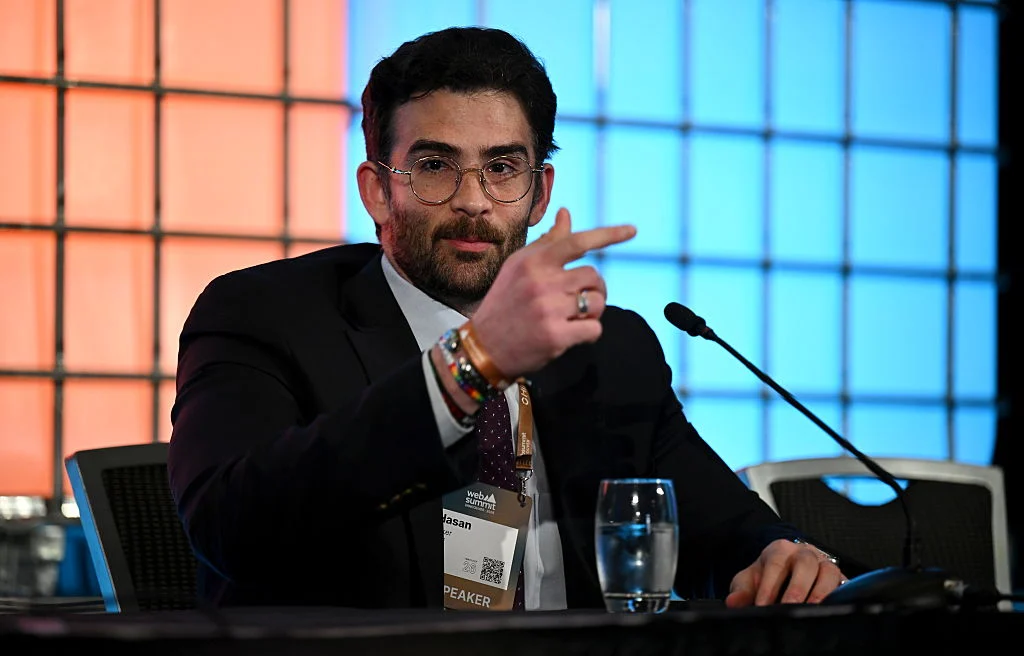
The problem for El-Sayed is that disavowing Piker is considerably easier in theory than it is in practice. Piker is not some random internet crank whose support happened to fall into his lap. He is one of the most prominent voices of the American online left, with an enormous audience made up disproportionately of precisely the kind of young, angry and highly politically engaged voters whom Democrats will need to turn out in November.
And therein lies a problem that extends well beyond one Senate candidate in Michigan.
For much of the last decade, the Democratic Party has enjoyed a rather convenient arrangement with its activist left. The activists are permitted to say things that mainstream Democratic politicians would never dream of saying themselves, while the politicians benefit from their energy, their organizing, their online reach and, of course, their votes. When somebody like Piker goes too far, the respectable wing of the party can tut disapprovingly without ever quite declaring him persona non grata. Or so it hoped.
That arrangement, it turns out, works perfectly well until somebody asks a Democrat a very simple question: do you actually want this person’s support? When that happens, their mouths tend to open and close in the manner of a fish pushing water over its gills.
No Comfortable Answer
El-Sayed, for one, has discovered that there is no especially comfortable answer.
Say “yes”, and moderate voters – not to mention Jewish Democrats – are entitled to ask why a candidate for the United States Senate is happy to associate himself with somebody who speaks about American Jews in such menacing terms. Perhaps a moderate Republican, such as El-Sayed’s opponent Mike Rogers, might be preferable.
Say “no”, however, and another question immediately presents itself: how many voters come with Piker? The answer appears to be “many more than we’re prepared to admit”.
That is the calculation Democrats increasingly have to make about the radical left. It is tempting for non-Democrats to imagine that the answer is easy: simply denounce them. Throw Piker overboard, condemn the anti-Israel activists, tell the campus radicals to take a hike and march confidently back toward the political center.
The Ugly Truth: Democrats Dislike Piker – and Need Him
But, of course, successful political parties do not generally make a habit of telling large numbers of their own voters that they are lunatics whose support is neither wanted nor welcome, particularly in the weeks before an election.
And the Democratic coalition has a particular vulnerability: younger voters are both substantially more hostile to Israel than older Americans and substantially more sympathetic to the kind of politics represented by Piker. The party does not merely need them to prefer Democrats to Republicans. It needs them sufficiently enthused to register, organize, donate and actually turn up.
This is where the distinction between "distancing" and "disavowing" becomes important.
A Democratic candidate can say that he disagrees with Piker’s comments. He can issue the customary statement about Israel’s right to exist alongside the legitimate aspirations of the Palestinian people. He can deplore hateful rhetoric with the laughable but mandatory qualification “wherever it comes from”.
What he cannot apparently say is: "Hasan Piker represents something ugly, his politics have no place in my movement, and I do not want his endorsement or the support that comes with it."
Michigan Is the Epicenter of the Party’s Fault Line
Because at that point he would be drawing a clear red line. And clear red lines are what the modern Democratic Party has spent years trying not to draw around its left flank.
There is a further complication: Piker’s audience will not necessarily regard a denunciation of him as a narrow dispute over antisemitism. To many of them, it will be interpreted as yet another example of the Democratic establishment “selling out to Israel”.
Or, in a rather delightful quandary for the party, the very words required to reassure one part of the Democratic coalition risk confirming every suspicion held by another.
This would matter less if November promised to be a landslide. In a close election, it matters enormously. Michigan happens to contain both a significant Jewish population and one of America’s largest and most politically important Arab-American communities. It is the perfect storm of “pick your poison”, because El-Sayed finds himself standing directly on top of one of the biggest fault lines running through the Democratic Party.
But he will not be the last, or the only candidate, to face this problem, especially as Piker grows ever more prominent.
Democrats would like, of course, to keep both camps in their party happy. But between them, Piker, El-Sayed and Jeremy Moss have just demonstrated that, in the end, somebody will force them to choose.